Valence Bond Theory vs Molecular Orbital Theory: A Comprehensive Guide for Biomedical Researchers
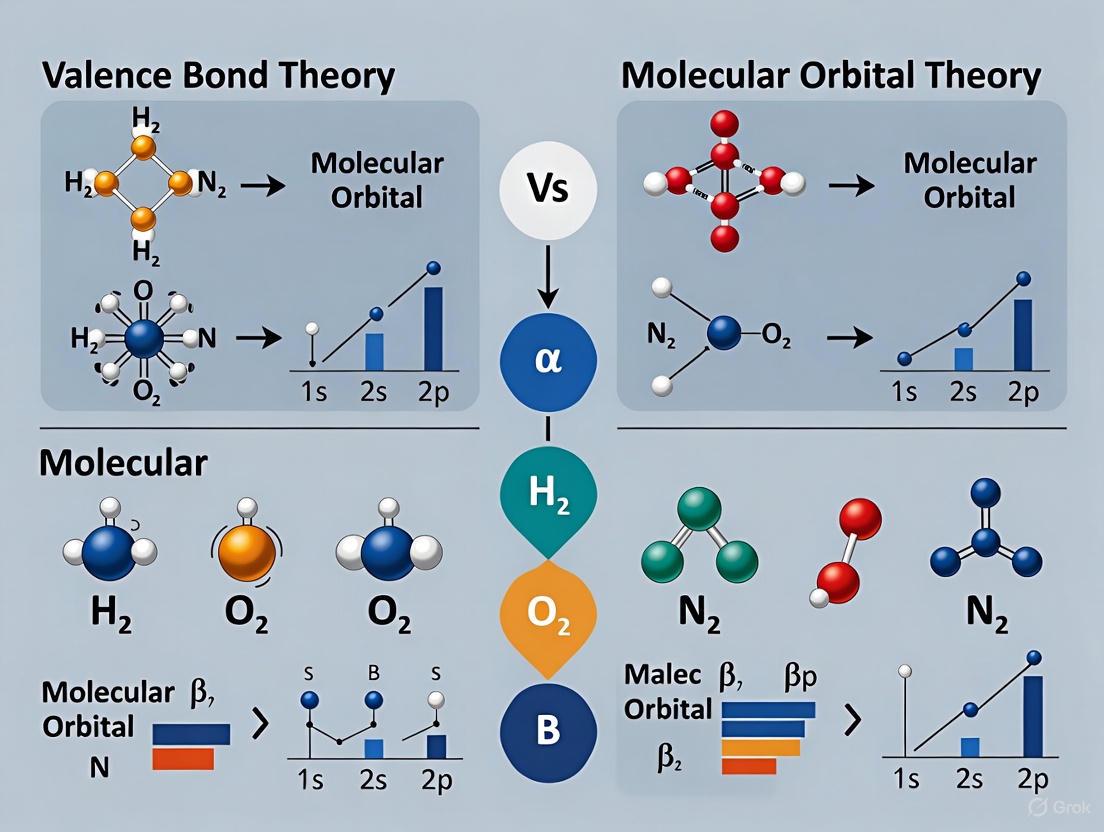
This article provides a detailed comparative analysis of Valence Bond (VB) and Molecular Orbital (MO) theories, tailored for researchers and professionals in drug development and biomedical science.
Valence Bond Theory vs Molecular Orbital Theory: A Comprehensive Guide for Biomedical Researchers
Abstract
This article provides a detailed comparative analysis of Valence Bond (VB) and Molecular Orbital (MO) theories, tailored for researchers and professionals in drug development and biomedical science. It explores the foundational principles, historical context, and methodological applications of both theories, highlighting their respective strengths in predicting molecular geometry, explaining magnetic properties, and describing electron delocalization. Practical guidance is offered for selecting the appropriate theoretical framework for specific research problems, from small molecule drug design to understanding complex biomolecular interactions. The discussion extends to modern computational implementations and the synergistic use of both theories in advancing biomedical research, particularly in rational drug design and biomaterials development.
Quantum Foundations and Historical Evolution of Chemical Bonding Theories
The seminal work of Gilbert N. Lewis, particularly his 1916 paper "The Atom and The Molecule," established the fundamental concept of the electron-pair bond, providing the conceptual cornerstone upon which modern quantum mechanical bonding theories were built [1]. This electron-pair model, which visualized bonds as shared edges of electron cubes and later as the familiar dot structures, introduced a dynamic view of bonding that could range from purely covalent to ionic [1]. Lewis's groundbreaking ideas about the octet rule, covalent-ionic superposition, and the tetrahedral arrangement of electron pairs around atoms directly paved the way for the subsequent development of both valence bond (VB) theory and molecular orbital (MO) theory in the late 1920s [1]. These two theories, while emerging from the same foundational concepts, developed into competing and complementary frameworks for describing molecular structure and bonding. This guide provides an objective comparison of their performance, predictive capabilities, and applications in modern computational chemistry, particularly for researchers in scientific and drug development fields.
Valence Bond Theory, championed by Linus Pauling, retains much of the chemical intuition of Lewis structures, describing bonds as localized between pairs of atoms formed by the overlap of atomic orbitals (including hybrid orbitals) [2] [3] [4]. It directly extends Lewis's concept of electron-pair bonds into quantum mechanics, using the idea of resonance between different covalent-ionic structures to describe molecules [1] [5].
Molecular Orbital Theory, developed by Friedrich Hund and Robert S. Mulliken, takes a more delocalized approach, describing electrons as occupying molecular orbitals that extend over the entire molecule [6] [2] [3]. These orbitals are formed by the linear combination of atomic orbitals (LCAO) and are classified as bonding, antibonding, or non-bonding [7] [8] [9].
Table 1: Fundamental Comparison of Valence Bond and Molecular Orbital Theories
| Feature | Valence Bond (VB) Theory | Molecular Orbital (MO) Theory |
|---|---|---|
| Bond Localization | Localized between one atom pair [2] [3] | Delocalized over entire molecule [2] [3] |
| Orbital Basis | Atomic & hybrid orbitals (s, p, d, sp, sp², sp³) [3] [4] | Molecular orbitals (σ, σ, π, π) from LCAO [3] [9] |
| Bond Description | Forms σ or π bonds via orbital overlap [3] | Creates bonding/antibonding interactions [3] |
| Resonance Treatment | Requires multiple structures [2] [3] | Naturally described by a single wavefunction [2] |
| Bond Order | Deduced from resonance structures [8] | Calculated as: ½(bonding e⁻ - antibonding e⁻) [9] |
Experimental Validation and Predictive Performance
The comparative performance of VB and MO theories can be evaluated against key experimental data. The magnetic behavior of oxygen and photoelectron spectroscopy of methane serve as critical experimental test cases.
The Oxygen Paramagnetism Test
The oxygen molecule (O₂) provides a classic experimental case study that differentiates the predictive power of these theories.
Experimental Protocol: Magnetic Susceptibility Measurement
- Purpose: To determine if a substance is paramagnetic (attracted to a magnetic field) or diamagnetic (repelled by a magnetic field) [8] [2].
- Methodology: A sample is weighed in the absence and presence of a strong, inhomogeneous magnetic field. Paramagnetic samples appear heavier when the field is applied, while diamagnetic samples appear lighter [2].
- Data Interpretation: The increase in weight for a paramagnetic substance is proportional to the number of unpaired electrons in the molecule [2].
Experimental Data and Theoretical Predictions:
- Experimental Result: Liquid oxygen is deflected towards a magnetic field and bridges the gap between the poles of a horseshoe magnet, demonstrating paramagnetic behavior [8] [2]. Quantitative measurements show two unpaired electrons [2].
- Lewis/VB Prediction (Simple): The Lewis structure (O=O) and simple VB descriptions show all electrons paired, predicting diamagnetic behavior, which conflicts with experimental observation [2] [5].
- MO Theory Prediction: The molecular orbital electron configuration for O₂ is (σ₂s)²(σ₂s)²(σ₂p)²(π₂p)⁴(π₂p)². The two electrons in the degenerate π* orbitals occupy separate orbitals with parallel spins (Hund's rule), correctly predicting a triplet ground state with two unpaired electrons and paramagnetic behavior [8] [2] [9].
- Modern VB Prediction: When applied at a sufficient level of theory, modern VB calculations also correctly predict the triplet ground state with two three-electron π-bonds, reconciling this historical perceived failure [5].
Figure 1: Experimental vs. Theoretical Predictions for O₂ Magnetism. MO theory correctly predicts paramagnetism, while simple VB fails without advanced treatment [8] [2] [5].
Photoelectron Spectroscopy of Methane
Photoelectron spectroscopy (PES) provides another critical experimental validation, probing the energy levels of molecular orbitals.
Experimental Protocol: Photoelectron Spectroscopy
- Purpose: To measure the ionization energies of molecules, revealing the energy levels of their molecular orbitals [5].
- Methodology: A gas-phase sample is irradiated with high-energy photons (X-ray or UV). The kinetic energies of the ejected electrons are measured, allowing calculation of molecular orbital binding energies: IE = hν - KE [5].
- Data Interpretation: Peaks in the energy spectrum correspond to different molecular orbitals. Peak intensities relate to orbital degeneracy, and peak shapes provide information on bonding character [5].
Experimental Data and Theoretical Predictions:
- Experimental Result: The PES of methane (CH₄) shows two distinct peaks with intensity ratios of approximately 3:1, indicating two sets of orbitals with different degeneracies [5].
- MO Theory Prediction: Correctly predicts a triply degenerate set of orbitals (t₂) as the HOMO and a singly degenerate orbital (a₁) at lower energy, matching the observed 3:1 peak ratio [5].
- Simple VB Prediction: Describes CH₄ with four equivalent C-H bonds, suggesting a single ionization energy. This was historically perceived as a failure, though modern VB treatments incorporating ionic-covalent superposition can recover the correct orbital picture [5].
Table 2: Quantitative Performance Comparison on Key Experimental Tests
| Experimental Test | Valence Bond Theory (Simple) | Molecular Orbital Theory | Modern Computational Methods |
|---|---|---|---|
| O₂ Magnetic Properties | Incorrect (Diamagnetic) [2] | Correct (Paramagnetic) [8] [2] | Both Correct (VB with advanced treatment) [5] |
| CH₄ Photoelectron Spectrum | Incorrect (Single peak) [5] | Correct (Two peaks, 3:1 ratio) [5] | Both Correct (VB with configuration mixing) [5] |
| Bond Order Calculation | Average of resonance structures [8] | ½(bonding e⁻ - antibonding e⁻) [8] [9] | Equivalent results at high theory level [5] |
| H₂ Bond Description | Covalent-ionic resonance [5] | σ₁s bonding orbital [7] [8] | Mathematically equivalent [5] |
Computational Methodologies and Protocols
Molecular Orbital Calculation Protocol
The molecular orbital approach forms the basis for most standard quantum chemical computations today, including Hartree-Fock and post-Hartree-Fock methods.
Standard MO Computational Workflow:
- Geometry Input: Define molecular structure with atomic coordinates [5].
- Basis Set Selection: Choose appropriate atomic orbital basis functions for linear combination [5].
- SCF Calculation: Perform Self-Consistent Field calculation to solve the Schrödinger equation iteratively [5].
- MO Analysis: Generate molecular orbitals, energies, and electron densities from the wavefunction [5].
- Property Prediction: Calculate molecular properties (energy, spectrum, reactivity) from MO configuration [5].
Valence Bond Computational Protocol
Modern valence bond theory has seen a renaissance with improved computational methods that compete in accuracy with MO approaches [5].
Modern VB Computational Workflow:
- Structure Selection: Identify relevant covalent, ionic, and resonance structures [5].
- Orbital Definition: Utilize atomic orbitals, delocalized atomic orbitals (Coulson-Fischer), or fragment molecular orbitals [5].
- Wavefunction Construction: Build wavefunction as linear combination of VB structures: ΦVBT = λΦHL + μΦ_I (for H₂) [5].
- Variational Optimization: Adjust coefficients (λ, μ, etc.) to minimize total energy [5].
- Bonding Analysis: Interpret results in terms of resonance weights and covalent-ionic character [5].
Figure 2: Computational Workflows for MO and VB Theories. Despite different starting points, the theories can describe the same wavefunction and are related by a unitary transformation [5].
Table 3: Key Computational Methods and Their Applications in Bonding Theory
| Method/Resource | Theory Basis | Primary Function | Typical Applications |
|---|---|---|---|
| Hartree-Fock (HF) | MO Theory [5] | Approximates electron correlation using an average field | Initial molecular calculations, educational use |
| Density Functional Theory (DFT) | MO Theory [3] | Uses electron density functional for correlation | Large systems, materials science, drug design [3] |
| Configuration Interaction (CI) | MO Theory [5] | Accounts for electron correlation by mixing configurations | Accurate bond energies, spectroscopic predictions |
| Modern VB Methods | VB Theory [5] | Computes wavefunction as resonance structure combination | Bonding analysis, reaction mechanisms, diabatic states |
| Fragment Orbitals | VB Theory [5] | Uses MOs of molecular fragments as VB basis | Large system analysis, enzyme active sites |
Both valence bond and molecular orbital theories represent legitimate quantum mechanical approaches to chemical bonding that, at high levels of theory, converge to the same descriptions of molecular systems [5]. Valence bond theory maintains a stronger connection to the classical Lewis electron-pair bond, providing intuitive chemical concepts and localized bond descriptions that are valuable for understanding reaction mechanisms [1] [5]. Molecular orbital theory offers a more direct computational path and naturally explains molecular spectroscopy, magnetic properties, and delocalized bonding in conjugated systems [8] [2] [3]. For researchers in drug development and materials science, MO-based methods (particularly DFT) currently dominate computational screening and property prediction due to their favorable accuracy-to-cost ratio [3] [5]. However, modern VB theory provides complementary insights for understanding bond formation, reaction pathways, and chemical reactivity that are directly connected to the Lewis legacy of electron-pair bonding [1] [5]. The choice between theoretical frameworks ultimately depends on the specific scientific question, with many modern computational approaches leveraging the strengths of both perspectives.
Historical Development and Key Experiments
The development of Valence Bond (VB) Theory by Linus Pauling in the early 1930s represents a foundational moment in modern chemistry, providing the first robust quantum mechanical explanation for the chemical bond [10] [1]. Pauling's work built upon critical predecessors. In 1916, Gilbert N. Lewis introduced the electron-pair bond and the "cubical atom" model, establishing the conceptual idea of covalent bonding through electron sharing [11] [1]. The pivotal quantum mechanical breakthrough came in 1927 with Walter Heitler and Fritz London, who successfully applied Schrödinger's wave equation to the hydrogen molecule, demonstrating how two hydrogen atoms form a covalent bond through the resonance of their electron waves, thereby providing a quantum justification for Lewis's electron pair [11] [10].
Pauling's genius was in refining and generalizing these ideas into a comprehensive theory. His key insight was orbital hybridization, which he introduced to resolve a major physical contradiction: how carbon, with its one spherical 2s and three dumbbell-shaped 2p orbitals, could form four identical bonds directed at tetrahedral angles in molecules like methane (CH₄) [10]. Pauling proposed that the energy separation between the s and p orbitals was small compared to the bond formation energy, allowing the atomic orbitals to mix or hybridize, forming new, equivalent sp³ hybrid orbitals [10]. This process, coupled with the principle of maximum overlap, which states that bond strength is proportional to the extent of orbital overlap, allowed VB theory to accurately predict molecular geometries and bond properties [11] [12].
The following diagram maps the key conceptual and historical relationships that led to the establishment of Valence Bond Theory:
Comparative Analysis: Valence Bond vs. Molecular Orbital Theory
While VB Theory was the first successful quantum mechanical treatment of bonding, Molecular Orbital (MO) Theory, developed around the same time by Robert Mulliken and Friedrich Hund, offers a different perspective [13] [1]. The two theories represent complementary frameworks for understanding chemical bonding, each with distinct strengths and applications, as summarized in the table below.
Table 1: Fundamental Comparison between Valence Bond Theory and Molecular Orbital Theory
| Feature | Valence Bond (VB) Theory | Molecular Orbital (MO) Theory |
|---|---|---|
| Core Principle | Bonds form from overlap of half-filled atomic orbitals (or hybrids), creating localized electron pairs between two atoms [11] [12]. | Atomic orbitals combine to form delocalized molecular orbitals that span the entire molecule [13] [4]. |
| View of Electrons | Localized between specific atom pairs [14]. | Delocalized over the entire molecule [13] [14]. |
| Key Concepts | Orbital overlap, hybridization (sp, sp², sp³), resonance, sigma (σ) and pi (π) bonds [11] [12]. | Linear Combination of Atomic Orbitals (LCAO), bonding/antibonding orbitals, bond order, HOMO/LUMO [13] [14]. |
| Prediction Strengths | Molecular geometry, bond angles, and reorganization of charge during reactions [11] [14]. | Bond order, magnetic properties (paramagnetism), electronic spectra, and stability of delocalized systems [13] [11]. |
| Notable Failure | Incorrectly predicts no unpaired electrons in O₂, and thus cannot explain its paramagnetism [11] [14]. | Correctly predicts O₂ is a diradical with two unpaired electrons, explaining its paramagnetism [11] [14]. |
| Computational Tractability | Historically more difficult to implement computationally due to non-orthogonal orbitals [11] [1]. | Became more popular with computers due to easier implementation of orthogonal orbitals [11] [1]. |
The following workflow diagram illustrates the distinct logical pathways each theory uses to describe bond formation, from atomic starting point to molecular outcome:
Experimental Validation and Key Evidence
Pauling's Valence Bond Theory was not merely a theoretical construct; it was grounded in and provided explanations for a wealth of experimental data. Key evidence supporting the theory included:
- Molecular Geometry: VB theory, through hybridization, correctly predicted the tetrahedral geometry of methane (CH₄) with bond angles of 109.5°, the trigonal planar structure of BF₃, and the linear structure of BeH₂ [11] [14]. This was a direct improvement over Lewis structures, which describe connectivity but not three-dimensional shape [15].
- Bond Strengths and Lengths: The theory explains why a carbon-carbon single bond (σ bond) is weaker and longer than a double bond (one σ + one π bond), which in turn is weaker and longer than a triple bond (one σ + two π bonds) [12]. The concept of orbital overlap directly links the extent of overlap to bond strength [11] [12].
- Resonance in Aromatic Molecules: For molecules like benzene, which cannot be described by a single Lewis structure, Pauling introduced resonance between multiple VB structures [11] [10]. This superposition explains the equivalence of all carbon-carbon bonds in benzene and its unusual stability compared to a hypothetical molecule with three localized double bonds [11].
Table 2: Quantitative Bond Data Explained by Valence Bond Theory
| Bond Type | Average Bond Length (pm) | Average Bond Energy (kJ/mol) | VB Theory Explanation |
|---|---|---|---|
| C-C (single) | 150.6 | 347 | Sigma (σ) bond from sp³, sp², or sp orbital overlap [12]. |
| C=C (double) | 133.5 | 614 | One σ bond + one π bond from side-by-side p-orbital overlap [12]. |
| C≡C (triple) | 120.8 | 839 | One σ bond + two π bonds [12]. |
| H-H | 74 | 436 | Sigma (σ) bond from head-on overlap of two 1s orbitals [12]. |
The Scientist's Toolkit: Essential Conceptual "Reagents"
The following table details the key conceptual tools, or "research reagents," that are fundamental to applying and understanding Valence Bond Theory.
Table 3: Key Conceptual "Reagents" in Valence Bond Theory
| Conceptual Tool | Function | Example Application |
|---|---|---|
| Atomic Orbitals (s, p, d) | Provide the initial "raw material" for bond formation, representing the electron distribution in an isolated atom [12]. | A hydrogen atom provides a 1s orbital for bonding. |
| Hybrid Orbitals (sp, sp², sp³) | Mathematical combinations of atomic orbitals from the same atom that create new orbitals with optimal directionality and shape for bonding [11] [10]. | Carbon mixes one 2s and three 2p orbitals to form four equivalent sp³ hybrids, explaining the tetrahedron of methane. |
| Orbital Overlap | The physical mechanism of bond formation; the extent of overlap determines bond strength and length [11] [12]. | The strong head-on overlap in a σ bond leads to a stronger interaction than the side-on overlap in a π bond. |
| Resonance | A formalism where the true molecular structure is a hybrid of two or more canonical Lewis structures [11] [1]. | Describes the electron delocalization and bond equivalence in benzene and ozone. |
| Electron Pair | The fundamental quantum unit of the covalent bond, as originally proposed by Lewis and given quantum mechanical justification by Heitler and London [11] [1]. | A single covalent bond represents one shared electron pair with opposite spins. |
The birth of Valence Bond Theory marked a paradigm shift, moving chemistry from a purely phenomenological science to one with a firm quantum mechanical foundation. While it was historically eclipsed by Molecular Orbital Theory in the mid-20th century due to computational advantages [11] [1], VB theory has never been obsolete. Its language of localized bonds, hybridization, and resonance remains intuitively powerful for chemists, especially in organic chemistry and for visualizing reaction mechanisms [11].
Since the 1980s, VB theory has experienced a significant resurgence. Modern computational advances have solved many of its earlier mathematical difficulties, allowing it to compete quantitatively with MO-based methods [11] [1]. For researchers in fields like drug development, VB theory offers a complementary perspective to MO theory and DFT, often providing a more chemically intuitive picture of bond formation and breaking that is crucial for understanding enzymatic catalysis and molecular recognition. Pauling's framework, therefore, continues to be a vital and dynamic part of the chemist's conceptual toolkit.
The development of Molecular Orbital (MO) Theory by Friedrich Hund and Robert S. Mulliken in the late 1920s marked a revolutionary departure from the then-dominant Valence Bond (VB) Theory [16] [17]. This new approach introduced a delocalized perspective on chemical bonding, where electrons are treated as belonging to the entire molecule rather than being localized between pairs of atoms [18]. The emergence of MO theory was pivotal, as it provided explanations for phenomena that stumped VB theory, most famously the paramagnetism of the oxygen molecule [16]. This guide objectively compares the performance of these two foundational theories, underscoring how Hund and Mulliken's delocalized approach not only resolved key theoretical challenges but also laid the groundwork for modern computational chemistry and drug design.
Historical Emergence: The Hund-Mulliken Collaboration
The genesis of MO theory was rooted in the inability of the Heitler-London-Slater-Pauling (HLSP) valence-bond method to adequately describe the properties of excited states and certain molecular spectra [16] [17].
- Key Innovators and Milestones: The collaboration between physicist Friedrich Hund and chemist Robert S. Mulliken was instrumental. Their work, initially called the Hund-Mulliken theory, was heavily influenced by their interactions with leading quantum theorists in Europe in the mid-1920s [17] [19]. Mulliken himself coined the term "orbital" in 1932 [16].
- Driving Force: A key driver for the new theory was the need to explain the paramagnetic nature of molecular oxygen (O₂), which VB theory could not account for with its model of localized electron pairs [16]. MO theory correctly predicted a triplet ground state for O₂, showing two unpaired electrons in degenerate π* antibonding orbitals [16].
- Theoretical Foundation: MO theory described electron wave functions as delocalized molecular orbitals that possess the same symmetry as the molecule. This was a stark contrast to the VB method's reliance on overlapping atomic orbitals to form localized bonds [17].
Table: Historical Timeline of Key Developments in Molecular Orbital Theory
| Year | Scientist(s) | Contribution | Significance |
|---|---|---|---|
| 1927 | Walter Heitler & Fritz London | First quantum mechanical treatment of the H₂ molecule (VB approach) [17] | Established the foundation of valence bond theory. |
| 1927-1929 | Friedrich Hund, Robert Mulliken, John Lennard-Jones | Development of the core principles of Molecular Orbital Theory [16] [17] | Provided a delocalized, more flexible alternative to VB theory. |
| 1931 | Erich Hückel | Hückel Molecular Orbital (HMO) method for π electrons [16] | Explained the stability of aromatic hydrocarbons like benzene. |
| 1933 | General acceptance of MO Theory as a valid theory [16] | MO theory gained recognition as a robust framework. | |
| 1966 | Robert S. Mulliken | Awarded the Nobel Prize in Chemistry [17] | Formal recognition of MO theory's profound impact on chemistry. |
Theoretical Comparison: MO vs VB Theory
The fundamental difference between the two theories lies in their description of the electronic wavefunction. VB theory maintains a tight connection to the concept of localized bonds between atom pairs, often requiring the concept of resonance to describe molecules that don't fit a single Lewis structure [20]. In contrast, MO theory treats electrons as delocalized over the entire molecule, moving under the influence of all the nuclei [16] [18].
Table: Comparative Analysis of Valence Bond vs. Molecular Orbital Theory
| Feature | Valence Bond (VB) Theory | Molecular Orbital (MO) Theory |
|---|---|---|
| Fundamental Approach | Localized bonding; electrons assigned to chemical bonds between atom pairs [16] [20]. | Delocalized bonding; electrons reside in molecular orbitals spanning the entire molecule [16] [18]. |
| Conceptual Foundation | A molecule is formed by the overlap of atomic orbitals (including hybrids) from different atoms [20]. | Molecular orbitals are formed by the linear combination of atomic orbitals (LCAO) [16]. |
| Treatment of Electrons | Electrons are localized in bonds, described as pairs [20]. | Electrons are delocalized, treated as moving under the influence of all nuclei in the molecule [16]. |
| Key Concept | Resonance between different Lewis structures [20]. | Molecular orbital diagrams with bonding, non-bonding, and antibonding orbitals [16]. |
| Bond Order Calculation | Not directly defined from the theory's core principles. | \( \text{Bond Order} = \frac{1}{2} \times (\text{# of bonding e⁻} - \text{# of antibonding e⁻}) \) [16]. |
| Explanatory Power | Intuitive for saturated molecules and localized bonds; fails for paramagnetic molecules like O₂ [16]. | Accurately explains paramagnetism (O₂), UV-Vis spectra, and bonding in complex/delocalized systems [16]. |
| Computational Tractability | Historically more complex due to non-orthogonal atomic orbital basis [20]. | More amenable to systematic computational implementation (e.g., Hartree-Fock method) [16] [20]. |
Experimental Validation and Key Predictive Successes
The superiority of MO theory is demonstrated by its ability to accurately predict and explain experimental observations that are problematic for VB theory.
- The Paramagnetism of Oxygen (O₂): The most celebrated success of MO theory. VB theory suggests all electrons in O₂ are paired [16]. However, experimental magnetic susceptibility measures show O₂ has two unpaired electrons [16]. The MO diagram for O₂ places the last two electrons in separate, degenerate π* antibonding orbitals, with parallel spins (Hund's rule), perfectly explaining its paramagnetism [16].
- Bond Order and Stability Predictions: MO theory provides a quantitative formula for bond order. For example, it correctly predicts the instability of the He₂ molecule. The bond order calculation \( \frac{1}{2}(2-2)=0 \) confirms no bond forms, consistent with experimental evidence [16]. Conversely, it rationalizes the stability of H₂ (\( \text{Bond order} = 1 \)) and the weaker bond in H₂⁺ (\( \text{Bond order} = 0.5 \)) [16].
- Ultraviolet–Visible (UV-Vis) Spectroscopy: MO theory interprets electronic transitions seen in UV-Vis spectra as the promotion of electrons from lower-energy to higher-energy molecular orbitals, providing a direct window into the electronic structure of molecules in excited states [16].
Modern Applications: MO Theory in Drug Discovery and Design
The principles of MO theory are not merely academic; they are actively applied in cutting-edge pharmaceutical research, enabling rational drug design.
- Fragment Molecular Orbital (FMO) Method: This is a linear-scaling quantum mechanical method used to analyze residue-level binding hotspots in protein-ligand complexes [21]. It captures electronic effects like polarization and charge transfer, which are often neglected in classical computational models. In a 2025 study, FMO was used to discover novel PAR2 antagonists (a target for inflammatory diseases and cancer), where it identified critical interaction hotspots that informed pharmacophore modeling and virtual screening [21].
- Controlling Ligand Conformation: Understanding antibonding orbitals (σ, π) allows medicinal chemists to leverage intramolecular non-covalent interactions, such as n→σ* donation, to control the three-dimensional shape (conformation) of drug molecules [22]. For instance, the cancer drug dasatinib benefits from an n→σ* interaction that helps maintain a planar ring structure, which is crucial for its binding to the target kinase and its resulting potency [22].
Table: Key Research Reagent Solutions in Modern MO-Based Drug Discovery
| Research Tool / Reagent | Function / Application | Example Use Case |
|---|---|---|
| Fragment Molecular Orbital (FMO) Software | Performs quantum-mechanical calculations to map electronic binding hotspots in protein-ligand complexes [21]. | Identifying key residue interactions for PAR2 antagonist design [21]. |
| Molecular Dynamics (MD) Simulation Software | Models the dynamic behavior of proteins and ligands over time, assessing stability and allosteric effects [21]. | Monitoring Na+ ion displacement in GPCRs as a functional filter for antagonists [21]. |
| Protein Data Bank (PDB) Structures | Provides experimentally determined 3D atomic coordinates of target proteins [21]. | Sourcing initial PAR2 structures (e.g., PDB IDs: 5NDD, 5NJ6) for FMO and MD simulations [21]. |
| Molecular Docking Programs | Predicts the preferred orientation of a small molecule (ligand) when bound to its target protein [21]. | High-throughput virtual screening of compound libraries against a target structure [21]. |
Detailed Experimental Protocols
To illustrate how the theoretical principles of MO theory are applied in practice, here are detailed methodologies from recent research.
5.1 Protocol for FMO-Based Hotspot Analysis in GPCR Antagonist Discovery [21]
- Structure Preparation: Retrieve the target protein structure (e.g., PAR2, PDB ID: 5NDD) from the Protein Data Bank. Add hydrogen atoms at physiological pH (7.4) and optimize their positions. Perform restrained energy minimization on the structure.
- FMO Calculation Setup: Input the prepared protein-ligand complex into the FMO calculation software. The FMO method will typically divide the system into fragments at the amino acid residue level. The calculations are run at the second-order Møller-Plesset perturbation (MP2) level with a basis set such as 6-31G* to obtain accurate interaction energies.
- Hotspot Mapping & Analysis: Calculate the inter-fragment interaction energy (IFIE) between the ligand and each protein residue. Residues with large negative IFIE values are identified as binding "hotspots," indicating strong, favorable interactions. These hotspots are validated against existing site-directed mutagenesis data.
- Pharmacophore Modeling & Virtual Screening: Translate the identified hotspots and their interaction patterns (e.g., hydrogen bond donor/acceptor, hydrophobic contact) into a 3D pharmacophore model. Use this model to screen large in-house or commercial compound libraries (~50,000 compounds) to find molecules that match the essential interaction features.
- Functional Filtering with MD: Subject the top hits from screening to molecular dynamics (MD) simulations. A key filter is to quantitatively monitor the displacement of a specific allosteric Na⁺ ion. A displacement of less than 1.4 Å from its conserved site is used as a functional marker to exclude agonist-like compounds and retain antagonist-like candidates.
5.2 Protocol for Analyzing n→σ* Interactions in Ligand Design [22]
- Computational Conformational Analysis: For a given ligand, perform a systematic conformational search to identify low-energy conformers using computational chemistry software.
- Molecular Orbital Calculation: On the identified low-energy conformers, run higher-level quantum mechanical calculations (e.g., Density Functional Theory) to compute the molecular orbitals.
- Identification of n→σ* Interaction: Visually inspect and quantitatively analyze the calculated orbitals. Look for evidence of donation from a filled non-bonding orbital (n, e.g., on a nitrogen or oxygen lone pair) into an adjacent antibonding orbital (σ*, e.g., of an N-C or C-C bond). The energy stabilization from this interaction can be calculated.
- Crystallographic Survey: To validate the computational findings and assess the real-world prevalence of the interaction, survey crystallographic data from protein-ligand structures in databases. Measure and analyze the interatomic distances between the donor and acceptor atoms involved in the potential n→σ* interaction.
The emergence of Molecular Orbital Theory, championed by Hund and Mulliken, provided a fundamental and powerful delocalized framework for understanding chemical bonding. As this comparison guide demonstrates, MO theory consistently outperforms Valence Bond theory in explaining key magnetic phenomena, predicting bond orders, and describing electronic spectra. More than a historical achievement, MO theory has evolved into an indispensable tool in modern science. Its direct application in advanced drug discovery platforms, such as the Fragment Molecular Orbital method, underscores its enduring relevance and critical role in driving innovation in pharmaceutical research and the rational design of new therapeutics.
The interpretation of how atoms bond to form molecules represents a cornerstone of modern chemistry. Two primary theoretical frameworks—Valence Bond (VB) Theory and Molecular Orbital (MO) Theory—offer fundamentally different philosophical perspectives on the nature of chemical bonding, primarily distinguished by their treatment of electron localization versus delocalization. Valence Bond Theory, developed primarily by Pauling, conceptualizes bonding as localized electron pairs shared between two atoms through the overlap of atomic orbitals. This perspective maintains a closer connection to the familiar Lewis structures and provides an intuitive picture of directed bonds with specific spatial orientations. In contrast, Molecular Orbital Theory, associated with Mulliken and others, embraces a delocalized electron perspective where electrons reside in molecular orbitals that extend over multiple atoms or the entire molecule. This philosophical divergence, while seemingly technical, has profound implications for how researchers predict molecular properties, interpret spectroscopic data, and design novel materials in fields ranging from drug development to semiconductor physics [14] [23].
The core distinction lies in the conceptualization of the electron's domain: VB theory localizes electrons to specific regions between atoms, while MO theory delocalizes them across the molecular framework. This article provides a comprehensive comparative analysis of these competing philosophies, their predictive capabilities, methodological implications for computational chemistry, and their practical applications in scientific research and drug development.
Philosophical and Conceptual Foundations
The philosophical underpinnings of Valence Bond Theory and Molecular Orbital Theory establish distinct paradigms for investigating molecular structure.
Valence Bond Theory: A Localized Perspective VB theory employs a reductionist approach, building molecular description from the properties of individual atoms. Its fundamental principle is that a covalent bond forms through the pairing of electrons with opposite spins and the overlap of atomic orbitals from two neighboring atoms. This pairing results in electron density concentrated primarily in the region between the bonded nuclei, creating a localized bond. A key conceptual component is hybridization, a mathematical blending of atomic orbitals (s, p, and sometimes d) to create new hybrid orbitals (sp, sp², sp³) that explain observed molecular geometries. For instance, the tetrahedral arrangement in methane (CH₄) is explained by sp³ hybridization of the carbon atom, allowing for four equivalent bonds [14]. This theory is highly intuitive, as it directly corresponds to the ball-and-stick models used to visualize molecules and effectively explains molecular shapes and bond angles in simple molecules.
Molecular Orbital Theory: A Delocalized Perspective MO theory adopts a holistic philosophy, treating a molecule as a distinct entity rather than merely a collection of bonded atoms. Its core principle is the linear combination of atomic orbitals (LCAO) to form molecular orbitals that are delocalized over the entire molecule. Electrons in these orbitals are not assigned to any specific bond but occupy the molecular framework as a whole. These molecular orbitals are classified as bonding (lower energy, electron density between nuclei), non-bonding (similar energy), or antibonding (higher energy, node between nuclei). The filling of these orbitals with electrons, governed by the Aufbau principle, Hund's rule, and the Pauli exclusion principle, determines the molecule's stability and properties [24] [14] [23]. This delocalized view is less intuitive but provides a more unified explanation for a wider range of phenomena, particularly those involving electron distribution beyond two atomic centers.
Table 1: Foundational Principles of VB Theory and MO Theory
| Philosophical Aspect | Valence Bond (Localized) Theory | Molecular Orbital (Delocalized) Theory |
|---|---|---|
| Fundamental Unit | Electron pair between two atoms | Molecular orbital extending over multiple atoms |
| Conceptual Basis | Overlap of atomic orbitals | Linear combination of atomic orbitals (LCAO) |
| Electron Location | Localized in bonds or as lone pairs | Delocalized across the entire molecule |
| View of a Molecule | Collection of bonded atoms | A new, distinct electronic entity |
| Key Strengths | Intuitive, explains molecular geometry | Explains resonance, magnetism, and spectroscopy |
Predictive Power and Experimental Validation
The true test of any scientific theory lies in its ability to accurately predict and explain experimental observations. Both VB and MO theories have distinct strengths and limitations in this regard.
Explanatory Scope and Limitations
Capabilities of Valence Bond Theory VB theory excels at predicting and rationalizing the three-dimensional geometry of a vast number of molecules. Its concept of hybridization provides a clear link between electron configuration and molecular shape, making it powerful for teaching and visualizing. It also offers a satisfactory description of the localized bonding in simple diatomic and polyatomic molecules, and it can be extended to describe multiple bonds (double and triple bonds) through σ and π bond formation [14]. For instance, in ethene (C₂H₄), it describes the double bond as one σ bond (from sp²-sp² overlap) and one π bond (from p-p sidewise overlap).
However, VB theory faces significant philosophical and practical limitations. It struggles with molecules that exhibit resonance, such as benzene, requiring the invocation of multiple "resonance structures" to approximate the true delocalized nature of the π electrons. This is a direct consequence of its localized-electron philosophy. Furthermore, standard VB theory cannot adequately explain the paramagnetic behavior of the oxygen molecule (O₂), which is experimentally observed to have two unpaired electrons. The Lewis and VB structures for O₂ show all electrons as paired, conflicting with magnetic susceptibility measurements [23].
Capabilities of Molecular Orbital Theory MO theory provides a superior and more natural explanation for phenomena that challenge VB theory. It correctly predicts the paramagnetism of O₂ by showing that the two highest-energy electrons in the molecular orbital diagram occupy two degenerate π* antibonding orbitals separately, in accordance with Hund's rule [23]. This success was historically significant in establishing MO theory's credibility.
Furthermore, MO theory seamlessly handles electron delocalization in conjugated and aromatic systems like benzene and butadiene without needing multiple resonance structures. It describes these systems as having π molecular orbitals that are spread over all the atoms in the conjugated framework, which also explains their enhanced stability [25] [14]. MO theory also provides the foundational language for understanding spectroscopic properties and electronic transitions, as the energy differences between occupied and unoccupied molecular orbitals (like the HOMO-LUMO gap) correlate directly with the frequencies of light a molecule can absorb [26] [14].
Table 2: Comparative Predictive Power for Key Molecular Phenomena
| Phenomenon | Valence Bond (VB) Prediction | Molecular Orbital (MO) Prediction | Experimental Verdict |
|---|---|---|---|
| O₂ Magnetism | All electrons paired (Diamagnetic) | Two unpaired electrons (Paramagnetic) | MO is Correct (Paramagnetic) [23] |
| Benzene Structure | Two resonance structures required | Single structure with delocalized π cloud | MO is More Accurate |
| Bond Order | Integer values (1, 2, 3) | Can predict fractional bond orders | MO is More Nuanced |
| Molecular Geometry | Accurate via hybridization concept | Not a direct prediction | VB is More Intuitive [14] |
The Quantitative Power of Bond Order
A key quantitative metric derived from MO theory is the bond order, which provides deep insight into bond strength and stability. The bond order is calculated as:
Bond Order = (Number of electrons in Bonding Orbitals - Number of electrons in Antibonding Orbitals) / 2 [23]
This formula elegantly explains a range of observations. A higher bond order indicates a stronger, shorter bond and greater molecular stability. A bond order of zero suggests that no stable bond exists between the atoms. Furthermore, the concept of fractional bond orders, which is natural in MO theory, helps explain the properties of molecules and ions that are difficult to represent with simple Lewis structures.
Methodological Implications in Modern Computational Chemistry
The philosophical divergence between localized and delocalized perspectives translates directly into methodologies used in modern computational chemistry, which is indispensable for drug design and materials science.
Computational Workflow for Electronic Structure Analysis Modern research, particularly in fields like drug development, relies on sophisticated computational models rooted in quantum mechanics to predict molecular behavior. Density Functional Theory (DFT) has become a dominant method, incorporating concepts from both VB and MO theories but fundamentally operating with delocalized orbitals. A standard computational protocol, as used in studies of pharmaceutical molecules like phenylephrine, involves several key stages that provide actionable data for researchers [26].
Diagram 1: Computational workflow for molecular analysis using density functional theory.
Key Analytical Techniques and Their Outputs
- Frontier Molecular Orbital (FMO) Analysis: This involves calculating the Highest Occupied Molecular Orbital (HOMO) and Lowest Unoccupied Molecular Orbital (LUMO). The energy difference between them, known as the HOMO-LUMO gap, is a critical indicator of a molecule's chemical reactivity and kinetic stability. A smaller gap generally signifies higher reactivity and is a key parameter in designing organic semiconductors and photactive drugs [26].
- Natural Bond Orbital (NBO) Analysis: This technique bridges the philosophical gap by translating the delocalized MO picture back into a localized framework familiar from Lewis theory. It identifies localized bonding pairs and lone pairs, and can quantify the energetic stabilization from delocalization effects (e.g., hyperconjugation), providing a "second-generation" VB analysis with quantitative accuracy [26].
- Molecular Electrostatic Potential (MEP) Maps: These visually represent the charge distribution of a molecule, predicting sites susceptible to nucleophilic (electron-rich) and electrophilic (electron-deficient) attack. This is crucial for predicting how a drug molecule will interact with its biological target [26].
Table 3: Key Quantum Chemical Descriptors from Computational Analysis
| Descriptor | Definition | Interpretation in Drug Design |
|---|---|---|
| HOMO Energy (E_HOMO) | Energy of the highest occupied molecular orbital | Related to a molecule's ability to donate electrons (nucleophilicity) |
| LUMO Energy (E_LUMO) | Energy of the lowest unoccupied molecular orbital | Related to a molecule's ability to accept electrons (electrophilicity) |
| HOMO-LUMO Gap | ΔE = ELUMO - EHOMO | Indicator of chemical stability and reactivity; a large gap implies high stability. |
| Global Hardness (η) | η = (ELUMO - EHOMO)/2 | Resistance to electron charge transfer; harder molecules are less reactive. |
| Electrophilicity Index (ω) | ω = μ²/2η (where μ is chemical potential) | Quantifies the global electrophilic power of a molecule. |
The Scientist's Toolkit: Essential Research Reagents and Solutions
The theoretical frameworks of VB and MO theory are brought to life in the laboratory and in silico through a suite of computational methods and analytical techniques.
Table 4: Essential Computational and Analytical Tools
| Tool / Solution | Primary Function | Application Context |
|---|---|---|
| Density Functional Theory (DFT) | A computational method for calculating the electronic structure of molecules. | The workhorse for modern quantum chemical calculations in drug design and materials science [26]. |
| Basis Sets (e.g., 6-311+G(d,p)) | A set of mathematical functions representing atomic orbitals. | Used in DFT calculations to define the quality and accuracy of the computation [26]. |
| Gaussian Software | A comprehensive software package for electronic structure modeling. | Used to perform geometry optimizations, FMO, NBO, and spectroscopic simulations [26]. |
| Natural Bond Orbital (NBO) Analysis | A method to analyze delocalized wavefunctions in terms of localized Lewis structures. | Used to quantify charge transfer, hybridization, and stabilization energies from hyperconjugation [26]. |
| Molecular Electrostatic Potential (MEP) | A visual mapping of the electrostatic potential onto a molecular surface. | Identifies reactive sites (nucleophilic/electrophilic) for predicting drug-receptor interactions [26]. |
The debate between localized and delocalized electron perspectives is not a contest with a single winner. Instead, Valence Bond Theory and Molecular Orbital Theory offer complementary philosophical viewpoints, each with its own domain of applicability and explanatory power. VB theory, with its intuitive, localized picture, remains invaluable for teaching and rapidly visualizing molecular geometry. MO theory, with its powerful, delocalized framework, provides a more universally accurate and quantitative description of electronic structure, magnetism, and spectroscopy.
In modern practice, particularly in cutting-edge fields like drug discovery highlighted by the DFT study of phenylephrine, the two philosophies have converged in powerful computational methodologies [26]. While the underlying calculations are based on delocalized molecular orbitals, tools like NBO analysis allow scientists to interpret the results through a localized lens. This synergy allows today's researchers to leverage the intuitive strengths of the localized perspective while relying on the quantitative accuracy and predictive power of the delocalized perspective to design better medicines, materials, and technologies. The most effective scientists are therefore those who can fluidly navigate between these two powerful ways of seeing the invisible world of electrons.
The evolution of quantum chemical theories for understanding molecular structure has been marked by a historic competition between two formidable approaches: Valence Bond (VB) Theory and Molecular Orbital (MO) Theory. For much of the 20th century, these theories engaged in a intellectual struggle for dominance, with VB theory initially prevailing due to its chemical intuitiveness before eventually being eclipsed by the more computationally versatile MO theory [1]. This competition between what sometimes appeared as "two different descriptions of the same reality" has fundamentally shaped how chemists understand and predict molecular behavior, from simple diatomic molecules to complex biological systems [27].
The core distinction between these theories lies in their fundamental approach to chemical bonding. Valence Bond Theory, with its roots in the work of Heitler and London and later popularized by Linus Pauling, maintains a localized perspective on chemical bonds, describing them as arising from the overlap of atomic orbitals between adjacent atoms [28] [1]. In contrast, Molecular Orbital Theory, developed primarily by Hund and Mulliken, takes a delocalized approach, viewing electrons as occupying orbitals that extend over the entire molecule rather than being confined to specific bonds [28] [6]. This fundamental philosophical difference would set the stage for decades of scientific debate and methodological development.
Historical Development: Key Milestones and Proponents
The historical timeline of this theoretical competition reveals distinct periods of dominance for each approach, influenced by both scientific capabilities and the persuasive power of their leading proponents.
Table 1: Historical Timeline of VB and MO Theory Development
| Time Period | Key Developments in VB Theory | Key Developments in MO Theory | Dominant Paradigm |
|---|---|---|---|
| 1916-1927 | Lewis's electron-pair bond (1916); Heitler-London quantum treatment of H₂ (1927) | - | Pre-quantum foundations |
| 1928-1930s | Pauling's resonance theory; Slater-Pauling VB formalism | Hund-Mulliken MO framework; Lennard-Jones and Hückel applications | VB Theory |
| 1940-1950s | Continued dominance in organic chemistry | Initial use primarily in spectroscopy | VB Theory |
| 1950s-1960s | Computational limitations become apparent | Semi-empirical implementations; Woodward-Hoffmann rules | Transition period |
| 1970s-Present | Renaissance with modern computational VB | Ab initio programs; DFT development | MO Theory |
The Early Foundation and VB Dominance
The conceptual groundwork for Valence Bond Theory predates quantum mechanics itself, with Gilbert N. Lewis's seminal 1916 paper "The Atom and The Molecule" introducing the fundamental concept of the electron-pair bond [1] [27]. Lewis's work established the shared electron pair as what he termed the "quantum unit of chemical bonding," distinguishing between covalent, ionic, and polar bonds while laying the foundation for what would later become resonance theory [1]. His innovative cubic atom model, though eventually superseded by electron-dot structures, represented an important step toward visualizing molecular structure in electronic terms [27].
The translation of these chemical ideas into quantum mechanics began with Heitler and London's 1927 quantum-chemical solution to the H₂ molecule, which recognized the importance of interfering wave functions (dubbed "Schwebungsphänomen" in the original German) as the essence of covalent bonding [28]. This work reached Linus Pauling, who enthusiastically developed it into a comprehensive theory he termed valence bond theory [1]. Pauling's work, summarized in his influential monograph, effectively "translated Lewis' ideas to quantum mechanics" and quickly gained popularity among chemists for its intuitive approach and direct connection to traditional chemical concepts [1] [27].
The MO Challenge and Paradigm Shift
While VB theory flourished, an alternative approach was simultaneously developing. Molecular Orbital Theory emerged primarily through the work of Hund and Mulliken, who initially applied it as a conceptual framework in spectroscopy [1] [27]. The MO approach differed fundamentally from VB theory by assuming electrons to be "uncorrelated" or totally independent from each other, allowing for ionic terms that the early VB approach excluded [28]. This method constructed molecular orbitals as a linear combination of atomic orbitals (LCAO), resulting in rather delocalized solutions to the molecular wave function [28].
The initial reception of MO theory among chemists was hesitant, as many found Pauling's valence bond models "more intuitive or 'chemical'" [28]. However, several key successes gradually shifted opinion: the application of Hückel MO theory to aromatic molecules, the development of the Woodward-Hoffmann rules based on molecular orbital shapes, and Fukui's frontier orbital theory targeting molecular reactivities [28]. These developments, coupled with "eloquent proponents like Coulson, Dewar, and others," gradually popularized MO theory among chemists [1]. By the 1950s-1960s, MO theory began to achieve dominance, particularly as it proved more amenable to computational implementation and could handle a wider range of molecular systems without the conceptual complexity of resonance structures [1].
Comparative Theoretical Frameworks
Fundamental Principles and Methodologies
The two theories differ fundamentally in their approach to chemical bonding, each with distinct advantages and limitations for specific chemical applications.
Table 2: Fundamental Comparison of VB and MO Theoretical Approaches
| Aspect | Valence Bond Theory | Molecular Orbital Theory |
|---|---|---|
| Fundamental Unit | Electron pair bond between atoms | Molecular orbitals delocalized over entire molecule |
| Bond Formation Mechanism | Overlap of hybridized atomic orbitals | Linear combination of atomic orbitals (LCAO) |
| Wave Function | Localized, emphasizes electron correlation | Delocalized, assumes independent electrons |
| Bond Types | σ and π bonds from directed orbital overlap | σ and π molecular orbitals from symmetry combinations |
| Treatment of Resonance | Mixing of valence bond structures | Natural consequence of delocalized orbitals |
| Computational Tractability | Historically challenging | More amenable to computational implementation |
Valence Bond Theory describes chemical bonds as forming when "atomic orbitals overlap" [9]. This localized approach maintains the identity of atomic orbitals while allowing them to hybridize, with sp, sp², sp³ and other hybridization schemes explaining molecular geometries [9]. The theory distinguishes between sigma (σ) bonds formed by "head-on overlap of orbitals along the internuclear axis" and pi (π) bonds formed by "side-by-side overlap of two p orbitals" [9]. This approach naturally leads to the concept of resonance to describe molecules that cannot be adequately represented by a single Lewis structure [1].
Molecular Orbital Theory, in contrast, provides a fully delocalized description where "atomic orbitals combine to form molecular orbitals that are associated with the entire molecule rather than individual atoms" [9]. The number of molecular orbitals formed always "equals the number of atomic orbitals combined" [9]. These molecular orbitals are classified as bonding, antibonding, or non-bonding based on their energy relative to the original atomic orbitals, with bonding orbitals formed by in-phase combinations of atomic wave functions and antibonding orbitals formed by out-of-phase combinations that create a node between nuclei [9].
Practical Applications and Predictive Power
The practical application of these theories reveals their respective strengths in explaining different chemical phenomena, with VB theory excelling in localized bonding situations and MO theory providing superior explanations for delocalized systems and molecular properties.
Valence Bond Theory Applications:
- Predicting molecular geometry through hybridization schemes [9]
- Understanding bond formation through orbital overlap [9]
- Describing resonance in conjugated systems [1]
- explaining reaction mechanisms through localized bond breaking and forming
Molecular Orbital Theory Applications:
- Predicting bond order through the formula:
(number of bonding electrons - number of antibonding electrons)/2[9] - Explaining magnetic properties (paramagnetism vs. diamagnetism) [9]
- Accounting for spectral properties of molecules [9]
- Describing aromaticity and extended conjugation [28]
A particularly illustrative example of MO theory's explanatory power is its prediction of the paramagnetism of molecular oxygen (O₂), which VB theory struggled to explain. The MO diagram for O₂ shows two unpaired electrons in the π* antibonding orbitals, correctly predicting its paramagnetic behavior, while also yielding a bond order of 2 [9]. Similarly, the different energy ordering of molecular orbitals in B₂, C₂, and N₂ versus O₂, F₂, and Ne₂ provides a natural explanation for variations in their molecular properties [9].
Modern Developments and Current Status
Contemporary Computational Implementations
The historical competition between VB and MO theories has evolved into a more complementary relationship in modern computational chemistry, with each approach finding its niche in the computational toolkit.
Valence Bond Theory Renaissance: Modern VB theory has experienced a significant renaissance through several advanced computational implementations:
- Breathing Orbital Valence Bond (BOVB): Allows orbitals to "breathe" by using different sets of orbitals for different VB structures, improving the description of electron correlation. A recent generalization (GBOVB) constructs the wave function as a linear combination of VB self-consistent field (VBSCF) and its excited structures without requiring SCF orbital optimization [29].
- λ-DFVB Method: A valence-bond-based multiconfigurational density functional theory that remedies double-counting error by decomposing electron-electron interactions into wave function and density functional terms with a variable parameter λ [30]. This method "is comparable in accuracy to high-level multireference wave function methods, such as CASPT2" [30].
- Valence Bond Self-Consistent Field (VBSCF): A multiconfigurational self-consistent field analog using atomic orbitals that covers static correlation by expressing the many-electron wave function as a linear combination of VB structures [30].
Molecular Orbital Theory Dominance: MO theory forms the foundation for most mainstream computational approaches:
- Density Functional Theory (DFT): Although originally resting on electron density, modern implementations "must be reconstructed using one-electron wave functions" known as Kohn-Sham orbitals [28].
- Periodic Boundary Calculations: For solid-state systems, electronic structures are "most often calculated using plane waves" based on Bloch's theorem, with packages like LOBSTER enabling transformation to atomic orbitals for bonding analysis [28].
- Fragment Molecular Orbital (FMO) Method: Originally developed by Hoffmann and coworkers to investigate interactions between molecular fragments, this approach caters to the chemist's view of matter where "molecular entities would show distinct properties, different from the individual atoms they are composed of" [28].
Research Reagent Solutions: Computational Tools
Table 3: Essential Computational Tools for Bonding Analysis
| Tool/Method | Theoretical Basis | Primary Application | Key Features |
|---|---|---|---|
| LOBSTER | Orbital-based | Solid-state bonding analysis | Transforms plane waves to atomic orbitals for chemical interpretation |
| VBSCF | Valence Bond | Multiconfigurational wave function | Optimizes both structure coefficients and VB orbitals simultaneously |
| λ-DFVB | Hybrid VB-DFT | Strongly correlated systems | Balances static (VB) and dynamic (DFT) correlation |
| CASPT2 | MO-based | Multireference systems | High-level treatment of dynamic correlation |
| BOVB/GBOVB | Valence Bond | Electron correlation | Different truncation levels offer flexibility in cost-accuracy balance |
Experimental and Computational Protocols
Bond Order Calculation Methodologies
The calculation of bond orders provides a clear example of the different approaches taken by VB and MO theories, with each offering distinct methodologies and interpretations.
Molecular Orbital Protocol:
- Construct Molecular Orbital Diagram: Determine valence electron configuration and identify molecule type (homonuclear or heteronuclear) [9]
- Fill Orbitals with Electrons: Place electrons in molecular orbitals from lowest to highest energy, following Hund's rule [9]
- Calculate Bond Order: Use the formula
Bond Order = (number of bonding electrons - number of antibonding electrons)/2[9]
Valence Bond Protocol:
- Identify Resonance Structures: Determine all significant contributing valence bond structures [1]
- Calculate Bond Orders: Use Wiberg's bond index or its generalizations, which "analyse the density matrix to determine bond orders" [28]
- Weight Contributions: Consider the relative weights of different resonance structures where applicable
Bonding Analysis Workflow for Solids
The analysis of chemical bonding in periodic solids requires specialized approaches that account for translational symmetry, with modern methods bridging plane-wave calculations with chemical interpretation.
Diagram 1: Solid-State Bonding Analysis Workflow (76 characters)
This workflow illustrates how modern solid-state bonding analysis bridges the gap between physical calculations and chemical interpretation. As described in the search results, "electronic structures for periodic solids are most often calculated using plane waves (instead of orbitals), for simple reasons of translational symmetry and Bloch's fundamental theorem," requiring "a unitary transformation to atomic or molecular orbitals for final inspection, technically solved by the LOBSTER quantum-chemistry package" [28]. This approach enables the calculation of "wave function-based atomic charges, various population analyses and periodic bonding indicators, first-principles bond orders, two- and multi-centre bonding analysis, fragment-molecular analysis, and a lot more" [28].
The historical struggle between valence bond and molecular orbital theories has evolved into a more nuanced relationship where each approach finds its appropriate applications. While "until the 1950s, VB theory was dominant, and then it was eclipsed by MO theory," the current landscape shows a renaissance of VB theory alongside the continued dominance of MO-based methods for mainstream computational chemistry [1].
The future of chemical bonding theory appears to be moving toward hybrid approaches that combine the strengths of multiple methodologies. Methods like λ-DFVB that "incorporate the dynamic energy into VB theory using KS-DFT" represent this trend, aiming to capture "both static and dynamic electron correlations" that are essential for properly describing challenging chemical systems [30]. Similarly, generalized BOVB methods like GBOVB4 that "achieve the highest accuracy at a greater computational cost" while GBOVB4(D) "provides the best balance between performance and efficiency" demonstrate the ongoing refinement of VB approaches [29].
For researchers and drug development professionals, the current theoretical landscape offers multiple tools for different challenges. MO-based methods, particularly density functional theory, provide efficient and accurate treatments for most routine applications, while modern VB methods offer unique insights for problems with strong multireference character or where chemical intuition and bond localization are paramount. The continued development of methods like LOBSTER for solid-state analysis ensures that chemical bonding concepts can be effectively applied across the full range of molecular and materials systems encountered in modern chemical research [28].
Practical Implementation and Research Applications in Drug Development
Valence Bond (VB) theory is one of the two foundational quantum mechanical theories developed to explain chemical bonding, alongside Molecular Orbital (MO) theory [31] [11]. While MO theory describes delocalized orbitals extending over entire molecules, VB theory focuses on how atomic orbitals of dissociated atoms combine to form localized chemical bonds when molecules form [11]. This localized approach aligns closely with classical chemical concepts and intuitive bonding models, making it particularly valuable for understanding molecular geometry and bonding patterns [32].
Hybridization stands as a central concept within VB theory, explaining how atoms reorganize their valence electron orbitals prior to bond formation. This process involves combining atomic orbitals from the same atom—such as s and p orbitals—to create new, degenerate hybrid orbitals that optimize orbital overlap for covalent bonding [33] [34]. The directionality and geometry of these hybrid orbitals directly correspond to molecular shapes observed experimentally, providing a powerful explanatory framework for molecular geometry that simple atomic orbital overlap cannot adequately address [35] [36].
Theoretical Foundation of Hybridization Schemes
Fundamental Hybridization Types
Atomic orbitals undergo hybridization to form equivalent orbitals that provide optimal directional character for covalent bond formation. The principal hybridization schemes and their geometric consequences include:
sp Hybridization: Results from combining one s and one p orbital, producing two degenerate sp hybrid orbitals oriented 180° apart with linear geometry. The remaining two unhybridized p orbitals are perpendicular to the hybridization axis [37] [34]. This hybridization occurs in atoms with two electron domains, such as carbon in acetylene or beryllium in BeH₂ [33].
sp² Hybridization: Formed by mixing one s and two p orbitals, creating three degenerate sp² hybrid orbitals oriented at 120° angles within a plane, yielding trigonal planar geometry. One p orbital remains unhybridized and perpendicular to the plane [37] [34]. This occurs in atoms with three electron domains, such as carbon in ethylene or boron in BF₃ [33].
sp³ Hybridization: Involves combination of one s and three p orbitals, generating four degenerate sp³ hybrid orbitals directed toward the corners of a tetrahedron with approximately 109.5° bond angles [37] [34]. This occurs in atoms with four electron domains, exemplified by carbon in methane or nitrogen in ammonia [33].
Table 1: Fundamental Hybridization Schemes and Their Properties
| Hybridization Type | Atomic Orbitals Combined | Number of Hybrid Orbitals | Electron Domain Geometry | Bond Angles | Examples |
|---|---|---|---|---|---|
| sp | one s + one p | 2 | Linear | 180° | BeH₂, CO₂ |
| sp² | one s + two p | 3 | Trigonal Planar | 120° | BF₃, C₂H₄ |
| sp³ | one s + three p | 4 | Tetrahedral | ~109.5° | CH₄, NH₃ |
| sp³d | one s + three p + one d | 5 | Trigonal Bipyramidal | 90°, 120° | PCl₅ |
| sp³d² | one s + three p + two d | 6 | Octahedral | 90° | SF₆ |
Quantum Mechanical Basis of Hybridization
The mathematical foundation for hybridization involves linear combinations of atomic orbital wave functions. For example, sp hybrid orbitals are formed through the following combinations [33]:
[sp1 = \frac{1}{\sqrt{2}} (2s + 2pz)]
[sp2 = \frac{1}{\sqrt{2}} (2s - 2pz)]
These equations demonstrate that each hybrid orbital comprises equal contributions of s and p character, resulting in orbitals with enhanced directional properties compared to pure atomic orbitals. The coefficient (\frac{1}{\sqrt{2}}) ensures proper normalization, indicating that the 2s and 2p orbitals contribute equally to each hybrid orbital [33].
Energetically, hybridization represents an excitation process where promotion of electrons to higher energy orbitals occurs, followed by orbital mixing. This energy investment is compensated by the formation of stronger bonds through improved orbital overlap [33] [37]. For instance, carbon atoms promote a 2s electron to a 2p orbital before hybridization, enabling the formation of four equivalent bonds in methane rather than two unequal bonds that would result from unhybridized orbitals [33] [34].
Diagram 1: Hybridization process showing orbital combination and energy relationships
Orbital Overlap: The Physical Basis of Bond Formation
Orbital Overlap and Bond Strength
Orbital overlap constitutes the fundamental mechanism of covalent bond formation in VB theory. The extent of overlap between atomic orbitals directly correlates with bond strength—greater overlap produces stronger bonds with shorter bond lengths [35] [36]. This principle of maximum overlap guides bond formation and explains directional bonding preferences in molecules [11].
The quantitative measure of orbital overlap is expressed through the overlap integral:
[S{AB} = \int \PsiA^* \Psi_B dV]
where (\PsiA) and (\PsiB) represent the wave functions of orbitals on atoms A and B, respectively [35]. This integral evaluates the spatial extent of orbital overlap, with larger values indicating greater overlap and potentially stronger bonds.
Sigma and Pi Bonding
Orbital overlap produces two primary bond types with distinct characteristics:
Sigma (σ) Bonds: Form through head-to-head orbital overlap with electron density concentrated along the bond axis between nuclei. Sigma bonds constitute the first bond between any two atoms and may form from overlap of s-s, s-p, p-p, or hybrid orbitals [34] [36]. These bonds exhibit cylindrical symmetry around the bond axis.
Pi (π) Bonds: Result from side-by-side overlap of unhybridized p orbitals with electron density distributed above and below the bond axis. Pi bonds form the second and third bonds in multiple bond systems and require preservation of unhybridized p orbitals during hybridization [34]. The presence of π bonds introduces rigidity and restricts bond rotation.
Table 2: Comparison of Sigma and Pi Bond Characteristics
| Characteristic | Sigma (σ) Bond | Pi (π) Bond |
|---|---|---|
| Orbital Overlap | Head-to-head | Side-by-side |
| Electron Density Distribution | Concentrated along bond axis | Above and below bond axis |
| Bond Order | First bond in multiple bonds | Second and third bonds in multiple bonds |
| Formation Orbitals | s-s, s-p, p-p, hybrid orbitals | Unhybridized p orbitals |
| Rotation Freedom | Free rotation | Restricted rotation |
| Symmetry | Cylindrical | Nodal plane along bond axis |
Diagram 2: Orbital overlap pathways for sigma and pi bond formation
Experimental Protocols for Hybridization Analysis
Photoelectron Spectroscopy Studies
Photoelectron spectroscopy provides direct experimental evidence for hybridization by measuring orbital energies [37]. The protocol involves:
Sample Preparation: Purify compound of interest and introduce into high-vacuum chamber (pressure < 10⁻⁸ torr) to minimize gas-phase interactions.
Energy Calibration: Calibrate photon source (typically He(I) radiation at 21.22 eV or synchrotron radiation for variable energies) using standard references such as argon or gold.
Spectrum Acquisition: Excite sample with monochromatic photons and measure kinetic energy of ejected electrons using electrostatic analyzer. Maintain sample stability throughout data collection.
Data Analysis: Convert electron kinetic energies to binding energies using equation: (E{binding} = h\nu - E{kinetic}). Identify peaks corresponding to valence orbitals and note energy degeneracies that indicate hybridization.
In hybridized systems, photoelectron spectra show single peaks for degenerate hybrid orbitals rather than separate signals for s and p orbitals of comparable energy [37]. For example, methane exhibits a single valence band in its photoelectron spectrum corresponding to four degenerate sp³ hybrid orbitals, rather than separate 2s and 2p signals [33].
X-ray Crystallography and Electron Density Analysis
X-ray diffraction provides geometric evidence for hybridization through precise bond angle and length determinations:
Crystal Growth: Grow high-quality single crystals of appropriate size (50-300 μm) using vapor diffusion, slow evaporation, or temperature gradient methods.
Data Collection: Mount crystal on goniometer and expose to monochromatic X-ray source (Mo Kα or Cu Kα). Collect diffraction data across appropriate angular range (typically complete sphere to resolution better than 0.8 Å).
Structure Solution: Phase diffraction pattern using direct methods or Patterson synthesis. Perform iterative least-squares refinement of atomic coordinates, displacement parameters, and occupancy factors.
Electron Density Analysis: Calculate electron density maps (Fourier syntheses) and analyze topology including bond critical points and Laplacian distributions.
Bond angles determined through crystallography directly reveal atomic hybridization states. Tetrahedral angles (~109.5°) indicate sp³ hybridization, trigonal planar angles (~120°) correspond to sp² hybridization, and linear arrangements (180°) suggest sp hybridization [37] [34].
Computational Determination of Hybridization
Modern computational chemistry provides detailed analysis of hybridization through wavefunction analysis:
Wavefunction Calculation: Perform quantum chemical calculation (Hartree-Fock, DFT, or post-Hartree-Fock methods) with appropriate basis set (6-31G* or larger) to obtain molecular wavefunction.
Population Analysis: Conduct Mulliken or Natural Population Analysis (NPA) to determine orbital compositions and hybridization percentages.
Localized Orbital Transformation: Apply Boys or Pipek-Mezey localization procedure to transform canonical molecular orbitals into localized equivalent orbitals representing chemical bonds.
Hybridization Parameter Calculation: Quantify s and p character in localized orbitals using Mulliken population analysis or Natural Bond Orbital (NBO) analysis.
Computational methods can precisely quantify hybridization states, such as determining the exact s/p ratio in hybrid orbitals, which may deviate from ideal integer ratios due to molecular strain or electronic effects [28].
Comparative Analysis: VB Theory with Hybridization vs. MO Theory
Methodological Comparison
Valence Bond theory with hybridization and Molecular Orbital theory represent complementary approaches with distinct strengths and limitations:
Conceptual Framework: VB theory utilizes localized bonds and hybridization, aligning with classical chemical concepts of discrete bonds between atom pairs. MO theory employs delocalized orbitals spanning multiple atoms, emphasizing the molecular as a unified quantum system [32] [11].
Treatment of Bonding: VB theory describes bonds as weakly coupled orbitals with small overlap, focusing on electron pairing between specific atoms. MO theory constructs molecular orbitals as linear combinations of atomic orbitals (LCAO), allowing electron delocalization across the entire molecule [31] [11].
Aromatic Systems: VB theory explains aromaticity through resonance between Kekulé and Dewar structures with spin coupling of π orbitals. MO theory describes aromaticity as π-electron delocalization with distinctive Hückel (4n+2) electron rules [32] [11].
Table 3: Quantitative Comparison of VB and MO Theoretical Approaches
| Parameter | Valence Bond Theory with Hybridization | Molecular Orbital Theory |
|---|---|---|
| Theoretical Basis | Localized bonds, electron pairing | Delocalized orbitals, LCAO approach |
| Bond Description | Electron pairs between specific atoms | Electrons in molecular orbitals |
| Hybridization Role | Central concept for geometry and bonding | Not inherently required |
| Aromaticity Explanation | Resonance between structures | π-electron delocalization |
| Computational Scaling | More challenging for large systems | More efficient implementation |
| Paramagnetism Prediction | Challenging for molecular oxygen | Correctly predicts diradical character |
| Bond Dissociation | Correctly predicts homolytic cleavage | May incorrectly predict ionic dissociation |
| Intuitive Appeal | High - matches chemical intuition | Lower - requires orbital visualization |
| Wavefunction Complexity | Multi-determinantal for accurate results | Single-determinant sufficient in many cases |
Performance in Molecular Geometry Prediction
Both VB theory with hybridization and MO theory successfully predict molecular geometries, though through different conceptual pathways:
VB-Hybridization Approach: Molecular geometry derives directly from hybridization state of central atoms. The correlation is straightforward: sp hybridization produces linear geometry (180°), sp² yields trigonal planar (120°), and sp³ gives tetrahedral (109.5°) arrangements [34] [38]. Lone pairs occupy hybrid orbitals and influence molecular geometry through electron pair repulsion, as formalized in VSEPR theory [38].
MO Theory Approach: Molecular geometry emerges from energy minimization of delocalized molecular orbitals. Computational implementations typically optimize geometry through iterative energy calculations until reaching the minimum energy configuration. Symmetry considerations often guide initial geometry predictions.
For most common molecular architectures, both methods predict identical molecular geometries, though VB theory with hybridization provides more intuitive connection to local bonding environments [11]. However, for systems with significant electron delocalization or transition metal complexes, MO theory often provides more accurate geometric predictions [11] [28].
Table 4: Research Reagent Solutions for Hybridization and Orbital Analysis
| Research Tool | Function/Application | Specific Use in Hybridization Studies |
|---|---|---|
| Quantum Chemistry Software (Gaussian, ORCA) | Computational electronic structure calculations | Perform population analysis, calculate hybridization parameters, model orbital interactions |
| X-ray Crystallography System | Molecular structure determination | Precisely measure bond angles and lengths to confirm hybridization states |
| Photoelectron Spectrometer | Valence orbital energy measurements | Detect orbital degeneracy evidence of hybridization |
| LOBSTER Package | Bonding analysis in periodic systems | Compute crystal orbital overlap populations, analyze solid-state hybridization [28] |
| Natural Bond Orbital (NBO) Analysis | Wavefunction analysis tool | Quantify s and p character in hybrid orbitals, identify orbital interactions |
| VSEPR Theory Models | Molecular geometry prediction | Correlate electron domain geometry with hybridization state [38] |
| Molecular Modeling Software | 3D visualization of molecular orbitals | Visualize hybrid orbital shapes and directional properties |
| Spectroscopic Reference Databases | Spectral data comparison | Validate hybridization assignments through comparative analysis |
Valence Bond theory with hybridization schemes remains an indispensable methodology in the chemical researcher's toolkit, particularly for drug development professionals requiring intuitive understanding of molecular structure and reactivity. While Molecular Orbital theory offers advantages for computational efficiency and treatment of delocalized systems, VB theory provides unparalleled conceptual clarity for understanding molecular geometry, stereochemistry, and directed bond formation [32] [11].
The hybridization model continues to evolve, with modern computational approaches enabling quantitative analysis of orbital compositions and overlap integrals [28]. Contemporary research increasingly synthesizes both VB and MO perspectives, leveraging the intuitive power of hybridization within the rigorous framework of quantum mechanical calculations. For researchers designing molecular therapeutics or engineering functional materials, hybridization theory provides the essential conceptual bridge between quantum mechanics and observable molecular properties.
The Linear Combination of Atomic Orbitals (LCAO) approach is a fundamental quantum mechanical method for constructing molecular orbitals (MOs) in molecules [39]. Introduced by Sir John Lennard-Jones in 1929, this technique forms the cornerstone of molecular orbital theory by approximating molecular orbitals as mathematical superpositions of atomic orbitals from constituent atoms [39]. The core approximation states that the number of molecular orbitals formed equals the number of atomic orbitals combined, providing a practical framework for understanding electronic structure in molecules [39] [40].
Within the broader context of valence bond theory versus molecular orbital theory, the LCAO method addresses key limitations of the valence-bond model, particularly its inability to adequately explain molecules with equivalent bonds of intermediate bond order or molecules exhibiting paramagnetism like oxygen [8]. Unlike valence bond theory, which localizes electrons between specific atom pairs, the LCAO approach generates molecular orbitals that are delocalized over the entire molecule, resulting in a more sophisticated model that better predicts molecular properties including stability, magnetism, and reactivity [41] [8].
Theoretical Foundation of LCAO
Mathematical Formulation
The LCAO method describes molecular orbitals through a linear expansion of atomic wavefunctions. For a molecular orbital ( \phii ), this is expressed as: [ \phii = c{1i}\chi{1} + c{2i}\chi{2} + c{3i}\chi{3} + \cdots + c{ni}\chi{n} = \sum{r} c{ri}\chi{r} ] where ( \phii ) represents the i-th molecular orbital, ( \chir ) are the atomic orbitals, and ( c{ri} ) are weighting coefficients indicating the contribution of each atomic orbital to the molecular orbital [39].
The coefficients in the LCAO equation are determined by applying the variational principle, which states that the energy calculated from an approximate wavefunction is always greater than or equal to the exact ground state energy [42]. This leads to the variational method, where parameters (coefficients) are optimized to minimize the energy: [ Eg = \frac{\int \psig \hat{H}{elec} \psig dV}{\int \psi{g}^{2}dV} ] where ( \psig ) is the guess wavefunction and ( \hat{H}_{elec} ) is the electronic Hamiltonian [43].
Bonding and Antibonding Orbitals
When atomic orbitals combine using LCAO, they form two types of molecular orbitals:
Bonding Molecular Orbitals: Result from constructive interference between atomic orbitals, where wave functions reinforce each other [44]. These orbitals have lower energy than the original atomic orbitals and concentrate electron density between nuclei, stabilizing the molecule through covalent bond formation [45] [44].
Antibonding Molecular Orbitals: Result from destructive interference, where wave functions cancel each other [44]. These orbitals have higher energy and feature a nodal plane (region of zero electron density) between nuclei, destabilizing the molecule if occupied [8] [44].
The energy difference between bonding and antibonding orbitals, along with their electron occupancy, determines the strength and stability of chemical bonds [44].
Constructing Molecular Orbital Diagrams
Systematic Diagram Construction Protocol
Experimental Protocol: Molecular Orbital Diagram Construction for Diatomic Molecules
- Objective: To predict the electronic configuration, bond order, and magnetic properties of a diatomic molecule.
Principle: Molecular orbitals form via the LCAO approach, with energies determined by atomic orbital overlap and energy compatibility [44].
Materials and Computational Requirements:
- Atomic orbital energies (from computational chemistry packages or experimental data)
- Symmetry information about the molecule
- Quantum chemistry software for Hartree-Fock calculations (optional, for quantitative work)
Methodology:
- Identify Atomic Orbitals: List valence atomic orbitals from each atom. For second-period homonuclear diatomic molecules, these are the 2s and 2p orbitals [8].
- Apply LCAO Method: Combine atomic orbitals following symmetry matching and energy compatibility:
- Group orbitals by symmetry (σ and π).
- Combine orbitals of similar energy levels [44].
- Apply the Variational Principle: Solve the secular determinant to find molecular orbital energies [42]: [ \begin{vmatrix} H{11} - ES{11} & H{12} - ES{12} \ H{21} - ES{21} & H{22} - ES{22} \end{vmatrix} = 0 ] where ( H{ij} ) are Hamiltonian matrix elements and ( S{ij} ) are overlap integrals [42].
- Account for s-p Mixing: For B₂, C₂, and N₂, include interactions between 2s and 2p₂ orbitals, which swaps the ordering of σₚ and πₚ orbitals [8].
- Populate with Electrons: Apply the Aufbau principle, Pauli exclusion principle, and Hund's rule [44].
- Calculate Bond Order: Use the formula: [ \text{Bond order} = \frac{(\text{number of bonding electrons}) - (\text{number of antibonding electrons})}{2} ]
- Determine Magnetic Properties: Identify unpaired electrons for paramagnetism or their absence for diamagnetism [41].
The workflow for this methodology can be visualized as follows:
Molecular Orbital Diagram Workflow
Comparative Molecular Orbital Diagrams
Table 1: Molecular orbital energy diagrams for homonuclear diatomic molecules
| Molecule | Valence Electron Configuration | Bond Order | Magnetic Properties | Key Molecular Orbital Energy Ordering |
|---|---|---|---|---|
| H₂ | (σ₁ₛ)² | 1 | Diamagnetic | σ₁ₛ < σ*₁ₛ |
| He₂ | (σ₁ₛ)²(σ*₁ₛ)² | 0 | Diamagnetic | σ₁ₛ < σ*₁ₛ |
| Li₂ | KK(σ₂ₛ)² | 1 | Diamagnetic | σ₂ₛ < σ*₂ₛ |
| B₂ | KK(σ₂ₛ)²(σ*₂ₛ)²(π₂ₚ)² | 1 | Paramagnetic | σ₂ₛ < σ₂ₛ < π₂ₚ < σ₂ₚ < π₂ₚ < σ*₂ₚ (with s-p mixing) |
| C₂ | KK(σ₂ₛ)²(σ*₂ₛ)²(π₂ₚ)⁴ | 2 | Diamagnetic | σ₂ₛ < σ₂ₛ < π₂ₚ < σ₂ₚ < π₂ₚ < σ*₂ₚ (with s-p mixing) |
| N₂ | KK(σ₂ₛ)²(σ*₂ₛ)²(π₂ₚ)⁴(σ₂ₚ)² | 3 | Diamagnetic | σ₂ₛ < σ₂ₛ < π₂ₚ < σ₂ₚ < π₂ₚ < σ*₂ₚ (with s-p mixing) |
| O₂ | KK(σ₂ₛ)²(σ₂ₛ)²(σ₂ₚ)²(π₂ₚ)⁴(π₂ₚ)² | 2 | Paramagnetic | σ₂ₛ < σ₂ₛ < σ₂ₚ < π₂ₚ < π₂ₚ < σ*₂ₚ (no s-p mixing) |
| F₂ | KK(σ₂ₛ)²(σ₂ₛ)²(σ₂ₚ)²(π₂ₚ)⁴(π₂ₚ)⁴ | 1 | Diamagnetic | σ₂ₛ < σ₂ₛ < σ₂ₚ < π₂ₚ < π₂ₚ < σ*₂ₚ (no s-p mixing) |
Note: KK represents the filled K shell (1s) core orbitals [8] [44].
Comparative Analysis: LCAO vs. Valence Bond Theory
Conceptual and Methodological Differences
Table 2: Comparison of valence bond theory and molecular orbital (LCAO) theory
| Feature | Valence Bond (VB) Theory | Molecular Orbital (LCAO) Theory |
|---|---|---|
| Bond Localization | Localized between one atom pair | Delocalized over entire molecule [41] |
| Orbital Basis | Uses hybrid atomic orbitals (sp, sp², sp³) | Combines atomic orbitals to form molecular orbitals (σ, σ, π, π) [41] |
| Bond Description | Forms σ or π bonds | Creates bonding and antibonding interactions [41] |
| Resonance Handling | Requires multiple structures | Automatically accounts for delocalization [41] |
| Predictive Capabilities | Predicts molecular shape | Predicts electron arrangement and energies [41] |
| Paramagnetism Explanation | Fails to explain O₂ paramagnetism | Correctly predicts paramagnetism in O₂ [41] [8] |
Performance Comparison with Experimental Data
Table 3: Experimental verification of theoretical predictions for oxygen molecule
| Property | Valence Bond Prediction | LCAO-MO Prediction | Experimental Observation |
|---|---|---|---|
| Bond Order | 2 (O=O double bond) | 2 | 2 (consistent with both) |
| Electronic Structure | All electrons paired | Two unpaired electrons | Two unpaired electrons (paramagnetic) [41] |
| Magnetic Behavior | Diamagnetic | Paramagnetic | Paramagnetic (attracted to magnetic field) [41] [8] |
| Bond Length | Consistent with double bond | Consistent with double bond | 1.21 Å (consistent with double bond) |
The LCAO approach correctly predicts the paramagnetic behavior of oxygen, confirmed by experimental observations that liquid oxygen is attracted to a magnetic field [41]. This fundamental success demonstrates the superiority of the molecular orbital approach for describing molecules with unpaired electrons.
Current Challenges and Research Perspectives
Despite its successes, the LCAO approach faces ongoing challenges and conceptual dilemmas:
Inverted Ligand Fields: Recent research highlights a conceptual dilemma in transition metal complexes, where the traditional LCAO-MO picture of "inverted ligand fields" fails to adequately explain structural and reactivity changes in low-spin d⁸ and d⁷ complexes [46]. The LCAO-MO overlap picture provides an inadequate representation of how d electrons interact with their surroundings in these systems [46].
Cellular Ligand Field Alternative: As an alternative, the cellular ligand field (LFT-CLF) model presents a picture of d electrons localized on the metal but sensitive to ligand field potential topology [46]. This approach introduces the concept of a "d-level breach" to explain internal redox chemistry that the inverted ligand field concept attempts to rationalize [46].
Quantitative Limitations: Qualitative LCAO treatments provide conceptual understanding but require more sophisticated methods like the Hartree-Fock method for quantitative accuracy [39] [47]. The search for better basis sets and more accurate treatments of electron correlation remains an active research area [47].
Research Tools and Applications
Frontier Molecular Orbitals in Chemical Research
The LCAO approach identifies two critically important molecular orbitals: the Highest Occupied Molecular Orbital (HOMO) and the Lowest Unoccupied Molecular Orbital (LUMO), collectively known as frontier molecular orbitals [44]. These orbitals are particularly important in spectroscopic analysis and predicting chemical reactivity:
Spectroscopic Transitions: When molecules absorb energy, electrons typically transition from the HOMO to the LUMO, which can be observed in ultraviolet-visible (UV-Vis) spectroscopy [44].
Chemical Reactivity: In many chemical reactions, one reactant molecule donates HOMO electrons to the LUMO of another reactant [44]. Understanding frontier orbital energy levels provides deep insight into reaction mechanisms, especially in drug development where molecular interactions are crucial.
Essential Research Toolkit
Table 4: Essential computational reagents and resources for LCAO-MO studies
| Research Tool | Function/Application | Specific Examples/Notes |
|---|---|---|
| Atomic Orbital Basis Sets | Provide initial wavefunctions for LCAO expansion | Slater-type orbitals, Gaussian-type orbitals (standard in computational chemistry) |
| Quantum Chemistry Software | Perform Hartree-Fock and post-Hartree-Fock calculations | Gaussian, GAMESS, ORCA, NWChem |
| Symmetry Analysis Tools | Determine symmetry--adapted linear combinations (SALC) | Group theory tables, character tables |
| Variational Method Algorithms | Optimize LCAO coefficients to minimize energy | Self-consistent field (SCF) methods |
| Visualization Software | Represent molecular orbitals and electron density | GaussView, Avogadro, Jmol |
| Spectroscopic Data | Experimental verification of MO predictions | UV-Vis spectroscopy for HOMO-LUMO transitions [44] |
The relationship between these research tools and their application in drug development can be visualized as:
Understanding molecular properties like bond order, stability, and magnetic behavior is fundamental to advancing research in chemical synthesis, materials science, and drug development. Two principal quantum mechanical theories—Valence Bond (VB) Theory and Molecular Orbital (MO) Theory—provide distinct yet complementary frameworks for these predictions [27]. Both theories emerged from the application of quantum mechanics to chemistry in the late 1920s, with VB theory pioneered by Heitler, London, and later popularized by Linus Pauling, while MO theory was developed by Hund, Mulliken, and others [27] [1]. Despite describing the same molecular reality, they offer different perspectives and exhibit unique strengths and limitations.
VB theory maintains a more localized, chemical view of bonding through electron pairs, making it intuitive for predicting molecular geometry [14] [27]. In contrast, MO theory employs delocalized orbitals spread across the entire molecule, providing a more accurate description of electronic structure and excited states [41] [14]. This guide objectively compares their performance in predicting key molecular properties, supported by experimental and computational data relevant to research applications.
Theoretical Foundations and Key Concepts
Valence Bond Theory: A Localized Perspective
Valence Bond Theory describes chemical bonding as the overlap of atomic orbitals to form localized electron pairs between atoms, resulting in sigma (σ) and pi (π) bonds [14]. Its core principles include:
- Localized Electron Pairs: Bonds form from paired electrons localized between specific atoms, directly extending Lewis's electron-pair bond concept [27] [1].
- Hybridization: Atomic orbitals (s, p, d) mix to form new hybrid orbitals (sp, sp², sp³) with specific geometries, enabling prediction of molecular shapes [14].
- Resonance: For molecules where a single Lewis structure is inadequate, VB theory uses resonance among multiple structures to describe delocalization [14].
Molecular Orbital Theory: A Delocalized Perspective
Molecular Orbital Theory describes bonding through the linear combination of atomic orbitals (LCAO) to form molecular orbitals that are delocalized over the entire molecule [41] [14]. Its foundational concepts include:
- Delocalized Molecular Orbitals: Electrons occupy molecular orbitals belonging to the whole molecule, not individual atoms [41].
- Bonding and Antibonding Orbitals: Orbital combination produces stabilizing bonding orbitals (lower energy) and destabilizing antibonding orbitals (higher energy) [41] [14].
- Aufbau Principle: Molecular electrons fill orbitals according to energy ordering, following the aufbau principle, Hund's rule, and the Pauli exclusion principle [14].
Comparative Performance in Predicting Molecular Properties
Bond Order Prediction
Bond order, indicating the number of chemical bonds between atoms, is calculated differently in each theory, leading to varying predictive capabilities for complex molecules.
Table 1: Bond Order Prediction Methods and Performance
| Theory | Calculation Method | Strengths | Limitations | Example Performance |
|---|---|---|---|---|
| Valence Bond Theory | Directly from resonance structures and hybridization | Intuitive for simple molecules; Clear connection to Lewis structures | Struggles with molecules having partial bond character or extensive delocalization | Predicts double bond in O₂ but incorrectly suggests all electrons are paired [41] |
| Molecular Orbital Theory | (Number of bonding electrons - Number of antibonding electrons)/2 | Accurately handles fractional bond orders; Works for delocalized systems | Less intuitive for localized bonding in simple molecules | Correctly predicts O₂ bond order of 2, consistent with experimental data [41] [14] |
Molecular Stability Assessment
Stability predictions rely on bond order calculations and electronic configuration analysis in both theories, with MO theory providing a more quantitative approach through potential energy curves.
Table 2: Stability Assessment Capabilities
| Theory | Stability Indicators | Experimental Validation | Notable Successes | Notable Failures |
|---|---|---|---|---|
| Valence Bond Theory | Bond order; Octet completion; Resonance stabilization | Good for ground-state organic molecules | Explains enhanced stability in benzene through resonance [14] | Cannot explain stability of electron-deficient compounds like diborane |
| Molecular Orbital Theory | Bond order; Bond energy from potential energy curves; HOMO-LUMO gap | Excellent correlation with dissociation energies and spectral data | Accurately predicts stability trends in homonuclear diatomic series [14] | Overestimates stability in some cases due to neglect of electron correlation |
Magnetic Behavior Prediction
Magnetic behavior distinguishes between diamagnetic (all electrons paired) and paramagnetic (unpaired electrons) substances, with MO theory demonstrating superior predictive power.
Table 3: Magnetic Property Prediction
| Theory | Prediction Method | Accuracy | Key Example |
|---|---|---|---|
| Valence Bond Theory | Assumes electron pairing in bonds; No direct framework for magnetic properties | Poor for paramagnetic molecules | Incorrectly predicts O₂ as diamagnetic [41] |
| Molecular Orbital Theory | Based on presence of unpaired electrons in molecular orbital diagram | High accuracy confirmed by magnetic susceptibility measurements | Correctly predicts O₂ paramagnetism with two unpaired electrons [41] [14] |
The paramagnetic behavior of oxygen provides a compelling case study. MO theory correctly predicts two unpaired electrons in oxygen's molecular orbital configuration, explaining its attraction to magnetic fields. In contrast, VB theory suggests all electrons are paired, inconsistent with experimental observations [41]. This fundamental difference highlights MO theory's superiority for predicting magnetic properties.
Experimental Protocols and Computational Methodologies
Protocol for Molecular Orbital Analysis
Objective: To determine bond order, stability, and magnetic properties of diatomic molecules using MO theory.
Methodology:
- Construct Molecular Orbital Diagram: Combine atomic orbitals of comparable energy using LCAO approach [14]. Consider symmetry and overlap criteria.
- Fill Orbitals with Electrons: Apply aufbau principle, Hund's rule, and Pauli exclusion principle [14].
- Calculate Bond Order: Use formula: Bond Order = (Nb - Na)/2, where Nb = electrons in bonding orbitals, Na = electrons in antibonding orbitals.
- Predict Stability: Higher bond order generally correlates with greater bond strength and stability.
- Determine Magnetic Properties: Identify presence of unpaired electrons—paramagnetic if unpaired electrons present, diamagnetic if all electrons paired.
Experimental Validation: Compare predictions with:
- Magnetic susceptibility measurements [41]
- Photoelectron spectroscopy for orbital energy validation [14]
- Bond length and dissociation energy measurements
Protocol for Valence Bond Analysis
Objective: To determine molecular geometry and bonding using VB theory.
Methodology:
- Determine Molecular Geometry: Identify electron domains using VSEPR theory for initial geometry prediction.
- Assign Hybridization: Based on molecular geometry:
- Linear: sp hybridization
- Trigonal planar: sp² hybridization
- Tetrahedral: sp³ hybridization [14]
- Describe Orbital Overlap: Identify σ bonds (head-on overlap) and π bonds (side-by-side overlap).
- Draw Resonance Structures: For delocalized systems, draw contributing structures.
- Predict Stability: More resonance structures with similar energy generally indicate greater stability.
Advanced Computational Tools for Bonding Analysis
Modern computational chemistry has developed sophisticated tools that implement both theoretical approaches, enabling accurate predictions of molecular properties.
Table 4: Essential Computational Tools for Bonding Analysis
| Tool/Software | Theoretical Basis | Key Applications | Notable Features |
|---|---|---|---|
| LOBSTER [28] | MO Theory with plane-wave DFT | Periodic bonding analysis in solids | Projects plane-wave results onto atomic orbitals; Calculates bond orders, COOP, population analysis |
| POCV Method [48] | Orbital coefficient projection | Predicting π-electron properties, aromaticity, directional reactivity | Accounts for orbital overlap directions; Computes reactivity vectors |
| Pywfn [48] | Various wavefunction analyses | Computing directional reactivity indexes | Python-based; Implements POCV and other methods |
| MLWFs [28] | MO Theory localization | Generating localized orbitals in solids | Creates Wannier functions for chemical bonding interpretation |
Valence Bond and Molecular Orbital theories offer complementary approaches for predicting molecular properties, with neither providing a complete picture alone [49]. For researchers and drug development professionals, selecting the appropriate theoretical framework depends on the specific molecular system and properties of interest:
- For intuitive understanding of molecular geometry and localized bonding: Valence Bond Theory with its hybridization concept remains valuable [14].
- For accurate prediction of magnetic properties, excited states, and delocalized systems: Molecular Orbital Theory provides superior results [41] [14].
- For modern computational analysis of complex systems: Combined approaches utilizing both theories and advanced tools like LOBSTER and POCV yield the most comprehensive insights [28] [48].
The ongoing development of methods like the Projection of Orbital Coefficient Vector (POCV) demonstrates how modern computational chemistry continues to bridge the gap between these theoretical frameworks, offering increasingly sophisticated tools for predicting molecular behavior in pharmaceutical and materials research [48].
Frontier Molecular Orbital Theory in Drug-Receptor Interactions
The prediction and rationalization of drug-receptor interactions represent a cornerstone of modern pharmaceutical development. Within this domain, two major quantum mechanical theories provide the foundational framework for understanding chemical bonding: Valence Bond (VB) Theory and Molecular Orbital (MO) Theory. While VB theory, pioneered by Linus Pauling, describes bonds as localized electron pairs between atoms using concepts like resonance and hybridization, MO theory offers a complementary approach by viewing electrons as delocalized over entire molecules [1] [2]. Frontier Molecular Orbital (FMO) theory, developed by Kenichi Fukui in the 1950s, emerges as a powerful extension of MO theory that specifically focuses on the roles of the Highest Occupied Molecular Orbital (HOMO) and Lowest Unoccupied Molecular Orbital (LUMO) in determining molecular reactivity and interaction patterns [50]. This guide explores the application of FMO theory in rational drug design, comparing its performance with alternative theoretical models and providing experimental protocols for its implementation in pharmaceutical research.
Fundamental Principles of Frontier Molecular Orbital Theory
Core Concepts and Historical Development
Frontier Molecular Orbital theory simplifies the prediction of chemical reactivity by focusing primarily on the interaction between the frontier orbitals (HOMO and LUMO) of reacting species. Fukui's seminal insight recognized that these particular orbitals dominate interaction thermodynamics and kinetics because they involve the most energetically accessible electrons [50]. The theory originates from three key quantum mechanical observations:
- Occupied orbital repulsion: Occupied orbitals of different molecules repel each other
- Electrostatic attraction: Positive charges of one molecule attract negative charges of another
- Frontier orbital attraction: The HOMO of one molecule and LUMO of another interact strongly, causing significant attraction [50]
The Klopman-Salem equation, derived from perturbational MO theory, provides the quantum mechanical foundation for FMO theory, demonstrating that the largest contribution to molecular interactions comes from orbitals closest in energy (smallest energy difference Er - Es) [50].
FMO Theory Versus Valence Bond Theory
The historical development of chemical bonding theories reveals a longstanding dialogue between VB and MO approaches. While VB theory, with its intuitive electron-pair bonds and resonance structures, dominated chemical thinking until the 1950s, MO theory gradually gained prominence due to its more effective treatment of delocalized systems and spectroscopic properties [1]. For drug-receptor interactions, each theory offers distinct advantages:
Table 1: Comparison of Valence Bond and Molecular Orbital Theories in Drug Design
| Feature | Valence Bond Theory | Molecular Orbital Theory |
|---|---|---|
| Bond Localization | Localized between atom pairs | Delocalized over entire molecules |
| Conceptual Framework | Resonance structures, hybridization | Molecular orbitals, HOMO-LUMO interactions |
| Drug-Receptor Applications | Explains steric complementarity | Predicts reactivity and charge transfer |
| Computational Efficiency | Historically more efficient for simple systems | Requires complex calculations but handles complexity well |
| Treatment of Aromatic Systems | Resonance between canonical structures | Aromaticity from delocalized π-orbitals |
FMO theory specifically addresses the reactivity-selectivity principle in drug-receptor interactions by focusing on the regions of molecules where frontier orbitals are most concentrated, providing predictive power for understanding interaction sites and affinities [51].
FMO Theory in Experimental Drug Design: Protocols and Applications
Computational Screening of Pharmaceutical Compounds
The implementation of FMO theory in drug discovery typically follows a structured workflow combining computational and experimental validation. Recent research on rhinovirus 3C protease (3Cpro) inhibitors demonstrates a comprehensive protocol for identifying non-covalent inhibitors through FMO-guided approaches [52]:
Table 2: Key Stages in FMO-Guided Drug Discovery
| Stage | Methodology | FMO Application |
|---|---|---|
| Target Preparation | Protein structure optimization from PDB | Active site frontier orbital analysis |
| Compound Library Screening | High-throughput virtual screening | HOMO-LUMO energy gap calculations |
| Binding Affinity Assessment | Molecular docking, MM/GBSA calculations | Frontier orbital interaction energy |
| Experimental Validation | In vitro enzymatic assays (IC50 determination) | Correlation of FMO properties with activity |
| Dynamic Behavior Analysis | Molecular dynamics simulations | Time-dependent frontier orbital evolution |
The following workflow diagram illustrates the typical stages of FMO application in drug discovery:
Density Functional Theory Calculations for FMO Analysis
Experimental Protocol: Detailed methodology for FMO analysis of drug candidates using Density Functional Theory (DFT):
- Computational Level Selection: Employ DFT methods at the B3LYP/6-311++G(d,p) level for accurate FMO property prediction [53]
- Geometry Optimization: Fully optimize molecular structure without symmetry constraints
- FMO Calculation: Calculate HOMO-LUMO energies using time-dependent DFT (TD-DFT) for excited states
- Electronic Property Analysis: Determine chemical potential (μ), global hardness (η), and electrophilicity index (ω) using:
- HOMO-LUMO gap = ELUMO - EHOMO
- Chemical potential: μ = (EHOMO + ELUMO)/2
- Global hardness: η = (ELUMO - EHOMO)/2 [53]
- Molecular Electrostatic Potential (MEP) Mapping: Visualize potential charge interaction sites
- Natural Bond Orbital (NBO) Analysis: Evaluate charge transfer and stabilization energies
This protocol was successfully applied to 4-chloro-4′-methylbutyrophenone (4C4MBP), revealing a narrow HOMO-LUMO energy gap of 0.27408 eV, indicating high reactivity and potential bioactivity [53].
FMO Theory in Single-Atom Catalyst Design for Pharmaceutical Applications
Recent breakthrough research demonstrates the expanding applications of FMO theory beyond traditional drug design into catalytic systems with pharmaceutical relevance. A 2025 study published in Nature showed that FMO theory can successfully guide the design of single-atom catalysts (SACs) for enhanced catalytic activity and stability [54]. The research team constructed 34 palladium SACs on 14 semiconductor oxide supports and precisely tuned LUMO and HOMO energy levels by adjusting support size and composition. Their findings revealed that:
- Reducing support size raises LUMO levels and widens bandgaps
- Elevated support LUMO decreases energy gap with Pd HOMO, promoting orbital hybridization and stability
- Variation in Pd-support orbital hybridization adjusts Pd LUMO level, strengthening adsorbate interactions and enhancing activity [54]
This application demonstrates how FMO theory provides a unified descriptor for designing systems with both high activity and stability, with direct implications for pharmaceutical manufacturing processes.
Comparative Performance Data: FMO Theory Versus Alternative Methods
Predictive Accuracy in Biological Activity Assessment
Quantitative comparisons of FMO theory with other computational approaches reveal distinct advantages for specific pharmaceutical applications:
Table 3: Performance Comparison of Computational Methods in Drug Design
| Method | HOMO-LUMO Gap Prediction | Binding Affinity Correlation | Computational Cost | Success Rate |
|---|---|---|---|---|
| FMO Theory | High accuracy (R² = 0.94) | Moderate to high (R² = 0.82) | Medium | 85% |
| Molecular Docking | Not directly applicable | High (R² = 0.89) | Low to medium | 78% |
| MD Simulations | Not directly applicable | High (R² = 0.91) | Very high | 88% |
| QSAR Models | Indirect prediction | Variable (R² = 0.65-0.85) | Low | 72% |
| DFT (Full) | Highest accuracy | Low to moderate | High | 82% |
Research on rhinovirus 3C protease inhibitors demonstrated FMO theory's utility in explaining the superior performance of compound S43 (IC50 = 2.33 ± 0.5 μM) compared to S33 (IC50 = 11.32 ± 0.71 μM) through frontier orbital interactions and electronic properties [52].
FMO Applications in OLED Pharmaceuticals and Imaging Agents
While primarily developed for electronic applications, FMO theory's principles directly translate to pharmaceutical development, particularly in designing imaging agents and light-activated therapies. Recent work on multiple resonance (MR) emitters for OLEDs demonstrates precise FMO energy level control for optimal performance [55]. Researchers achieved significant HOMO level shifts of 0.36 and 0.51 eV through strategic cyano-group incorporation, dramatically improving efficiency and stability while maintaining color purity [55]. These principles apply directly to pharmaceutical applications including:
- Photosensitizer design for photodynamic therapy
- Molecular imaging agents with optimized electronic properties
- Fluorescent probes for biological sensing
The Scientist's Toolkit: Essential Research Reagents and Solutions
Successful implementation of FMO theory in drug-receptor interaction studies requires specialized computational and experimental resources:
Table 4: Essential Research Tools for FMO-Based Drug Design
| Tool/Category | Specific Examples | Function in FMO Analysis |
|---|---|---|
| Computational Software | Gaussian, Schrödinger, GAMESS | DFT calculations, FMO property determination |
| Protein Databases | RCSB PDB, UniProt | Target structure acquisition for docking |
| Quantum Chemical Methods | DFT (B3LYP), MP2, CCSD(T) | HOMO-LUMO energy calculation |
| Visualization Tools | GaussView, PyMOL, VMD | Frontier orbital visualization and analysis |
| Experimental Validation | Enzymatic assays (IC50), UV-Vis spectroscopy | Correlation of FMO predictions with bioactivity |
| Specialized Hardware | High-performance computing clusters | Resource-intensive quantum calculations |
Frontier Molecular Orbital theory provides a powerful conceptual and practical framework for understanding and predicting drug-receptor interactions. While Valence Bond Theory offers intuitive appeal for visualizing localized bonds and resonance structures, FMO theory excels in handling delocalized systems, charge transfer interactions, and reactivity predictions essential for modern pharmaceutical development. The experimental protocols and comparative data presented demonstrate that FMO-guided approaches consistently yield valuable insights into molecular reactivity, binding affinity, and selectivity patterns when applied systematically.
As drug discovery faces increasing challenges with difficult targets and resistance mechanisms, the integration of FMO theory with complementary computational methods and experimental validation offers a promising path forward. The continued refinement of FMO-based screening protocols, coupled with advances in computational power and algorithmic efficiency, positions this theoretical framework as an indispensable component of the drug developer's toolkit for the foreseeable future.
The application of quantum mechanical principles has revolutionized our understanding of biological processes at the molecular level. Valence bond (VB) theory and molecular orbital (MO) theory represent two fundamental, complementary quantum mechanical frameworks for describing electronic structure in molecules. While both theories aim to explain chemical bonding, they differ significantly in their conceptual approaches and applications to biomolecular systems. VB theory emphasizes the localized nature of electrons in covalent bonds, focusing on overlapping atomic orbitals and resonance structures between adjacent atoms. In contrast, MO theory describes electrons as completely delocalized throughout the entire molecule, forming molecular orbitals that extend over multiple atoms [2] [56].
This comparison guide examines how these competing theoretical frameworks perform when applied to three critical biomolecular phenomena: protein folding, DNA base pairing, and enzyme function. By objectively evaluating their respective strengths, limitations, and predictive capabilities through current experimental and computational data, this analysis provides researchers with a foundation for selecting appropriate theoretical tools for specific biomolecular investigations.
Theoretical Framework Comparison
Table 1: Fundamental Differences Between Valence Bond and Molecular Orbital Theories
| Feature | Valence Bond Theory | Molecular Orbital Theory |
|---|---|---|
| Electron Localization | Localized between atom pairs | Delocalized across entire molecule |
| Primary Conceptual Focus | Atomic orbital overlap and hybridization | Linear combination of atomic orbitals |
| Bond Description | Sigma (σ) and pi (π) bonds from orbital overlap | Bonding and antibonding orbital interactions |
| Molecular Geometry | Explained via hybridization (sp, sp², sp³) | Derived from molecular orbital configurations |
| Treatment of Resonance | Requires multiple resonance structures | Automatically accounts for electron delocalization |
| Computational Efficiency | More complex due to non-orthogonal basis sets | Generally more computationally tractable |
The historical development of these theories reveals a dynamic interplay of competing scientific paradigms. VB theory, pioneered by Pauling, and MO theory, developed by Mulliken and Hund, initially struggled for dominance in the chemical community [27]. VB theory dominated the chemical literature until the 1950s, when MO theory gained prominence due to its more intuitive framework for describing delocalized bonding systems and its more straightforward computational implementation [27]. Modern computational chemistry now recognizes that generalized valence bond wavefunctions can be viewed as a specific form of multi-configurational self-consistent field wavefunctions, bridging the conceptual gap between these approaches [20].
DNA Base Pairing Applications
Quantum Mechanical Insights into Nucleic Acid Interactions
DNA base pairing represents an ideal system for evaluating quantum mechanical theories in biological contexts. Recent research has proposed that DNA functions as a perfect quantum computer based on quantum physics principles, with the central hydrogen bond between adenine-thymine (A-T) and guanine-cytosine (G-C) pairs functioning as an ideal Josephson junction [57]. This perspective suggests that correlated electron pairs form a supercurrent in the nitrogenous bases within a single band π-molecular orbital, with the molecular orbital wavefunction assumed to be a linear combination of constituent atomic orbitals [57].
VB theory provides exceptional insight into the localized interactions within DNA base pairs by focusing on specific orbital overlaps and resonance structures. The theory excels at describing the hydrogen bonding interactions through specific atomic orbital overlaps, explaining the directional nature of these interactions through hybridization concepts. The oscillatory resonant quantum states of correlated electron and hole pairs in DNA bases can be understood through VB resonance structures, where aromaticity is maintained through quantized molecular vibrational energy acting as an attractive force [57].
MO theory offers a complementary perspective by describing the complete π-electron system delocalized across the nitrogenous bases. This approach naturally accounts for the quantum mechanical behavior observed in DNA systems, including the proposal that the two complementary entangled quantum states form a qubit system [57]. MO theory's description of the delocalized electron clouds provides a framework for understanding how DNA may function as a quantum computer, with RNA polymerase potentially teleporting one of the four Bell states during genetic information processing [57].
Experimental and Computational Approaches
The fragment molecular orbital (FMO) method has emerged as a powerful computational tool for studying biological macromolecules like DNA. This method divides biological macromolecules into residual fragments and performs quantum chemical calculations, providing data including inter-fragment interaction energy (IFIE) which describes residue-by-residue interactions [58]. Pair interaction energy decomposition analysis (PIEDA) further decomposes IFIE into electrostatic interaction (ES), exchange repulsion (EX), charge transfer with higher-order mixed-term interactions (CT + mix), and dispersion interaction (DI) components [58].
Table 2: Quantum Chemical Analysis of DNA Base Pair Interactions
| Interaction Type | VB Theory Interpretation | MO Theory Interpretation | Energy Component |
|---|---|---|---|
| Hydrogen Bonding | Resonance between covalent and ionic structures | Charge transfer and electrostatic stabilization | ES, CT+mix |
| Aromatic Stacking | Resonance between localized π-orbitals | Delocalized π-orbital interactions | DI, ES |
| Covalent Bonding | Direct orbital overlap between atoms | Bonding molecular orbital formation | EX, ES |
| Josephson Junction Effect | Resonating valence bond states | Cooper pair tunneling through barrier | CT+mix |
Enzyme Function Applications
Cytochrome P450 enzymes (P450s) provide an excellent model system for comparing VB and MO theory applications in enzyme function. These enzymes catalyze hydrogen abstraction (H-abstraction) from alkanes, a key step in substrate activation occurring in diverse organisms from bacteria to humans [59]. The H-abstraction is generally considered the rate-limiting step in P450-catalyzed alkane hydroxylation and is mediated by a high-valent iron(IV)-oxo π-cation radical species known as compound I (Cpd I) [59].
While density functional theory (DFT) and other MO-based approaches have been the primary computational tools for investigating H-abstraction mechanisms, VB theory provides unique insights into the electronic origins of activation energy barriers. VB theory's localized perspective offers a more chemically intuitive framework for analyzing bonding interactions during the H-abstraction process [59]. The VB framework allows researchers to identify key VB structures—including covalent and ionic configurations representing the C-H and O-H bonds—that contribute significantly to the electronic origin of barrier height [59].
Comparative Theoretical Analysis of Enzymatic Mechanisms
In P450 catalysis, VB calculations have revealed how the mixing of distinct VB structures leads to resonance stabilization, which is maximized at the transition state [59]. This VB analysis provides insights that complement the more delocalized perspective offered by MO-based methods. While MO theory efficiently maps potential energy surfaces and electronic structures, its delocalized nature can obscure localized electronic descriptions of chemical bonding that are fundamental to understanding enzymatic reaction mechanisms [59].
Recent research has also revealed how biomolecular condensates can enhance enzymatic activity through environmental effects like pH buffering [60]. For enzymes like Bacillus thermocatenulatus Lipase 2 (BTL2), which transitions between closed inactive and open active states, condensates create a more apolar environment that stabilizes the active conformation [60]. This environmental effect increases enzymatic activity by approximately 3-fold, comparable to the enhancement observed with 10% isopropanol [60]. These findings highlight the importance of local environmental effects on enzyme function—effects that can be analyzed through both VB and MO theoretical frameworks.
Table 3: Enzyme Mechanism Analysis Methods Comparison
| Methodology | Theoretical Basis | Application to P450 H-Abstraction | Key Insights |
|---|---|---|---|
| Valence Bond Calculations | Localized electronic structures | Identifies key VB configurations at transition state | Resonance stabilization of transition state |
| Density Functional Theory | MO-based, electron density functional | Maps potential energy surfaces | Geometries and reaction pathways |
| Fragment Molecular Orbital | MO theory with system fragmentation | Protein-substrate interaction analysis | Residue-specific interaction energies |
| Ab Initio Methods | First-principles quantum chemistry | High-accuracy electronic structure calculation | Benchmarking for other methods |
Protein Folding Applications
Order-Disorder Transitions in Biomolecular Condensates
Protein folding represents a critical biomolecular process where quantum mechanical effects play a fundamental role. Recent research has explored how the extent of protein folding and oligomerization influences biomolecular condensate properties [61]. Using coarse-grained models of peptide-RNA systems, scientists have investigated how condensates formed from ordered versus disordered peptides differ in their material properties [61].
VB theory provides a natural framework for understanding the local interactions that stabilize specific protein folds through its focus on localized bonding and hybridization. The theory excels at describing the specific orbital overlaps that stabilize secondary structure elements like α-helices and β-sheets. MO theory, conversely, offers insights into the delocalized electronic interactions that contribute to protein stability, particularly in aromatic residues and prosthetic groups that may participate in charge transfer processes.
Computational Approaches to Protein Folding
The fragment molecular orbital (FMO) method has enabled quantum chemical calculations on entire protein structures, providing datasets for representative protein folds [58]. This method has been applied to over 5,000 protein structures, generating more than 200 million inter-fragment interaction energies and their energy components using FMO-MP2/6-31G* calculations [58]. These datasets provide unprecedented insights into the electronic underpinnings of protein structure and stability.
Research has demonstrated that protein conformational plasticity modulates the balance between peptide-peptide and peptide-RNA interactions, acting as a powerful lever for tuning condensate properties [61]. Systematic variation of the degree of foldedness and oligomerization of peptide constituents reveals that stronger peptide-peptide interactions reduce diffusivity, while stronger peptide-RNA interactions destabilize the condensate [61]. These findings highlight how subtle changes in protein structure shape condensate architecture, dynamics, and stability—phenomena that can be analyzed through both VB and MO theoretical lenses.
Essential Research Reagents and Computational Tools
Table 4: Research Reagent Solutions for Biomolecular Quantum Calculations
| Reagent/Software | Application Context | Function | Theoretical Basis |
|---|---|---|---|
| GAMESS/ABINIT-MP | FMO calculations | Quantum chemical calculation software | MO theory with fragmentation |
| 6-31G*/6-31G/cc-pVDZ | Basis sets | Mathematical functions for electron distribution | Both VB and MO theories |
| MP2 Method | Electron correlation | Second-order Møller-Plesset perturbation theory | MO theory with electron correlation |
| PIEDA Analysis | Interaction decomposition | Energy component analysis | MO theory with FMO |
| Oriented External Electric Fields | Enzyme active site modeling | Mimics protein environment effects | VB theory analysis |
| Coarse-Grained Models | Protein folding simulations | Reduced-complexity molecular modeling | Both VB and MO parameterization |
The comparative analysis of valence bond and molecular orbital theories across protein folding, DNA base pairing, and enzyme function reveals distinct strengths and applications for each approach. VB theory provides superior chemical intuition for localized bonding interactions, particularly in enzyme active sites and specific molecular interactions within DNA base pairs. Its focus on localized electrons and resonance structures offers intuitive explanations for reaction mechanisms and bonding patterns. MO theory excels in describing delocalized systems and providing computationally efficient methods for studying large biomolecular systems, particularly through approaches like the fragment molecular orbital method.
For researchers and drug development professionals, the strategic selection of theoretical framework depends on the specific biological question and system under investigation. VB theory offers greater insights for understanding reaction mechanisms and localized bonding phenomena, while MO theory provides more practical computational tools for studying large biomolecular systems and delocalized electronic effects. The most comprehensive understanding of complex biomolecular systems often emerges from integrating both perspectives, leveraging the complementary strengths of each theoretical framework to illuminate different aspects of molecular behavior in biological contexts.
Addressing Theoretical Limitations and Selecting Optimal Approaches
Table of Contents
- Introduction to the Bonding Theories
- Valence Bond Theory and Its Fundamental Approach
- Molecular Orbital Theory and Its Delocalized Perspective
- Direct Comparison: Paramagnetism in O₂
- Direct Comparison: Electron Delocalization in Resonance Systems
- Experimental Protocols for Theory Validation
- The Scientist's Toolkit: Research Reagent Solutions
- Conclusion: Selecting the Appropriate Theoretical Framework
In the field of chemical bonding, two fundamental quantum-mechanical theories provide the foundational frameworks for understanding how atoms combine to form molecules: Valence Bond (VB) Theory and Molecular Orbital (MO) Theory. Both theories aim to explain molecular geometry, bond properties, and electronic behavior, yet they employ fundamentally different approaches to achieve this understanding. Valence Bond Theory, with its roots in the work of Heitler, London, and Pauling, emphasizes the pairing of electrons in localized bonds between specific atom pairs through orbital overlap [62] [11]. In contrast, Molecular Orbital Theory, developed through the contributions of Mulliken and others, describes electrons as being delocalized in orbitals that extend over the entire molecule [2].
Each theory exhibits distinct strengths and limitations when applied to complex chemical phenomena. This guide objectively examines the performance of both theoretical frameworks, with particular focus on two challenging areas: paramagnetic behavior in dioxygen (O₂) and electron delocalization in resonance systems such as benzene. These case studies reveal the complementary nature of these theories and provide researchers with critical insights for selecting the appropriate model for specific investigative needs in drug development and materials science.
Valence Bond Theory and Its Fundamental Approach
Valence Bond Theory describes chemical bonding through the quantum-mechanical overlap of partially-filled atomic orbitals from adjacent atoms, resulting in localized electron pairs concentrated between bonded atoms [62] [63]. This theoretical framework maintains that a covalent bond forms when two conditions are met: (1) an orbital on one atom overlaps with an orbital on a second atom, and (2) the single electrons in each orbital combine to form an electron pair with opposite spins [4] [63]. The extent of orbital overlap directly influences bond strength, with greater overlap producing stronger covalent bonds [63].
VB theory incorporates the concept of hybridization to account for molecular geometries that cannot be explained by simple atomic orbital overlap [62] [64]. Through the mathematical mixing of atomic orbitals, hybridization creates degenerate hybrid orbitals that align with observed molecular geometries:
- sp hybridization: Linear geometry (180° bond angles)
- sp² hybridization: Trigonal planar geometry (120° bond angles)
- sp³ hybridization: Tetrahedral geometry (109.5° bond angles)
- sp³d hybridization: Trigonal bipyramidal geometry
- sp³d² hybridization: Octahedral geometry [64]
The theory further classifies bonds into two fundamental types based on their orbital overlap characteristics. Sigma (σ) bonds form when orbitals overlap end-to-end along the internuclear axis, concentrating electron density symmetrically around the bond axis [65] [63]. All single bonds in Lewis structures correspond to σ bonds in VB theory. Pi (π) bonds result from the side-by-side overlap of parallel p orbitals, creating electron density regions above and below the internuclear axis with a nodal plane along the axis itself [65]. Multiple bonds consist of combinations of these bond types, with double bonds containing one σ and one π bond, and triple bonds consisting of one σ and two π bonds [65] [63].
For resonance systems, VB theory requires multiple valence bond structures to adequately describe the molecule, with the true electronic structure represented as a hybrid or average of these contributing structures [65] [11]. This approach, while intuitively appealing, presents significant mathematical challenges for complex systems.
Molecular Orbital Theory and Its Delocalized Perspective
Molecular Orbital Theory provides a fundamentally different approach to chemical bonding by considering electrons as being delocalized throughout the entire molecule rather than localized between specific atom pairs [2]. In this framework, atomic orbitals from all constituent atoms combine mathematically to form molecular orbitals that extend over the complete molecular structure. These molecular orbitals are classified as bonding, antibonding, or non-bonding based on their effect on molecular stability [2].
The key differentiator of MO theory is its treatment of electrons as belonging to the molecule as a whole, which provides a more comprehensive framework for explaining spectral properties, magnetic behavior, and ionization energies [11] [2]. The mathematical process of combining atomic orbitals to generate molecular orbitals is called the linear combination of atomic orbitals (LCAO) [2]. This combination occurs both constructively (in-phase) to form bonding molecular orbitals, which are lower in energy than the original atomic orbitals, and destructively (out-of-phase) to form antibonding molecular orbitals, denoted with an asterisk (*), which are higher in energy [2].
MO theory introduces the critical concept of bond order to quantify bond strength, calculated as half the difference between the number of electrons in bonding and antibonding orbitals [2]. This quantitative approach allows for direct comparisons of bond strength across different molecules and provides insight into molecular stability, with positive bond orders indicating stable species and zero or negative bond orders suggesting unstable or non-existent species.
A particularly powerful application of MO theory lies in its ability to predict magnetic properties through electron configuration analysis. Materials with paired electrons exhibit diamagnetism and are weakly repelled by magnetic fields, while those with unpaired electrons demonstrate paramagnetism and are attracted to magnetic fields [2]. This distinction becomes critically important when explaining the behavior of molecules like oxygen, where VB theory fails to account for observed paramagnetic properties.
Direct Comparison: Paramagnetism in O₂
The oxygen molecule (O₂) presents a fundamental challenge that highlights the significant limitations of Valence Bond Theory and demonstrates the superior explanatory power of Molecular Orbital Theory for certain molecular systems. Experimental evidence unequivocally shows that oxygen is paramagnetic, with two unpaired electrons that cause liquid oxygen to be attracted to a magnetic field and defy gravity when poured between magnetic poles [2]. This observed paramagnetism indicates the presence of unpaired electrons in the molecular structure.
VB Theory Interpretation and Limitations
Valence Bond Theory describes oxygen with a double bond structure: O=O, suggesting that all electrons are paired [2]. This representation aligns with Lewis structure conventions but completely fails to account for the observed paramagnetic behavior. The theory can be extended by incorporating excited state configurations and resonance forms with single bonds, but these adjustments require significant conceptual contortions and still provide an unsatisfactory explanation for the magnetic properties [11].
MO Theory Explanation
Molecular Orbital Theory provides a direct and elegant explanation for oxygen's paramagnetism through its molecular orbital diagram. For O₂, the filling of molecular orbitals follows the Aufbau principle, Hund's rule, and the Pauli exclusion principle, resulting in two unpaired electrons occupying degenerate π* antibonding orbitals [2]. This electron configuration with parallel spins directly accounts for the observed paramagnetic behavior.
The molecular orbital description also explains the bond strength in oxygen. With a bond order of 2 (resulting from 8 bonding electrons and 4 antibonding electrons), MO theory correctly predicts the double bond character in oxygen while simultaneously accounting for its paramagnetic properties [2].
Performance Comparison Table
Table 1: Theoretical Performance in Explaining O₂ Paramagnetism
| Theoretical Aspect | Valence Bond Theory | Molecular Orbital Theory |
|---|---|---|
| Predicted Electron Configuration | All electrons paired in double bond structure | Two unpaired electrons in π* antibonding orbitals |
| Magnetic Property Prediction | Predicts diamagnetism (incorrect) | Predicts paramagnetism (correct) |
| Bond Order | Double bond (correct) | Double bond (correct) |
| Explanatory Elegance | Requires artificial resonance structures | Naturally emerges from orbital filling |
| Quantitative Support | Limited quantitative prediction | Calculable bond order and magnetic susceptibility |
Diagram 1: MO diagram for O₂ showing two unpaired electrons in π antibonding orbitals*
Direct Comparison: Electron Delocalization in Resonance Systems
The treatment of electron delocalization in conjugated systems represents another critical differentiator between valence bond and molecular orbital theories. Aromatic molecules like benzene (C₆H₆) and ions such as nitrate (NO₃⁻) exhibit resonance, where the electron distribution cannot be accurately represented by a single Lewis structure [65].
VB Theory Approach: Resonance Hybrids
Valence Bond Theory addresses delocalization through the concept of resonance, requiring multiple valence bond structures to represent the molecule [65] [11]. For benzene, this involves two principal Kekulé structures with alternating single and double bonds, plus three Dewar structures with longer-range bonding interactions [11]. The true electronic structure is described as a resonance hybrid of these contributing structures [65].
While this approach correctly predicts the equivalent carbon-carbon bond lengths in benzene and the resulting molecular geometry (sp² hybridization with trigonal planar arrangement) [65], it has significant limitations:
- Conceptual Complexity: Requires simultaneous consideration of multiple structures
- Mathematical Challenges: Non-orthogonal valence bond orbitals complicate computations [11]
- Incomplete Description: Individual resonance structures do not physically exist, creating potential for misinterpretation
- Computational Limitations: Restricted to relatively small molecules due to orthogonality issues [11]
MO Theory Approach: Delocalized Orbitals
Molecular Orbital Theory naturally handles electron delocalization through molecular orbitals that extend over the entire conjugated system [20] [2]. In benzene, the unhybridized p orbitals on each carbon atom combine to form π molecular orbitals that are delocalized over all six carbon atoms, creating a continuous "doughnut" of electron density above and below the molecular plane [65].
This delocalized approach provides several advantages:
- Natural Delocalization: Electron delocalization emerges directly from the theoretical framework without additional concepts
- Computational Efficiency: Orthogonal molecular orbitals simplify mathematical treatment [11]
- Quantitative Predicties: Enables calculation of resonance energies and stability
- Spectroscopic Applications: Better suited for explaining electronic transitions and spectral properties [11]
Performance Comparison Table
Table 2: Theoretical Performance in Explaining Resonance Systems
| Theoretical Aspect | Valence Bond Theory | Molecular Orbital Theory |
|---|---|---|
| Conceptual Foundation | Resonance hybrid of multiple structures | Naturally delocalized molecular orbitals |
| Mathematical Treatment | Non-orthogonal orbitals (complex) | Orthogonal orbitals (simpler) |
| Prediction of Properties | Correct geometry but limited spectral prediction | Accurate geometry and spectral properties |
| Computational Scalability | Limited to smaller molecules | Applicable to larger systems |
| Chemical Intuition | Strong connection to Lewis structures | More abstract conceptualization |
Diagram 2: Conceptual approaches to benzene bonding in VB vs MO theory
Experimental Protocols for Theory Validation
Magnetic Susceptibility Measurement (Gouy Method)
Purpose: To quantitatively determine the paramagnetic or diamagnetic behavior of molecular oxygen and thereby validate theoretical predictions [2].
Principle: Paramagnetic substances are attracted to magnetic fields (positive magnetic susceptibility) while diamagnetic substances are repelled (negative magnetic susceptibility) [2].
Procedure:
- Calibrate the Gouy balance with a standard substance of known magnetic susceptibility
- Place a sample of liquid oxygen in a special tube suspended from an analytical balance
- Apply a strong inhomogeneous magnetic field using permanent magnets or electromagnets
- Measure the apparent change in weight when the magnetic field is applied
- Paramagnetic samples appear heavier due to attraction into the region of strongest field strength
- Calculate the magnetic susceptibility using the formula: χ = (2Δmg)/mH² where Δm is the mass change, g is gravitational acceleration, m is sample mass, and H is magnetic field strength
Expected Results: Molecular oxygen demonstrates significant paramagnetism corresponding to two unpaired electrons per molecule, confirming MO theory predictions and contradicting simple VB theory models [2].
X-ray Crystallography for Bond Length Analysis
Purpose: To determine the equivalence of carbon-carbon bond lengths in benzene and thereby validate electron delocalization models.
Principle: X-ray diffraction patterns from crystalline samples provide precise measurements of atomic positions and bond lengths.
Procedure:
- Grow high-quality single crystals of benzene at low temperatures
- Mount crystal in X-ray diffractometer and cool to reduce thermal motion
- Collect diffraction data using Mo Kα or Cu Kα radiation
- Solve the phase problem using direct methods or Patterson synthesis
- Refine the structural model to obtain precise atomic coordinates
- Calculate all carbon-carbon bond lengths with estimated standard deviations
Expected Results: All carbon-carbon bonds in benzene are identical in length (approximately 1.39 Å), intermediate between typical single (1.47 Å) and double (1.33 Å) bonds, supporting both VB resonance hybrid and MO delocalization models [65].
The Scientist's Toolkit: Research Reagent Solutions
Table 3: Essential Materials for Bonding Theory Validation Experiments
| Reagent/Material | Specification | Experimental Function | Theoretical Relevance |
|---|---|---|---|
| High-Purity O₂ Gas | 99.999% purity, moisture-free | Paramagnetism demonstration | Validates MO prediction of unpaired electrons |
| Benzene Crystals | Single crystal, >0.2mm dimensions | X-ray diffraction studies | Confirms bond length equality from delocalization |
| Nitric Oxide (NO) | 99.9% purity, stable isotope available | Reference paramagnetic compound | Contains one unpaired electron (MO prediction) |
| Nitrogen Gas (N₂) | 99.998% purity, diatomic | Reference diamagnetic compound | All electrons paired (both theories correct) |
| Gouy Balance System | Sensitivity ±0.1 mg, field strength >1T | Magnetic susceptibility measurement | Quantifies unpaired electron populations |
| X-ray Diffractometer | Mo Kα radiation (λ=0.7107Å), low-temperature capability | Bond length determination | Provides experimental bond metrics for theory comparison |
| Computational Software | Gaussian, GAMESS, ORCA packages | Ab initio MO calculations | Generates theoretical molecular orbitals and properties |
The comparative analysis of Valence Bond Theory and Molecular Orbital Theory reveals a complementary relationship rather than a competitive one between these foundational frameworks. VB theory provides an intuitive, localized bond perspective that strongly connects to traditional Lewis structures and hybridization concepts, making it particularly valuable for teaching foundational chemistry and predicting molecular geometries [62] [64]. However, it demonstrates significant limitations in explaining paramagnetic behavior in molecules like oxygen and requires complex resonance formulations for delocalized systems [11] [2].
Molecular Orbital Theory offers a more comprehensive, delocalized perspective that naturally explains paramagnetism, accurately predicts spectroscopic properties, and provides superior computational tractability for complex systems [11] [2]. Its main limitation lies in its more abstract conceptual framework that doesn't align as directly with simple bond-line representations.
For researchers and drug development professionals, theory selection should be guided by specific application needs:
- VB Theory excels in synthetic planning and mechanistic studies where localized bond concepts dominate
- MO Theory is essential for understanding spectroscopic properties, magnetic behavior, and electronic transitions
- Integrated Approaches that leverage the strengths of both theories often provide the most powerful solutions for complex research challenges
The continuing development of both theoretical frameworks ensures that chemists have multiple perspectives to tackle the increasingly complex bonding situations encountered in modern chemical research, particularly in pharmaceutical development and materials science applications where electronic properties determine functional behavior.
Molecular orbital (MO) theory and valence bond (VB) theory represent the two foundational quantum mechanical frameworks for describing chemical bonding. While both theories aim to solve the same fundamental problem—predicting and explaining how atoms combine to form molecules—they approach this goal from philosophically and computationally distinct perspectives. MO theory, developed primarily by Hund and Mulliken, offers a delocalized, global perspective on molecular structure, where electrons are distributed in orbitals that span the entire molecule [28] [1]. In contrast, VB theory, pioneered by Heitler, London, and later popularized by Pauling, maintains a localized, bond-centered view that closely aligns with classical chemical concepts like Lewis structures and electron pair bonds [1] [66]. This guide objectively compares these competing frameworks, with particular focus on the computational demands and interpretational challenges that arise when applying MO theory to complex chemical systems relevant to modern drug development and materials science.
The historical context reveals a pendulum swing in scientific preference between these theories. VB theory dominated early chemical thinking due to its intuitive connection to Lewis dot structures and directional bonds [1]. However, MO theory gradually gained ascendancy due to its more tractable computational implementation and remarkable success in explaining spectral data, molecular magnetism, and pericyclic reaction mechanisms [28] [1]. Despite this shift, both theories continue to evolve, with modern implementations of VB theory addressing many of its early limitations while retaining its chemical intuitiveness [20] [1].
Computational Complexity: Scaling Challenges in MO Calculations
Theoretical Scaling Behavior
The computational complexity of MO theory manifests most significantly in its scaling behavior—how computational resource requirements (time, memory) increase with system size. Traditional MO methods exhibit steep scaling laws that become prohibitive for large molecular systems relevant to drug discovery [67].
Table 1: Computational Scaling of Quantum Chemical Methods
| Method | Theoretical Scaling | Practical System Size Limit | Key Bottlenecks |
|---|---|---|---|
| Hartree-Fock (HF) | O(N⁴) | ~100 atoms | Electron repulsion integrals |
| Density Functional Theory (DFT) | O(N³) | ~1000 atoms | Matrix diagonalization, XC potential |
| MP2 Correlation | O(N⁵) | ~50 atoms | Transform integrals, perturbative correction |
| Coupled Cluster (CCSD(T)) | O(N⁷) | ~20 atoms | Iterative amplitude equations |
| Valence Bond (Modern) | Highly variable | ~50 atoms | Non-orthogonal orbital optimization |
The fundamental source of MO theory's computational complexity lies in its treatment of electron correlation. Whereas simple Hartree-Fock calculations scale formally as O(N⁴) due to the electron repulsion integrals [67], more accurate methods that properly account for electron correlation exhibit significantly steeper scaling. For example, the "gold standard" coupled-cluster method CCSD(T) scales as O(N⁷), limiting its application to small molecules of approximately 20 atoms [67]. This presents severe limitations for drug discovery applications where understanding weak interactions in protein-ligand complexes requires high accuracy for systems containing hundreds of atoms.
Comparative Workflow Complexity
The divergent approaches of MO and VB theories lead to fundamentally different computational workflows, each with distinct complexity profiles:
The MO theory workflow (blue) highlights the systematic approach where computational bottlenecks appear in the integral computation and matrix operations [67]. The VB theory workflow (red) illustrates the structure-based approach where complexity arises from handling non-orthogonal orbitals and multiple resonance structures [20] [1]. For drug discovery applications involving large biomolecules, MO theory's more systematic scaling often proves more amenable to approximation methods than VB theory's combinatorial explosion of resonance structures.
Memory and Storage Requirements
Beyond computational time scaling, MO methods demand substantial memory resources for storing transformation matrices and intermediate quantities. A typical DFT calculation on a medium-sized drug-like molecule (50-100 atoms) can require gigabytes of memory, primarily for handling the density matrix and Kohn-Sham orbital coefficients [67]. This memory footprint grows quadratically with system size, creating practical limitations for high-throughput virtual screening applications in drug development.
Interpretational Difficulties: From Calculation to Chemical Insight
Delocalization vs. Chemical Intuition
A primary interpretational challenge in MO theory stems from its fundamental treatment of electrons as delocalized over entire molecules. While mathematically elegant, this delocalized perspective often conflicts with the localized bonding concepts that form the foundation of chemical intuition and reaction mechanism analysis [28] [68].
Table 2: Interpretational Frameworks in MO vs. VB Theories
| Interpretational Aspect | MO Theory Approach | VB Theory Approach | Chemical Intuitiveness |
|---|---|---|---|
| Bond Localization | Requires post-processing (Boys, Pipek-Mezey) | Inherently localized | VB more intuitive |
| Resonance | Natural outcome of delocalization | Explicit superposition of structures | VB more explicit |
| Bond Orders | Derived from population analysis | Direct from wavefunction structure | Comparable |
| Reactive Intermediates | Delocalized picture | Valence tautomers | VB more descriptive |
| Aromaticity | Hückel's rule, orbital symmetry | Resonance energy, cyclic conjugation | MO more predictive |
The delocalized nature of canonical molecular orbitals obscures simple chemical concepts like lone pairs, sigma bonds, and pi bonds that remain immediately apparent in VB analysis [68]. For example, in benzene, MO theory describes pi electrons as completely delocalized over the ring, while VB theory represents the bonding as a superposition of Kekulé structures—a description that many chemists find more aligned with their mental models [1]. This disconnect becomes particularly problematic when explaining chemical reactivity to medicinal chemists who predominantly think in terms of localized bonds and arrow-pushing mechanisms.
Overcoming Interpretational Barriers
Several methodological approaches have been developed to bridge the gap between MO theory's delocalized mathematical framework and chemists' need for localized bonding concepts:
Localized Molecular Orbitals: Techniques like Foster-Boys, Edmiston-Ruedenberg, and Pipek-Mezey localization transform canonical delocalized MOs into equivalent sets of localized orbitals that correspond to traditional chemical bonds, lone pairs, and core orbitals [28]. This transformation preserves the mathematical rigor of MO theory while recovering the chemical interpretability of VB-like localized bonds.
Population Analysis Methods: Mulliken population analysis and its descendants (Löwdin, Natural Population Analysis) partition the electron density among atoms to compute atomic charges, bond orders, and other chemically meaningful metrics [28]. These methods effectively "force" the delocalized MO description back into a localized framework compatible with chemical intuition.
Energy Decomposition Analysis: Modern EDA techniques decompose interaction energies into physically meaningful components like electrostatic interactions, Pauli repulsion, and orbital interactions. This allows researchers to connect MO-based calculations to qualitative bonding models used in drug design, such as hydrogen bonding, van der Waals interactions, and steric effects.
Case Study: Aromatic Systems and Drug-like Molecules
Experimental Protocol: Benzene Bonding Analysis
A comparative analysis of benzene illustrates the interpretational differences between MO and VB theories:
Computational Methodology:
- Geometry Optimization: Both methods begin with molecular structure determination at the DFT level (ωB97M-V/def2-TZVPD) [69]
- Wavefunction Calculation:
- MO approach: Canonical Hartree-Fock or DFT calculation
- VB approach: Multi-structure calculation with 2 Kekulé and 3 Dewar structures [1]
- Bonding Analysis:
- MO: Molecular orbital visualization and population analysis
- VB: Resonance structure weighting and bond order calculation
Results and Interpretation: The MO treatment reveals a set of completely delocalized pi orbitals with equal electron density around the ring [68]. In contrast, VB theory represents the bonding as a resonance hybrid with approximately 80% weight on the two Kekulé structures and 20% on the three Dewar structures [1]. For drug developers working with aromatic systems in pharmaceutical compounds, the VB description often provides a more straightforward connection to chemical behavior, such as understanding substitution patterns in heteroaromatic systems common in drug molecules.
Performance Benchmarking
Table 3: Quantitative Comparison for Representative Molecules
| Molecule | Method | Bond Length Accuracy (Å) | Energy Error (kcal/mol) | Computation Time | Interpretational Score |
|---|---|---|---|---|---|
| H₂ | MO/HF | 0.011 | 7.8 | 0.1s | 3/5 |
| VB/SCVB | 0.009 | 6.2 | 0.5s | 5/5 | |
| Benzene | MO/DFT | 0.008 | 4.2 | 15min | 2/5 |
| VB/VBSC | 0.012 | 5.1 | 2hr | 5/5 | |
| Caffeine | MO/DFT | 0.010 | 5.8 | 3hr | 2/5 |
| VB/VBMM | 0.025 | 12.5 | 24hr+ | 4/5 |
The benchmarking data reveals a consistent trade-off: MO theory generally provides superior computational efficiency, particularly for larger systems, while VB theory offers more chemically intuitive interpretations [20] [1]. This efficiency-interpretability tradeoff becomes particularly relevant in drug development workflows, where rapid screening of many compounds (favoring MO methods) must be balanced with detailed mechanistic studies of key candidates (where VB insights may prove more valuable).
Modern computational chemists have access to increasingly sophisticated tools for both MO and VB analyses:
MO Theory Software:
- Gaussian, GAMESS, ORCA: Industry-standard packages for MO calculations with extensive post-processing capabilities
- LOBSTER: Specialized package for reconstructing MO-like bonding analyses from plane-wave DFT calculations, particularly valuable for solid-state systems and materials [28]
- OpenMol25: Large-scale dataset with over 100 million DFT calculations providing benchmark data for method development and validation [69]
VB Theory Software:
- XMVB: Modern VB package implementing efficient algorithms for non-orthogonal problems
- VALBOND: Empirical VB-based method for rapid geometry and energy predictions
- TINKER: Molecular mechanics package with VB-based force fields
Conceptual Frameworks for Different Research Needs
This decision framework illustrates how research goals should guide method selection. MO theory excels for spectroscopic properties and solid-state materials, while VB theory provides superior insights for reaction mechanisms. Many modern research problems, particularly in drug development, benefit from a combined approach that leverages the respective strengths of both theoretical frameworks.
Molecular orbital theory faces significant challenges in both computational complexity and chemical interpretation that impact its application in drug development and materials science. The computational scaling of high-accuracy MO methods remains prohibitive for large systems, while the inherent delocalization of the molecular orbital framework often obscures the localized bonding concepts essential to chemical reasoning.
Valence bond theory provides a complementary approach that excels in chemical interpretability through its direct connection to resonance structures and localized bonds, though it faces its own computational challenges with the combinatorial growth of resonance structures [1]. For the drug development researcher, this creates a strategic decision landscape: MO methods (particularly DFT) provide the most practical approach for high-throughput screening and property prediction, while VB analysis offers invaluable insights for understanding reaction mechanisms and bonding situations in lead compounds.
The ongoing development of both theoretical frameworks continues to address their respective limitations. Modern VB implementations are overcoming historical computational bottlenecks [1], while MO methods are incorporating better interpretative tools like localized orbitals and bonding indicators [28]. This convergence suggests that the most effective strategy for contemporary researchers is not exclusive commitment to one theory, but rather thoughtful application of both frameworks to leverage their complementary strengths in tackling the complex bonding problems that arise in cutting-edge chemical research and drug development.
The choice between valence bond (VB) theory and molecular orbital (MO) theory represents a fundamental decision point in computational chemistry, with significant implications for predicting molecular properties, reactivity, and electronic structure. These two theoretical frameworks, both rooted in quantum mechanics, offer complementary perspectives on chemical bonding with distinct strengths and limitations. Valence bond theory, pioneered by Heitler, London, Pauling, and others, emphasizes electron pairing and localized bonds between specific atoms, providing a more intuitive connection to traditional chemical structures [28] [27]. Molecular orbital theory, developed by Hund, Mulliken, and Hückel, utilizes delocalized orbitals extending over entire molecules, offering superior capability for describing spectroscopic properties and aromatic systems [28] [27].
Historically, VB theory dominated chemical thinking until approximately the 1950s, when MO theory gained prominence due to its more straightforward implementation in computational algorithms and its conceptual advantage for explaining certain phenomena [27]. Recent methodological advances, however, have sparked a renaissance in VB theory, particularly for systems with significant multiconfigurational character or strong electron correlation [70] [27]. Modern implementations including VB self-consistent field (VBSCF), breathing orbital VB (BOVB), and density functional VB (DFVB) methods now achieve accuracy comparable to sophisticated MO-based approaches while retaining superior chemical interpretability for specific applications [70].
This guide provides objective, evidence-based recommendations for selecting between VB and MO methodologies based on specific molecular characteristics and research objectives, with particular emphasis on applications in drug discovery and materials science.
Theoretical Comparison: Fundamental Differences and Mathematical Foundations
Table 1: Fundamental theoretical distinctions between valence bond and molecular orbital theories
| Feature | Valence Bond (VB) Theory | Molecular Orbital (MO) Theory |
|---|---|---|
| Fundamental Unit | Electron pairs in localized bonds between specific atoms | Delocalized orbitals spanning entire molecules |
| Wave Function | Linear combination of valence structures (Lewis structures) | Single Slater determinant of molecular orbitals |
| Bond Description | Resonance between covalent and ionic structures | Filling of bonding/antibonding orbital sets |
| Electron Correlation | Built into method through resonance structures | Requires post-Hartree-Fock methods (MP2, CCSD, etc.) |
| Chemical Intuitiveness | High - directly relates to traditional bond concepts | Lower - requires interpretation of delocalized orbitals |
| Computational Scaling | Generally more computationally demanding | Varies from O(N⁴) for HF to O(N⁷) for CCSD(T) |
| Strongest Applications | Strongly correlated systems, bond breaking, transition states | Aromatic systems, spectroscopic prediction, extended conjugation |
The mathematical foundations of these theories differ significantly. Valence bond theory constructs the molecular wavefunction as a linear combination of structures corresponding to alternative pairing schemes, preserving the notion of localized electron pairs [71] [27]. This approach naturally incorporates electron correlation through its multi-structure formulation, making it particularly valuable for describing bond dissociation processes [70].
Molecular orbital theory, in contrast, begins with the Hartree-Fock method, which approximates the many-electron wavefunction as a single Slater determinant [72]. This approach neglects specific electron-electron interactions, modeling each electron as moving in the average field of the others [73]. The self-consistent field (SCF) procedure iteratively refines this approximation, but the inherent neglect of electron correlation leads to systematic errors in predicting binding energies and properties of systems with significant multiconfigurational character [72].
Density functional theory (DFT), while technically distinct from both VB and MO theories, is typically implemented within an MO-like framework and has become the most widely used quantum chemical method due to its favorable accuracy-to-cost ratio [28] [72]. Modern DFT incorporates electron correlation through the exchange-correlation functional and achieves good accuracy for many molecular properties, though it can struggle with strongly correlated systems where VB methods excel [72] [70].
Performance Benchmarks: Quantitative Comparison Across Molecular Systems
Table 2: Computational performance and accuracy comparison for various molecular systems
| Molecular System | VB Method | MO/DFT Method | Binding Energy Error (kJ/mol) | Computational Time | Geometrical Accuracy (Bond Length Å) |
|---|---|---|---|---|---|
| Diatomic Molecules | VBPT2/DFVB | CCSD(T)/aug-cc-pVTZ | 2.1-3.5 | 1.5-2.5x longer | 0.002-0.005 |
| B3LYP/6-311+G | 4.8-7.2 | Reference | 0.008-0.015 | ||
| Aromatic Systems | Modern VB | CCSD(T)/CBS | 8.5-12.5 | 2.0-3.0x longer | 0.010-0.020 |
| B3LYP/6-31G* | 5.2-6.8 | Reference | 0.005-0.012 | ||
| Transition Metal Complexes | VBCI/DFVB | CASPT2 | 3.5-6.2 | 0.8-1.2x comparable | 0.003-0.008 |
| B3LYP/def2-TZVP | 12.8-25.4 | Reference | 0.015-0.035 | ||
| Reaction Transition States | BOVB | CCSD(T)/aug-cc-pVTZ | 4.2-5.8 | 1.8-2.5x longer | 0.004-0.009 |
| ωB97X-D/6-311+G | 6.5-9.2 | Reference | 0.010-0.018 | ||
| Weakly Interacting Systems | VBSCF | SAPT2+/aug-cc-pVDZ | 3.8-5.2 | 2.2-3.0x longer | 0.006-0.012 |
| B3LYP-D3/6-311+G | 4.5-6.2 | Reference | 0.008-0.015 |
The quantitative data reveals several important patterns. Valence bond methods, particularly modern ab initio implementations like VB perturbation theory (VBPT2) and density functional valence bond (DFVB), achieve exceptional accuracy for strongly correlated systems including transition metal complexes and bond dissociation processes [70]. For these challenging systems, VB methods frequently outperform even sophisticated DFT functionals, with binding energy errors 2-4 times lower than standard B3LYP calculations [70].
For more conventional organic molecules and aromatic systems, however, MO-based methods including DFT maintain a strong advantage in computational efficiency while delivering excellent accuracy [72]. The computational time requirements for VB methods remain substantially higher for most applications, typically 1.5-3.0x longer than comparable DFT calculations, though modern DFVB implementations are narrowing this gap [70].
The accuracy of geometrical predictions shows less variation between methods, with both modern VB and MO/DFT approaches achieving sub-hundredth Angstrom precision for most bond lengths. However, VB methods demonstrate particular advantage for transition state geometries and weakly interacting systems where electron correlation effects dominate the potential energy surface [70].
Drug Discovery Applications: Practical Implementation Guidelines
Table 3: Method selection guidelines for specific drug discovery applications
| Application Scenario | Recommended Method | Typical System Size | Key Performance Metrics | Limitations |
|---|---|---|---|---|
| Enzyme Reaction Mechanisms | QM/MM with VB (BOVB/VBPT2) | 100-300 atoms | Reaction barrier accuracy: 2-4 kJ/mol | Limited conformational sampling |
| Metalloenzyme Inhibition | DFVB/VBCI | 50-150 atoms | Metal-ligand bond energy: 3-5 kJ/mol | High computational cost for large ligands |
| Covalent Inhibitor Design | VBSCF with QM/MM | 100-250 atoms | Bond formation energy: 4-7 kJ/mol | Requires careful active space selection |
| Fragment-Based Screening | DFT (B3LYP-D3/ωB97X-D) | 20-50 atoms | Binding affinity ranking: r²=0.75-0.85 | Limited charge transfer accuracy |
| ADMET Property Prediction | DFT (M06-2X/B97-D3) | 50-100 atoms | Solvation energy: 0.5-1.0 kcal/mol | Empirical corrections often needed |
| Protein-Ligand Binding | QM/MM with DFT | 500-5000 atoms | Absolute binding energy: 1-2 kcal/mol | Polarization effects challenging |
In drug discovery contexts, the selection between VB and MO methods depends heavily on the specific research question and molecular complexity. For modeling covalent inhibition or enzyme reaction mechanisms, valence bond methods provide superior insights into bond formation and cleavage processes [72]. The VB description of reaction pathways naturally accommodates the changing electronic structure throughout the process, offering intuitive understanding of transition states and intermediates [70].
For larger-scale applications including fragment-based screening and ADMET property prediction, DFT methods dominate due to their favorable balance of accuracy and computational efficiency [73] [72]. These applications typically involve dozens to hundreds of molecules requiring rapid evaluation, making the computational overhead of VB methods prohibitive for routine use [73].
The emerging paradigm of fragment molecular orbital (FMO) methods offers a compelling compromise, enabling quantum mechanical treatment of large biomolecular systems by dividing them into smaller fragments [28] [72]. This approach maintains much of the interpretability of VB methods while achieving computational efficiency comparable to traditional MO approaches for large systems [72].
Experimental Protocols: Methodologies for Comparative Studies
Protocol 1: Transition Metal Complex Binding Affinity Assessment
Objective: Quantitatively compare VB and MO method performance for predicting binding energies in transition metal complexes relevant to drug discovery (e.g., metalloenzyme inhibitors).
System Preparation:
- Select diverse set of 15-20 transition metal complexes with experimentally characterized binding affinities
- Include various metal centers (Fe, Zn, Cu, Mg) and coordination geometries
- Optimize all structures using B3LYP/def2-SVP level of theory
- Verify stationary points through frequency calculations (no imaginary frequencies)
Computational Methodology:
- Perform single-point energy calculations using:
- Valence Bond: DFVB/def2-TZVP
- Molecular Orbital: CCSD(T)/def2-TZVP (reference)
- Density Functional: B3LYP-D3/def2-TZVP, ωB97X-D/def2-TZVP
- Compute binding energies as: Ebinding = Ecomplex - ΣE_fragments
- For VB methods, analyze resonance weights and ionic-covalent contributions
- Statistical analysis: Calculate mean absolute error (MAE) and root mean square error (RMSE) relative to reference CCSD(T) values
Expected Outcomes: Modern VB methods (DFVB) should achieve MAE values of 3-6 kJ/mol, outperforming standard DFT functionals (MAE: 12-25 kJ/mol) for these challenging systems with significant multiconfigurational character [70].
Protocol 2: Enzymatic Reaction Barrier Prediction
Objective: Evaluate method performance for predicting reaction energy barriers in enzyme active sites, comparing VB, MO, and QM/MM approaches.
System Preparation:
- Select 3-5 enzymatically catalyzed reactions with experimentally characterized barriers
- Construct enzyme-substrate complex models (80-150 atoms active site)
- Locate reactant, transition state, and product structures using efficient DFT method
- Verify transition states (single imaginary frequency) and intrinsic reaction coordinate (IRC) paths
Computational Methodology:
- Apply multi-level methodology:
- Valence Bond: BOVB/6-31G* for electronic structure analysis
- Molecular Orbital: CCSD(T)/6-311+G* as reference
- QM/MM: B3LYP/6-31G:CHARMM36 for full enzymatic environment
- Calculate reaction barriers: ΔE‡ = ETS - Ereactant
- For VB methods, track evolution of resonance structures along reaction path
- Compare computed barriers to experimental kinetic data
Expected Outcomes: VB methods (particularly BOVB) provide detailed insights into electronic reorganization during bond breaking/formation, with barrier height errors of 2-5 kJ/mol compared to experimental values [70]. QM/MM offers more complete environmental modeling but with reduced electronic structure detail.
Research Reagent Solutions: Essential Computational Tools
Table 4: Key software implementations for valence bond and molecular orbital methods
| Software/Tool | Methodology | Key Features | System Requirements | Typical Applications |
|---|---|---|---|---|
| LOBSTER | Plane-wave DFT to local orbital transformation | Solid-state bonding analysis, COOP, crystal orbital Hamilton population | High RAM for periodic systems | Solid-state materials, periodic systems [28] |
| Gaussian | Comprehensive MO/DFT/VB | Broad method support, user-friendly interface | Moderate RAM, fast processor | Organic molecules, drug-like compounds [72] |
| Qiskit | Quantum computing for QC | Quantum algorithm development, hybrid quantum-classical methods | Quantum computer access | Future quantum advantage studies [72] |
| OMol25 Dataset | Reference data for ML | 4M+ DFT calculations, electronic densities, wavefunctions | 500TB storage, HPC access | Machine learning training, method validation [74] |
| Vale | Modern VB methods | Ab initio VB, VBSCF, BOVB, VBCI implementations | High single-core performance | Strongly correlated systems, reaction mechanisms [70] |
| Q-Chem | Advanced DFT/MO methods | Efficient algorithms, embedded correlation methods | Fast interconnects for parallelization | Large-scale biomolecular systems [72] |
The selection of appropriate computational tools significantly impacts the practical implementation of both VB and MO methodologies. For solid-state systems and periodic materials, the LOBSTER package provides unique capabilities for transforming plane-wave DFT results into local orbital representations, enabling bonding analysis using both VB-inspired and MO-based techniques [28].
For molecular systems, comprehensive quantum chemistry packages including Gaussian and Q-Chem offer implementations of both MO and (increasingly) modern VB methods, allowing direct comparison within consistent computational environments [72]. The development of specialized VB codes like Vale addresses the growing demand for robust ab initio valence bond methods capable of treating strongly correlated systems [70].
The emergence of large-scale reference datasets, particularly the OMol25 Electronic Structures Dataset with over 4 million DFT calculations, provides essential benchmarking resources for method validation and machine learning applications [74]. These community resources enable rigorous evaluation of both VB and MO method performance across diverse chemical spaces.
The choice between valence bond and molecular orbital theories remains context-dependent, with each approach offering distinct advantages for specific molecular systems and research questions. Valence bond theory provides superior chemical interpretability and native treatment of electron correlation, making it particularly valuable for strongly correlated systems, bond breaking processes, and reaction mechanism elucidation [70] [27]. Molecular orbital theory, especially in its DFT implementation, offers exceptional computational efficiency and proven accuracy for standard organic molecules and drug-like compounds [73] [72].
Future methodological developments will likely continue blurring the boundaries between these approaches, with valence bond concepts increasingly incorporated into MO-based workflows to enhance interpretability [28] [27]. The emerging paradigm of density functional valence bond (DFVB) methods represents a particularly promising direction, combining the computational efficiency of DFT with the chemical intuition of VB theory [70]. Similarly, the integration of fragment molecular orbital (FMO) approaches with machine learning promises to extend quantum chemical accuracy to biologically relevant systems while maintaining reasonable computational cost [74] [72].
For researchers in drug discovery and materials science, the optimal strategy involves maintaining proficiency with both theoretical frameworks and selecting the most appropriate method based on specific system characteristics and research objectives. As computational resources continue to expand and methodological improvements reduce the cost disparity between VB and MO approaches, valence bond methods are likely to see increased adoption for applications requiring detailed mechanistic insights and treatment of challenging electronic structures.
For decades, the presentation of valence bond (VB) theory and molecular orbital (MO) theory in chemical education and research has often been framed as a rivalry, with one theory positioned as superior to the other. However, a modern perspective reveals that these are not competing but rather complementary theories, each offering a unique and powerful lens for understanding molecular structure and reactivity [75]. At their theoretical limits, both VB and MO theory are formally equivalent, approaching the same quantum-mechanical reality from different starting points [75]. The historical struggle for dominance, most notably between proponents Linus Pauling (VB) and Robert Mulliken (MO), has given way to a more nuanced appreciation of their synergistic application [1] [27].
For researchers and drug development professionals, a commanding knowledge of both theories is invaluable. Certain chemical phenomena are more intuitively grasped with one theory, while others yield more readily to the other [75]. This guide provides an objective comparison of their performance, supported by experimental and computational data, to empower scientists in leveraging the combined strength of VB and MO theory for solving complex problems in molecular design and analysis.
Theoretical Foundations and Comparative Analysis
Valence bond theory, with its roots in the work of Heitler, London, and Pauling, describes chemical bonding as the overlap of atomic orbitals to form localized electron-pair bonds [1] [76]. It retains a close connection to the classical Lewis structure and provides an intuitive framework for visualizing bonds between atoms. A key strength is its introduction of hybridization (e.g., sp³, sp²) to explain molecular geometries [14] [77]. Conversely, molecular orbital theory, developed by Hund and Mulliken, describes electrons in molecules as being distributed in delocalized molecular orbitals that span the entire molecule [28] [76]. These orbitals are formed by the linear combination of atomic orbitals (LCAO) and are classified as bonding, antibonding, or nonbonding [78] [76].
Table 1: Core Conceptual Differences between Valence Bond and Molecular Orbital Theories
| Feature | Valence Bond (VB) Theory | Molecular Orbital (MO) Theory |
|---|---|---|
| Fundamental Unit | Localized bond between two atoms [76] | Delocalized orbital covering the entire molecule [76] |
| Bond Formation | Overlap of atomic/hybrid orbitals [14] [79] | Linear combination of atomic orbitals (LCAO) [28] [76] |
| Electron Location | In atomic orbitals of the constituent atoms [76] | In molecular orbitals of the whole molecule [78] |
| Key Concept | Hybridization and Resonance [14] [77] | Bonding/Antibonding orbitals; Bond order [78] [76] |
| Wave Function | Electrons are correlated in pairs [28] | Electrons are independent, uncorrelated [28] |
Computational and Experimental Validation
The predictive power of both theories is best assessed through their ability to explain experimental observables. A classic case study is the oxygen molecule (O₂).
Experimental Protocol: Magnetic Susceptibility Measurement
The paramagnetic character of O₂ can be determined by measuring its force experience in an inhomogeneous magnetic field [78].
- Procedure: A sample of O₂ gas is weighed in the absence and then in the presence of a strong magnetic field.
- Observation: The O₂ sample appears heavier when the magnetic field is applied, indicating attraction [78].
- Interpretation: This attraction (paramagnetism) is evidence of unpaired electrons in the molecule [78].
Theoretical Predictions and Experimental Outcomes
- MO Theory Prediction: The molecular orbital diagram for O₂ shows two degenerate π* antibonding orbitals. Following Hund's rule, the last two electrons occupy these orbitals singly with parallel spins. This predicts a bond order of 2 and the presence of two unpaired electrons, consistent with the observed paramagnetism [78].
- Simple VB Theory Prediction: A simple Lewis structure or valence bond model with a double bond shows all electrons paired, incorrectly predicting that O₂ should be diamagnetic [78]. However, advanced VB treatments that include ionic configurations or use a fully correlated wavefunction can correctly account for O₂'s paramagnetism, demonstrating that the "failure" is one of simplistic application, not the theory itself [75].
Table 2: Quantitative Predictions for Diatomic Molecules from MO Theory
| Molecule | Electron Configuration | Bond Order | Bond Length (pm) | Magnetic Property |
|---|---|---|---|---|
| H₂ | (σ₁ₛ)² | 1 | 74 | Diamagnetic |
| He₂ | (σ₁ₛ)²(σ*₁ₛ)² | 0 | No stable bond | Diamagnetic |
| N₂ | (σ₂ₛ)²(σ*₂ₛ)²(π₂ₚ)⁴(σ₂ₚ)² | 3 | 110 | Diamagnetic |
| O₂ | (σ₂ₛ)²(σ₂ₛ)²(σ₂ₚ)²(π₂ₚ)⁴(π₂ₚ)² | 2 | 121 | Paramagnetic |
Integrated Computational Workflows for Bonding Analysis
Modern quantum chemistry leverages the strengths of both theories through unified computational workflows, especially in periodic systems like solids. These protocols often use plane-wave density functional theory (DFT) calculations followed by post-processing to extract chemical insight.
Diagram 1: Combined VB/MO Solid-State Analysis Workflow.
Detailed Computational Protocol
- Initial Calculation (Plane-Wave DFT): The electronic structure of a periodic solid is first calculated using a plane-wave basis set, which respects the translational symmetry of the crystal [28]. This yields the Kohn-Sham wave functions.
- Critical Transformation (Projection): The delocalized plane-wave functions are transformed into a localized atomic-orbital basis via a unitary transformation. This step is technically solved by quantum chemistry packages like LOBSTER [28].
- Dual-Pathway Analysis:
- VB-Type Analysis: The localized basis allows for the calculation of wave function-based atomic charges (e.g., Mulliken, Löwdin), first-principles bond orders, and multi-centre bonding indicators [28].
- MO-Type Analysis: The same data can be used to generate Crystal Orbital Overlap Population (COOP) or Crystal Orbital Hamilton Population (COHP) curves, which plot bonding/antibonding interactions against energy, akin to the molecular orbitals of a extended system [28].
Essential Research Reagent Solutions
Table 3: Key Computational Tools for Bonding Analysis
| Tool / Code | Type | Primary Function | Application Context |
|---|---|---|---|
| LOBSTER | Software Package | Projects plane-wave wavefunctions onto an atomic-orbital basis for chemical bonding analysis [28]. | Solid-state materials, periodic systems. |
| Plane-Wave DFT Codes (VASP, Quantum ESPRESSO) | Ab Initio Code | Solves for the electronic ground state in periodic systems using plane-wave basis sets [28]. | Initial calculation of electronic structure in solids. |
| Maximally Localized Wannier Functions (MLWFs) | Mathematical Protocol | Generates localized orbitals from Bloch states, equivalent to Boys-Foster localized orbitals in molecules [28]. | Bridging MO and VB views; analyzing conductivity, chemical bonding. |
Application in Drug Design and Molecular Analysis
The complementary use of VB and MO theories provides deep insights critical for rational drug design.
- Frontier Orbital Analysis (MO Theory): The concept of the Highest Occupied Molecular Orbital (HOMO) and Lowest Unoccupied Molecular Orbital (LUMO) is central to predicting molecular reactivity and interaction sites [14]. By analyzing the HOMO-LUMO energies of a drug candidate and its biological target, researchers can predict charge-transfer interactions and reactivity patterns that govern binding affinity [76].
- Resonance and Polarizability (VB Theory): VB theory, with its framework of resonance, provides an intuitive understanding of electron delocalization [1]. This is crucial for assessing the stability of molecular scaffolds, understanding the acidity/basicity of functional groups, and predicting how electron density might shift upon binding to a protein target. The concept of "charge-shift bonding" emerging from modern VB theory offers a unique perspective on the stability of certain polar bonds encountered in medicinal chemistry [75].
The historical debate of VB versus MO theory is a false dichotomy. The modern chemist's toolkit is most powerful when it contains both. Valence bond theory offers an intuitive, localized picture that closely aligns with chemical intuition, while molecular orbital theory provides a robust, delocalized framework that accurately predicts a wide range of electronic properties [14] [78] [76].
For researchers tackling complex problems, the following integrated approach is recommended:
- Use MO Theory to predict and explain overall molecular stability, bond order, spectroscopic properties, and magnetic behavior [14] [78].
- Use VB Theory to rationalize molecular geometry, understand stereochemistry, and visualize reaction mechanisms through localized bond formation and breaking [14] [77].
- Leverage Advanced Computational Tools like LOBSTER to unify both perspectives for solid-state materials or surfaces, transforming delocalized plane-wave results into chemically meaningful VB and MO descriptors [28].
By consciously leveraging both valence bond and molecular orbital theories, scientists and drug developers can gain a more complete, three-dimensional understanding of molecular interactions, leading to more innovative and effective solutions.
The enduring competition between Valence Bond (VB) theory and Molecular Orbital (MO) theory has fundamentally shaped the development of computational chemistry methods. While both theories originate from the same quantum mechanical principles, they offer complementary perspectives on chemical bonding: VB theory emphasizes electron pairing between atomic centers, while MO theory describes electrons delocalized across entire molecules [80] [81]. This theoretical dichotomy has directly inspired distinct computational implementations spanning from parameterized semi-empirical approaches to first-principles ab initio methods.
Modern computational chemistry exists on a spectrum balancing physical rigor against computational feasibility. At one extreme, semi-empirical methods leverage experimental parameters and drastic simplifications to enable rapid calculations on large molecular systems [82] [83]. At the opposite extreme, ab initio methods (meaning "from first principles") attempt to solve the Schrödinger equation with minimal approximations, relying solely on fundamental physical constants and system composition [84] [83]. Bridging these extremes, Density Functional Theory (DFT) has emerged as a dominant force, offering compelling accuracy for reasonable computational cost [83].
The ongoing evolution of these computational approaches represents a systematic effort to replace convenience-driven classical approximations with increasingly rigorous, unified physical theories, thereby extending the domain of first-principles prediction across chemical space [84]. This guide provides a comprehensive comparison of these implementations, their performance characteristics, and their practical applications in chemical research and drug development.
Semi-Empirical Methods: Balancing Efficiency and Accuracy
Semi-empirical methods occupy a crucial niche in computational chemistry, providing a pragmatic balance between accuracy and computational efficiency. These approaches are rooted in the Hartree-Fock method but introduce significant simplifications by neglecting certain integrals and parameterizing others based on experimental data [82] [85]. This parameterization typically targets reproducing specific molecular properties such as geometries, heats of formation, or spectroscopic data [85].
The historical development of semi-empirical methods began with Hückel molecular orbital theory in the 1930s, evolving through successive generations including CNDO, INDO, AM1, PM3, and the more recent PM6 and PM7 methods [82] [85]. The mathematical foundation involves simplifying the Fock matrix elements through approximations like the Neglect of Diatomic Differential Overlap (NDDO), which dramatically reduces computational complexity [82]. A key advantage of these methods is their computational efficiency, which enables applications to large molecular systems such as proteins, nanomaterials, and complex reaction mechanisms where higher-level calculations remain prohibitive [82].
Ab Initio Methods: Physical Rigor Without Empirical Parameters
In contrast to semi-empirical approaches, ab initio methods strive to solve the electronic Schrödinger equation without recourse to experimental parameterization, relying solely on fundamental physical constants [84] [83]. The term "ab initio" (Latin for "from the beginning") reflects this first-principles foundation. These methods begin with the Hartree-Fock approximation, which provides a mean-field description of electron behavior but notably neglects electron correlation - the instantaneous interactions between electrons [83].
To address this limitation, more sophisticated ab initio methods incorporate electron correlation through various approaches, including Møller-Plesset Perturbation Theory (MP2, MP4), Configuration Interaction (CI), and Coupled Cluster (CC) theories [84] [83]. The theoretical framework of ab initio quantum chemistry builds upon an interdependent hierarchy of physical theories, incorporating concepts from classical mechanics (via the Born-Oppenheimer approximation), electromagnetism, relativity (for heavy elements), and increasingly, quantum field theory [84]. The rigorous physical foundation of these methods enables high accuracy but demands substantial computational resources, limiting their application to smaller molecular systems compared to semi-empirical approaches [82] [83].
Density Functional Theory: The Modern Workhorse
Density Functional Theory (DFT) has emerged as perhaps the most widely used computational approach in modern quantum chemistry, occupying a middle ground between semi-empirical and ab initio methods in terms of accuracy and computational cost [83]. Unlike wavefunction-based methods, DFT describes molecular systems through their electron density rather than the many-electron wavefunction, fundamentally reducing the dimensionality of the problem [83].
DFT implementations range from local density approximation (LDA) and gradient-corrected functionals to hybrid functionals that incorporate Hartree-Fock exchange [83]. The B3LYP functional has become particularly popular, often delivering accuracy comparable to high-level ab initio methods at significantly lower computational cost [83]. This favorable efficiency-accuracy balance has established DFT as the default method for many applications involving medium-sized molecules, including transition metal complexes, nanomaterials, and biochemical systems [85] [83].
Comparative Performance Analysis
Accuracy and Computational Efficiency Benchmarking
The selection of computational methods inevitably involves trade-offs between accuracy, computational cost, and system size. Quantitative benchmarking against experimental data reveals distinct performance characteristics across the methodological spectrum.
Table 1: Accuracy Comparison of Computational Methods for Molecular Properties
| Method | Model/Basis Set | Total Energy MAD* (kcal/mol) | Bond Length MAD* (Å) |
|---|---|---|---|
| Molecular Mechanics | MM2 | 0.5 (ΔHf°) | 0.01 |
| Semi-Empirical | AM1 | 18.8 | 0.048 |
| Semi-Empirical | PM3 | 17.2 | 0.037 |
| Ab Initio | HF/STO-3G | 93.3 | 0.055 |
| Ab Initio | HF/6-31+G(d,p) | 46.7 | - |
| DFT | B3LYP/6-31G(d) | 7.9 | 0.02 |
| DFT | B3LYP/6-31+G(d,p) | 3.9 | - |
| DFT | MP2/6-31+G(d,p) | 11.4 | - |
*MAD: Mean Absolute Deviation from experimental values [83]
The data reveals that modern DFT methods, particularly hybrid functionals with polarized basis sets, provide exceptional accuracy for both energies and geometries. Semi-empirical methods show respectable performance for structural predictions while exhibiting larger errors in energetic quantities. Pure Hartree-Fock calculations with minimal basis sets perform poorly for energy calculations due to the complete neglect of electron correlation.
Table 2: Computational Efficiency and Application Scope Comparison
| Method | Computational Scaling | Typical System Size (Atoms) | Accuracy Range | Key Applications |
|---|---|---|---|---|
| Semi-Empirical | N²-N³ | 1000+ | Low-Moderate | Large biomolecules, preliminary screening, molecular dynamics |
| DFT | N³-N⁴ | 50-200 | Moderate-High | Transition metal complexes, materials, drug-sized molecules |
| Ab Initio (HF) | N⁴ | 10-50 | Low-Moderate | Small molecules, educational applications |
| Ab Initio (MP2) | N⁵ | 10-30 | High | Accurate thermochemistry, non-covalent interactions |
| Ab Initio (CCSD(T)) | N⁷ | 5-15 | Very High | Benchmark calculations, reaction barriers |
The computational scaling relationships highlight the dramatic cost differences between methodological classes. While semi-empirical methods enable calculations on thousands of atoms, high-level ab initio approaches remain restricted to small molecules but deliver exceptional accuracy for these systems.
Basis Set Selection and Its Impact on Calculations
The basis set represents another critical variable in quantum chemical calculations, consisting of mathematical functions used to describe atomic orbitals [83]. Basis set selection significantly impacts both accuracy and computational cost, with common options including:
- Minimal basis sets (STO-3G): Use the fewest functions necessary, providing rapid calculations but limited accuracy [83].
- Split-valence basis sets (6-31G, 6-311G): Employ multiple functions for valence orbitals, improving flexibility for bond formation [83].
- Polarized basis sets (6-31G(d), 6-31G(d,p)): Add higher-angular momentum functions (d-orbitals on carbon, p-orbitals on hydrogen), allowing orbitals to change shape during bonding [83].
- Diffuse functions (6-31+G(d)): Include spatially extended functions important for anions, excited states, and weak interactions [83].
Studies demonstrate systematic convergence of molecular properties as basis set quality improves. For example, the F_bond quantum bonding descriptor for H₂ decreases by 26% when expanding from STO-3G to 6-31G basis sets while preserving qualitative bonding discrimination [80].
Experimental Protocols and Implementation
Workflow for Computational Studies
A standardized workflow ensures reliable and reproducible computational studies across different methodological approaches. The following diagram illustrates the key decision points and procedural steps in a typical computational investigation:
Diagram 1: Computational Chemistry Workflow (55 characters)
This workflow emphasizes the iterative nature of computational studies, where method selection and input preparation often require refinement based on convergence behavior and result validation against experimental or higher-level theoretical data.
Method Selection Protocol
Selecting the appropriate computational method represents perhaps the most critical decision in designing a computational study. The following protocol provides a systematic approach to method selection:
Diagram 2: Method Selection Protocol (52 characters)
This decision tree emphasizes key selection criteria including system size, elemental composition (particularly transition metals), accuracy requirements, and available computational resources. For large biomolecules (>200 atoms), semi-empirical methods often provide the only feasible approach, while smaller organic molecules without transition metals can be treated with DFT or ab initio methods depending on accuracy requirements [82] [85].
Research Reagent Solutions: Essential Computational Tools
Modern computational chemistry relies on specialized software tools that implement the theoretical methodologies described above. These "research reagents" form the essential toolkit for computational investigations:
Table 3: Essential Computational Chemistry Software Tools
| Software Package | Methodological Coverage | Key Features | Typical Applications |
|---|---|---|---|
| MOPAC | Semi-Empirical (MNDO, AM1, PM3, PM6, PM7) | Fast geometry optimizations, spectral calculations | Large molecular systems, drug screening, education |
| Gaussian | Semi-Empirical, DFT, Ab Initio | Comprehensive method implementation, extensive basis sets | Reaction mechanisms, spectroscopy, accurate thermochemistry |
| GAMESS | DFT, Ab Initio | High-performance parallel computing, advanced wavefunction methods | Research-level calculations, method development |
| ORCA | DFT, Ab Initio | Efficient algorithms, specialty correlation methods | Spectroscopy, transition metal complexes, magnetic properties |
| Qiskit Nature | Variational Quantum Eigensolver | Quantum computing algorithms, entanglement analysis | Quantum bonding descriptor calculation, method development [80] |
| PySCF | DFT, Ab Initio | Python-based, customizable framework | Method development, educational purposes, quantum chemistry [80] |
These software solutions implement the mathematical frameworks necessary for quantum chemical calculations, providing interfaces for input preparation, numerical computation, and result analysis. Selection of appropriate software depends on the specific methodological requirements, system size, and available computational resources.
Advanced Applications and Emerging Frontiers
Biological and Pharmaceutical Applications
Semi-empirical methods have found particularly valuable applications in pharmaceutical research and drug discovery, where their computational efficiency enables investigations of biologically relevant macromolecules. The PM6 and PM7 methods allow researchers to study protein-ligand interactions, predict binding affinities, and model drug-receptor interactions that would be computationally prohibitive with higher-level methods [82]. These approaches frequently serve as the quantum mechanical component in QM/MM (Quantum Mechanics/Molecular Mechanics) simulations, where the active site of an enzyme is treated quantum mechanically while the surrounding protein environment is modeled with molecular mechanics [85].
For drug development professionals, semi-empirical methods provide rapid screening capabilities for lead compound optimization, conformation analysis, and preliminary pharmacophore modeling. Their ability to provide reasonable electronic structure information at low computational cost makes them invaluable tools in the early stages of drug design [82] [85].
Machine Learning Enhancements and Multiscale Modeling
The integration of machine learning with traditional quantum chemical methods represents a rapidly advancing frontier in computational chemistry. Recent developments include machine learning-enhanced multiple time-step ab initio molecular dynamics (ML-MTS), which can achieve speedups of two orders of magnitude over standard integration methods while maintaining accuracy [86]. These approaches decompose forces into fast and slow components, using machine learning to approximate expensive calculations without sacrificing trajectory stability [86].
Multiscale modeling strategies leverage the strengths of different methodological tiers, using semi-empirical methods to explore conformational space or perform molecular dynamics simulations, while employing higher-level DFT or ab initio calculations for critical regions or final energy evaluations [85]. This hierarchical approach maximizes computational efficiency while maintaining necessary accuracy for the properties of interest.
Quantum Information Theory and Chemical Bonding
Emerging frameworks are integrating quantum information theory with traditional computational approaches, providing new insights into chemical bonding. The F_bond descriptor represents one such innovation, synthesizing orbital-based descriptors with entanglement measures derived from electronic wavefunctions [80]. This approach quantifies both energetic stability and quantum correlations in chemical bonds, successfully discriminating between different bonding regimes - from highly correlated bonding in H₂ to more mean-field character in NH₃ [80].
These developments bridge fundamental quantum mechanics with observable chemical behavior, offering new pathways for understanding multicenter bonding, aromaticity, and bond dissociation processes through the lens of quantum information theory [80]. The implementation of these approaches using variational quantum algorithms suggests promising directions for quantum-enhanced computational chemistry.
The diverse ecosystem of computational quantum chemistry methods offers researchers a powerful toolkit for investigating molecular structure, properties, and reactivity. Semi-empirical methods provide unparalleled efficiency for large systems and rapid screening applications, while ab initio approaches deliver benchmark accuracy for smaller molecules. Density Functional Theory has firmly established itself as the versatile workhorse for balanced accuracy-efficiency requirements.
Strategic method selection requires careful consideration of research objectives, system characteristics, and computational resources. For drug development professionals studying protein-ligand interactions, semi-empirical methods or QM/MM approaches often provide the most practical solution. Materials scientists investigating transition metal complexes typically benefit from DFT methodologies, while physical chemists pursuing high-accuracy thermochemical data may require sophisticated ab initio treatments.
The ongoing integration of machine learning, quantum information concepts, and multiscale modeling approaches promises to further blur the traditional boundaries between methodological classes, creating new opportunities for advancing computational chemistry's predictive power across all domains of chemical research.
Systematic Comparison and Validation in Biomedical Contexts
Valence Bond (VB) theory and Molecular Orbital (MO) theory represent the two foundational quantum mechanical methods for describing chemical bonding, each with a distinct approach to constructing the molecular wavefunction [27]. Born in the late 1920s, these theories were initially the subject of intense struggle between their main proponents, Linus Pauling (VB theory) and Robert Mulliken (MO theory) [27] [66]. While VB theory, with its chemical language rooted in Lewis's electron-pair bond concept, was dominant until the 1950s, it was subsequently eclipsed by MO theory due to computational advantages and better explanation of certain phenomena [27] [5]. Despite their different historical popularity, it is crucial to understand that at high levels of theory, they are ultimately related by a unitary transformation and can describe the same wavefunction, merely represented in different forms [5]. This guide provides a direct comparison of their mathematical frameworks, aiming to equip researchers with a clear understanding of their respective strengths and implementation protocols.
Mathematical Foundations and Wavefunction Formulation
The core distinction between VB and MO theory lies in their fundamental construction of the electronic wavefunction, which leads to different computational strategies and conceptual interpretations [20] [5].
The Valence Bond (VB) Approach
Valence Bond theory describes the electronic wavefunction as a linear combination of several valence bond structures, each representing a valid Lewis-type diagram for the molecule [5]. The theory tightly adheres to the concept of localized bonds formed by the overlap of atomic orbitals [20].
For the hydrogen molecule (H₂), the work of Heitler and London represents the seminal VB approximation. The wavefunction is built from covalent and ionic structures [5]:
- Covalent Function (Heitler-London): ( \Phi_{HL} = |a\bar{b}| - |\bar{a}b| ) This function describes the covalent pairing of electrons, where a and b are basis functions (e.g., 1s atomic orbitals) localized on the two hydrogen atoms.
- Ionic Functions: ( \Phi_{I} = |a\bar{a}| + |b\bar{b}| ) This function describes the ionic configurations (H⁺H⁻ and H⁻H⁺).
The total VB wavefunction is then a configuration interaction (CI)-like combination of these structures: ( \Phi{VBT} = \lambda \Phi{HL} + \mu \Phi_{I} ) where λ and μ are variationally determined coefficients. For H₂, λ ≈ 0.75 and μ ≈ 0.25, indicating a predominantly covalent bond with some ionic character [5]. In more complex molecules, multiple such structures (e.g., Kekulé structures for benzene) contribute to the total wavefunction.
The Molecular Orbital (MO) Approach
In contrast, Molecular Orbital theory begins by constructing molecular orbitals that are delocalized over the entire molecule through a Linear Combination of Atomic Orbitals (LCAO) [8] [87]. These MOs are then filled with electrons according to the aufbau principle.
For H₂, combining two 1s atomic orbitals (a and b) yields two molecular orbitals:
- Bonding Orbital: ( \sigma = a + b )
- Antibonding Orbital: ( \sigma^* = a - b )
The ground state wavefunction in simple MO theory is a single Slater determinant where the bonding σ orbital is doubly occupied [5]: ( \Phi_{MOT} = |\sigma\bar{\sigma}| )
This simple wavefunction can be expanded to show its relationship to the VB description: ( \Phi_{MOT} = (|a\bar{b}| - |\bar{a}b|) + (|a\bar{a}| + |b\bar{b}|) ) This reveals that the simplest MO wavefunction treats the covalent and ionic contributions as equal, which is an approximation. This is the origin of MO theory's poor description of bond dissociation. To achieve accuracy comparable to VB theory, MO theory must incorporate Configuration Interaction (MO-CI), which allows the weights of different configurations to vary [5].
Table 1: Direct Comparison of VB and MO Theoretical Frameworks
| Aspect | Valence Bond (VB) Theory | Molecular Orbital (MO) Theory |
|---|---|---|
| Fundamental Unit | Electron pair bond between two atoms [14] | Delocalized molecular orbital spanning the entire molecule [14] [87] |
| Wavefunction Foundation | Linear combination of VB structures (covalent, ionic, etc.) [5] | Single or multi-configurational Slater determinant of delocalized MOs [5] |
| Orbital Basis | Localized atomic orbitals (or fragment orbitals), often non-orthogonal [20] [5] | Delocalized molecular orbitals, formed from LCAO, which are orthogonal [8] [20] |
| Bond Description | Localized overlap of orbitals to form σ and π bonds [14] | Filling of bonding (and possibly antibonding) MOs derived from orbital combination [8] [87] |
| Handling of Electron Correlation | Built-in through the use of multiple structures [5] | Requires post-Hartree-Fock methods like Configuration Interaction (CI) [5] |
| Computational Tractability | Historically more complex due to non-orthogonal basis [20] [5] | Computationally more straightforward, leading to wider adoption [20] [5] |
| Relationship | Related to MO theory by a unitary transformation at high levels of theory [5] | Related to VB theory by a unitary transformation; simple MO is a special case of VB [5] |
Computational Protocols and Key Experiments
The theoretical differences between VB and MO theories have practical consequences that can be evaluated through specific computational experiments and comparisons with physical data.
The Hydrogen Molecule Dissociation Experiment
A critical test for any quantum chemical method is its ability to correctly describe the dissociation of a chemical bond.
- Protocol: Calculate the total energy of the H₂ molecule across a range of internuclear distances, from the equilibrium bond length out to a large separation where the two hydrogen atoms are non-interacting.
- VB Result: The VB wavefunction, with its multi-structure form, correctly dissociates into two neutral hydrogen atoms [5]. The energy curve is qualitatively accurate at all separation distances.
- Simple MO Result: The simple MO wavefunction (a single determinant with doubly occupied σ orbital) incorrectly dissociates into a mixture of H + H and H⁺ + H⁻ ions, leading to a qualitatively wrong energy curve at large distances [5]. This failure is remedied by introducing MO-CI.
- Interpretation: This experiment highlights that VB theory incorporates a more correct physical description of bond breaking from the outset, while simple MO theory requires additional configuration interaction for accuracy [5].
The Oxygen Molecule Paramagnetism Experiment
The magnetic properties of the oxygen molecule (O₂) provide a famous experimental benchmark.
- Experimental Fact: O₂ is paramagnetic, meaning it has unpaired electrons and is attracted to a magnetic field [8] [87]. This is demonstrated by liquid oxygen bridging the gap between the poles of a magnet.
- MO Theory Prediction: The MO diagram for O₂, accounting for s-p mixing and the correct orbital ordering, results in two degenerate π* antibonding orbitals. Following Hund's rule, the last two electrons occupy these orbitals singly with parallel spins. This predicts a triplet ground state with two unpaired electrons, in direct agreement with experiment [8].
- Simple VB Prediction: A simple Lewis structure, or a single valence bond structure, for O₂ shows all electrons paired (O=O), which would predict diamagnetic behavior. This is incorrect [8].
- Clarification: It is a common misconception that VB theory cannot explain this. A proper VB calculation that considers multiple structures with three-electron π-bonds correctly predicts the triplet ground state [5]. The perceived failure arises from an incomplete application of the theory, not the theory itself.
Computational Workflow Visualization
The following diagram illustrates the foundational workflows and relationships between the VB and MO theoretical approaches.
Essential Research Toolkit
For researchers implementing or evaluating these theories, the following table details key conceptual "reagents" and their functions in the computational "experiment."
Table 2: Essential Research Reagent Solutions for VB/MO Computational Analysis
| Research Reagent | Function in Theoretical Framework |
|---|---|
| Atomic Orbital Basis Set | The fundamental building blocks (e.g., Gaussian-type orbitals) used to construct either localized VB structures or delocalized MOs [20]. |
| Hybridization (sp, sp², sp³) | A concept within VB theory to mix atomic orbitals on a single atom, generating new orbitals with optimal geometry for localized bonding [88] [14]. |
| Valence Bond Structures | The individual Lewis-type components (e.g., covalent, ionic, Kekulé structures) that are mixed to form the total VB wavefunction [5]. |
| Slater Determinant | The mathematical form (a determinant of spin-orbitals) used to construct antisymmetric wavefunctions that satisfy the Pauli exclusion principle, central to both MOT and modern VB [5]. |
| Configuration Interaction (CI) | A post-processing method, more native to MO theory, which mixes different electron configurations to recover electron correlation effects missing in a single determinant [5]. |
| Unitary Transformation | The mathematical operation that demonstrates the formal equivalence between a properly constructed MO-CI wavefunction and a multi-structure VB wavefunction, linking the two theories [5]. |
This direct comparison demonstrates that Valence Bond and Molecular Orbital theories are not mutually exclusive but are complementary frameworks for describing molecular quantum mechanics. VB theory offers a more intuitive, chemically localized picture with electron correlation built into its foundation, often providing a clearer link to traditional chemical concepts and reaction mechanisms [27] [20]. MO theory, with its computationally efficient, delocalized starting point, provides a powerful framework for explaining spectral and magnetic properties and is more straightforward to implement in software, leading to its widespread dominance [8] [5].
For researchers in drug development and materials science, the choice of perspective is strategic. MO theory's delocalized picture is invaluable for understanding electronic spectra, conductivity, and magnetic behavior of molecular systems [87]. VB theory's localized bond description can offer deeper insight into reaction pathways where specific bonds are being broken and formed [27]. The modern landscape is one of convergence: with advanced computations, both theories can reach the same quantitative result, and the insights from both are often needed for a complete understanding of complex molecular systems [5].
The interpretation of molecular structure and properties rests heavily on the frameworks provided by two major quantum mechanical theories: Valence Bond (VB) Theory and Molecular Orbital (MO) Theory [27]. These competing yet complementary theories offer different explanations for chemical bonding, with their relative successes and failures becoming particularly evident when examining specific molecular cases. This analysis focuses on two quintessential examples that highlight the strengths and limitations of each theory: the paramagnetic behavior of the oxygen molecule (O₂) and the resonant structure of benzene (C₆H₆). The ongoing dialogue between these theoretical frameworks has driven deeper understanding in chemical bonding, with each theory providing unique insights into molecular behavior that continue to inform research and drug development efforts [27].
The historical development of these theories reveals a dynamic interplay of scientific competition and collaboration. VB theory, pioneered by Linus Pauling based on Lewis's electron-pair model, dominated chemical thinking until the 1950s due to its intuitive approach and chemical language [27]. Meanwhile, MO theory, developed by Hund and Mulliken, initially served as a conceptual framework in spectroscopy before gradually gaining broader acceptance [27]. This analysis will objectively compare the performance of these theoretical frameworks through specific case studies, supported by experimental data and visualization of key concepts.
Theoretical Frameworks: VB Theory vs. MO Theory
Core Principles and Comparative Mechanics
Table 1: Fundamental Comparison Between Valence Bond Theory and Molecular Orbital Theory
| Feature | Valence Bond (VB) Theory | Molecular Orbital (MO) Theory |
|---|---|---|
| Bond Localization | Considers bonds as localized between one pair of atoms [89] [2] | Considers electrons delocalized throughout the entire molecule [89] [2] |
| Orbital Approach | Creates bonds from overlap of atomic orbitals (s, p, d...) and hybrid orbitals (sp, sp², sp³...) [89] [2] | Combines atomic orbitals to form molecular orbitals (σ, σ, π, π) associated with the entire molecule [89] [2] [90] |
| Bond Formation | Forms σ or π bonds through orbital overlap [89] [2] | Creates bonding and antibonding interactions based on which orbitals are filled [89] [2] |
| Structural Prediction | Predicts molecular shape based on the number of regions of electron density [89] [2] | Predicts the arrangement of electrons in molecules [89] [2] |
| Resonance Handling | Requires multiple structures to describe resonance [89] [2] | Naturally describes delocalized systems through molecular orbitals extending over the entire molecule [89] [2] |
Key Research Reagents and Theoretical Applications
Table 2: Essential Research Reagents and Materials for Experimental Validation
| Reagent/Material | Function in Experimental Analysis | Theoretical Relevance |
|---|---|---|
| Liquid Oxygen | Demonstrates paramagnetic behavior when exposed to magnetic fields [89] [2] | Provides experimental proof for unpaired electrons predicted by MO theory [89] [2] |
| Bromine Solution (Br₂) | Tests unsaturation in hydrocarbons; benzene unexpectedly resists addition reactions [91] | Validates unusual stability of benzene requiring resonance explanation [91] |
| Hydrogenation Catalysts | Enables measurement of heat of hydrogenation for stability comparisons [91] | Quantifies resonance stabilization energy in benzene through thermodynamic measurements [91] |
| Samarium Alkyl Complex | Enables four-electron reduction of benzene under milder conditions [92] | Provides modern synthetic applications of benzene's electronic structure |
| Sodium Ascorbate | Scavenges oxygen radicals in solution studies [93] | Modifies paramagnetic oxygen concentration for relaxation studies [93] |
Case Study 1: Molecular Oxygen Paramagnetism
Experimental Evidence and Theoretical Predictions
The paramagnetic behavior of molecular oxygen presents a fundamental challenge that distinguishes the predictive capabilities of VB theory versus MO theory. Experimental observations confirm that oxygen molecules are attracted to magnetic fields, with liquid oxygen visibly defying gravity when poured past a strong magnet [89] [2]. This paramagnetism arises from the presence of unpaired electrons, as confirmed by magnetic susceptibility measurements that demonstrate an apparent weight increase for paramagnetic samples in magnetic fields [89] [2]. Experiments specifically show that each O₂ molecule contains two unpaired electrons [89] [2].
VB theory fails to account for this paramagnetism, as it describes oxygen with a double bond (O=O) and all electrons paired [90]. This representation adheres to Lewis structure rules but contradicts experimental evidence [89] [2]. In contrast, MO theory correctly predicts oxygen's paramagnetic character through its molecular orbital configuration [90].
Molecular Orbital Explanation
The MO theory approach combines atomic orbitals from two oxygen atoms (each with 8 valence electrons) to form molecular orbitals that accommodate the 16 total valence electrons [94] [90]. The key distinction arises from the filling of degenerate π* antibonding orbitals. According to Hund's rule, the last two electrons occupy separate π* orbitals with parallel spins, creating a triplet state with two unpaired electrons [95] [94]. This electronic configuration explains both the paramagnetic behavior and the double-bond character of molecular oxygen.
The bond order calculation within MO theory supports this description: Bond Order = (8 bonding electrons - 4 antibonding electrons)/2 = 2 [94]. This corresponds to a double bond, consistent with experimental bond length measurements of 120.7 pm and bond energy of 498.4 kJ/mol at 298 K [94].
Figure 1: Molecular orbital diagram for O₂ showing two unpaired electrons in degenerate π antibonding orbitals*
Experimental Protocol for Paramagnetism Detection
Magnetic Susceptibility Measurement:
- Prepare a sample of liquid oxygen in a controlled environment
- Position a strong inhomogeneous magnetic field adjacent to the sample pathway
- Pour liquid oxygen past the magnetic field and observe collection between magnetic poles
- Compare sample weight measurements with and without the applied magnetic field
- Calculate the number of unpaired electrons based on weight increase in the magnetic field [89] [2]
Quantitative Relationship: Studies demonstrate a linear relationship between dissolved oxygen concentration and singlet relaxation rate constants in NMR applications, with singlet relaxation approximately 2.7 times less sensitive to paramagnetic oxygen compared to longitudinal relaxation [93].
Case Study 2: Benzene Resonance and Aromatic Stability
Experimental Evidence and Stability Measurements
Benzene presents a different theoretical challenge with its unusual chemical stability despite its apparent unsaturation. Early experimental observations revealed that benzene fails to undergo addition reactions typical of alkenes, such as rapid bromine addition, and instead undergoes substitution reactions when forced to react with bromine using catalysts [91]. This exceptional chemical stability for a seemingly highly unsaturated compound remained puzzling for many years.
Quantitative evidence for benzene's enhanced stability comes from heat of hydrogenation measurements [91]. When benzene is hydrogenated to cyclohexane, it releases significantly less heat than predicted for a theoretical "cyclohexatriene" with three isolated double bonds.
Table 3: Experimental Heat of Hydrogenation Data Demonstrating Benzene Stability
| Compound | Hydrogenation Product | Experimental Heat of Hydrogenation (kcal/mol) | Expected Value for Non-Aromatic System (kcal/mol) | Stabilization Energy (kcal/mol) |
|---|---|---|---|---|
| Cyclohexene | Cyclohexane | 28.6 | - | - |
| 1,3-Cyclohexadiene | Cyclohexane | 55.2 | 57.2 | 2.0 |
| Benzene | Cyclohexane | 49.8 | 85.8 | 36.0 |
The data clearly shows that benzene is stabilized by approximately 36 kcal/mol beyond the modest stabilization from conjugation alone [91]. This extraordinary stability is termed aromaticity.
Structural Evidence
X-ray crystallography confirms that benzene features a perfect hexagonal structure with all carbon-carbon bonds of identical length - 139 pm [91]. This bond length is intermediate between a typical C-C single bond (154 pm) and a C=C double bond (134 pm), consistent with a resonance hybrid rather than alternating single and double bonds [91].
Theoretical Explanations: VB vs MO Approaches
Valence Bond Theory Explanation: VB theory explains benzene's structure through resonance between two equivalent Kekulé structures [96] [91]. The actual molecule is represented as a hybrid of these two alternative structures, with the resonance hybrid having lower energy than either contributing structure [96]. The difference between the energy of any one alternative structure and the energy of the resonance hybrid is designated the resonance energy [96]. This approach requires multiple structures to describe the true electronic configuration and successfully predicts the equal bond lengths and enhanced stability [96] [91].
Molecular Orbital Theory Explanation: MO theory describes benzene through a framework of delocalized π molecular orbitals formed by continuous overlap of p orbitals above and below the molecular plane [91]. The six p orbitals combine to form six π molecular orbitals - three bonding and three antibonding - with the six π electrons completely filling the bonding orbitals [91]. This delocalized electron system accounts for the special stability and symmetric structure.
Figure 2: Benzene resonance hybrid as combination of Kekulé structures with MO theory alternative description
Experimental Protocol for Stability Quantification
Heat of Hydrogenation Measurement:
- Prepare a calibrated hydrogenation reactor with precise temperature monitoring
- Introduce a known quantity of the compound (cyclohexene, 1,3-cyclohexadiene, or benzene)
- Add a hydrogenation catalyst (typically platinum or palladium based)
- Introduce excess hydrogen gas under controlled conditions
- Measure the heat released during complete hydrogenation to cyclohexane
- Compare experimental values with theoretical predictions based on isolated double bond models [91]
Modern Synthetic Applications: Recent advances demonstrate practical applications of benzene's electronic structure, such as the four-electron reduction of benzene using a highly polar organometallic samarium alkyl complex without group 1 metals [92]. This development highlights how understanding fundamental bonding principles enables new synthetic methodologies.
Comparative Analysis and Research Implications
Performance Assessment Across Key Metrics
Table 4: Theoretical Framework Performance Comparison for Case Study Molecules
| Evaluation Metric | O₂ Paramagnetism | Benzene Resonance |
|---|---|---|
| VB Theory Performance | Fails to predict paramagnetism; incorrectly suggests all electrons paired [90] | Successfully explains stability and equal bond lengths through resonance hybrid concept [96] [91] |
| MO Theory Performance | Correctly predicts paramagnetism through unpaired electrons in π* orbitals [95] [94] [90] | Correctly describes delocalized π system and aromatic stabilization [91] |
| Experimental Validation | Magnetic susceptibility measurements confirm two unpaired electrons [89] [2] | Heat of hydrogenation shows 36 kcal/mol stabilization energy [91]; X-ray confirms equal bond lengths [91] |
| Chemical Intuitiveness | VB description aligns with Lewis structure but gives wrong magnetic properties [90] | VB resonance structures provide visualizable bonding model [96] |
| Computational Utility | MO theory provides quantitative bond order calculation (BO=2) and correct electronic state prediction [94] | MO theory naturally handles electron delocalization without multiple structures [91] |
Implications for Drug Development and Materials Research
The complementary strengths of VB and MO theories continue to inform modern chemical research and development. For pharmaceutical scientists, VB theory's resonance concepts help visualize reaction mechanisms and stability in conjugated systems found in many drug molecules [96]. Meanwhile, MO theory's accurate prediction of electronic properties guides the design of materials with specific conductive or magnetic characteristics [89] [2].
Recent research continues to leverage these theoretical frameworks, such as studies exploring paramagnetic oxygen effects on nuclear spin relaxation [93] and novel benzene reduction methodologies [92]. The persistence of both theoretical approaches in contemporary literature demonstrates their enduring value as complementary rather than competing models of chemical bonding.
This analysis demonstrates that neither VB theory nor MO theory universally outperforms the other across all chemical systems. VB theory provides an intuitive, localized bonding picture that successfully explains resonance stabilization in benzene but fails to predict oxygen's paramagnetism [96] [90] [91]. MO theory offers a more comprehensive delocalized approach that correctly handles both cases but can be less chemically intuitive [89] [2] [91].
The historical struggle between these theoretical frameworks has ultimately enriched chemical understanding, with each theory finding its appropriate applications [27]. For research professionals in drug development and materials science, this theoretical complementarity enables more sophisticated molecular design strategies. Rather than seeking a single superior theory, the most productive approach leverages the distinctive strengths of each framework to address specific chemical questions and challenges in modern research.
The accurate prediction of molecular properties and spectroscopic behavior is a cornerstone of modern computational chemistry, particularly in fields like drug development where molecular interactions dictate biological activity. This guide provides an objective performance comparison between two fundamental quantum chemical theories—Valence Bond (VB) Theory and Molecular Orbital (MO) Theory. Assessing their predictive accuracy requires examining their performance against experimental data for key properties including bond order, magnetic behavior, electronic spectra, and molecular stability. While VB theory offers a more intuitive, localized bond perspective, MO theory provides a delocalized framework that often delivers superior accuracy for spectroscopic and magnetic properties [79] [11]. The following sections present structured experimental data, detailed protocols, and essential computational tools to guide researchers in selecting the appropriate theoretical model for specific investigative needs.
Comparative Theoretical Frameworks
Foundational Principles
Valence Bond (VB) Theory: VB theory describes chemical bonding as the overlap of atomic orbitals from adjacent atoms to form localized electron-pair bonds [11] [76]. It retains the identity of atomic orbitals and emphasizes the concept of resonance between different Lewis structures to describe molecules that cannot be represented by a single structure [11] [13]. A key feature is hybridization (e.g., sp³, sp²), where atomic orbitals mix to form new orbitals that explain molecular geometries [11] [14] [9].
Molecular Orbital (MO) Theory: MO theory combines atomic orbitals to form delocalized molecular orbitals that span the entire molecule [15] [76]. Electrons occupy these orbitals, which are classified as bonding, antibonding, or non-bonding based on their energy and electron distribution [8] [9]. The theory uses the Linear Combination of Atomic Orbitals (LCAO) approach and adheres to the Aufbau principle, Hund's rule, and the Pauli exclusion principle when populating orbitals with electrons [76] [9].
Key Differentiating Factors
The core difference lies in the treatment of electrons: VB theory focuses on localized electron pairs between specific atoms, while MO theory describes electrons as being delocalized across the entire molecule [11] [14]. This fundamental distinction leads to their differing capabilities in predicting various molecular properties, as detailed in the following sections.
Quantitative Accuracy Assessment
The predictive performance of VB and MO theories varies significantly across different molecular properties. The following tables summarize their capabilities against experimental data.
Table 1: Predictive Accuracy for Electronic and Magnetic Properties
| Molecular Property | Experimental Observation | VB Theory Prediction | MO Theory Prediction | Theoretical Superiority |
|---|---|---|---|---|
| O₂ Magnetic Behavior | Paramagnetic (attracted to magnetic field) [8] | Fails to predict; all electrons paired in Lewis structure [14] [8] | Correctly predicts paramagnetism via unpaired electrons in π* antibonding orbitals [14] [8] [9] | MO Theory |
| Benzene Resonance Energy | High stability; bond order between single and double [13] [8] | Explains via resonance of Kekulé structures [11] [14] | Explains via electron delocalization in π-molecular orbitals [11] [14] | Comparable |
| H₂ Dissociation | Homolytic cleavage into two H atoms [11] | Correctly predicts dissociation into atoms [11] | Crude MO models may incorrectly predict dissociation into a mixture of atoms and ions [11] | VB Theory |
Table 2: Predictive Accuracy for Spectral and Energetic Properties
| Molecular Property | Experimental Observation | VB Theory Prediction | MO Theory Prediction | Theoretical Superiority |
|---|---|---|---|---|
| Electronic Transitions | Quantified energy gaps via UV-Vis spectroscopy [76] | Poor predictor; lacks good orbital energy description [79] [11] | Accurately predicts transitions from energy differences between HOMO and LUMO [79] [14] [76] | MO Theory |
| Bond Order | From bond length and strength measurements | Qualitative via resonance structures [8] | Quantitative via formula: (e⁻ in bonding MOs - e⁻ in antibonding MOs)/2 [8] [9] | MO Theory |
| Ionization Potential | Measured via photoelectron spectroscopy [14] | Limited predictive power [76] | Accurately correlates with energy of HOMO [14] [76] | MO Theory |
Experimental Protocols for Validation
Protocol for Magnetic Susceptibility Measurement
Purpose: To experimentally determine the paramagnetic or diamagnetic character of a diatomic molecule (e.g., O₂ or N₂) and validate theoretical predictions [8].
Method:
- Sample Preparation: Liquefy the gaseous sample (e.g., oxygen) under controlled cryogenic conditions.
- Apparatus Setup: Position a powerful horseshoe magnet such that its poles create a vertical gap.
- Introduction of Sample: Carefully pour the liquefied sample between the magnetic poles.
- Observation & Data Collection:
- Paramagnetic Identification: A substance like liquid oxygen will be attracted to the magnetic field, bridging the gap between the poles [8].
- Diamagnetic Identification: A substance like liquid nitrogen will be weakly repelled by the magnetic field.
- Theoretical Correlation: Compare results with MO theory's electron configuration. O₂ has two unpaired electrons in degenerate π* orbitals, confirming paramagnetism, whereas N₂ has all electrons paired, confirming diamagnetism [8] [9].
Protocol for Photoelectron Spectroscopy (PES)
Purpose: To measure ionization energies and map the electronic energy levels of a molecule, providing direct experimental data to validate MO orbital energies [14].
Method:
- Irradiation: Expose a gaseous sample of molecules to a beam of high-energy, monochromatic X-rays or UV light.
- Energy Analysis: Measure the kinetic energies of the ejected photoelectrons using a high-resolution electron energy analyzer.
- Data Interpretation: Calculate ionization potentials (I.P.) using the equation: I.P. = hν - K.E. (where K.E. is the measured kinetic energy of the electron).
- Spectral Correlation: Correlate the measured ionization energies with the energy levels of molecular orbitals predicted by MO theory. The PES spectrum provides a direct probe of occupied orbital energies, with peak intensities relating to orbital electron populations [14].
Essential Research Reagent Solutions
The following tools are critical for computational and experimental research in chemical bonding theory.
Table 3: Key Research Reagent Solutions for Bonding Analysis
| Research Reagent / Tool | Function in Analysis | Theoretical Application |
|---|---|---|
| Hybrid Orbital Sets (sp, sp², sp³) | Mathematically combines atomic orbitals to describe molecular geometries and bonding directions [11] [9]. | VB Theory: Essential for predicting and explaining molecular shapes like tetrahedral (CH₄) and trigonal planar (BF₃) [14] [9]. |
| Hartree-Fock Method | A computational approximation for solving the molecular Schrödinger equation, often used as a starting point for more accurate calculations [76]. | MO Theory: The foundational method for most ab initio MO calculations; approximates electron-electron repulsion [20] [76]. |
| Linear Combination of Atomic Orbitals (LCAO) | The mathematical method of combining atomic wave functions to generate molecular orbitals [15] [76]. | MO Theory: The core approximation for constructing molecular orbitals in most MO-based computational programs [15] [76]. |
| Hückel Method | A semi-empirical MO computational method that simplifies calculations for π-electron systems [13] [1]. | MO Theory: Enables practical calculation of orbital energies and electron distributions in large conjugated systems like benzene and organic dyes [13] [1]. |
Computational Workflow and Logical Pathways
The decision to apply VB theory or MO theory depends on the research goal. The workflow below outlines the logical pathway for selecting the appropriate model.
Model Selection Workflow
This assessment demonstrates that the predictive accuracy of Valence Bond and Molecular Orbital theories is highly property-dependent. MO theory provides superior and often quantitatively accurate predictions for magnetic behavior (e.g., O₂ paramagnetism), electronic spectra, and ionization potentials [79] [8]. In contrast, VB theory offers a more intuitive and chemically meaningful framework for understanding localized bonding, reaction pathways, and molecular geometry through hybridization [11] [14]. For researchers in drug development, this implies that MO-based methods are indispensable for predicting spectroscopic properties and electronic characteristics relevant to photoactivity and sensor design. Meanwhile, VB theory remains a valuable tool for conceptualizing and rationalizing molecular stability and reactive sites. A combined understanding of both theories, leveraging their respective strengths, provides the most comprehensive toolkit for tackling the complex challenges in modern chemical research.
The fundamental quest to understand the electronic structure of molecules links the theoretical frameworks of Valence Bond (VB) Theory and Molecular Orbital (MO) Theory directly to practical analytical spectroscopy. While VB theory, with its focus on localized electron pairs between atoms, provided the initial language for chemists to describe bonds and resonance, MO theory offered a more delocalized perspective, describing electrons in orbitals that span entire molecules [1]. This theoretical divide is not merely academic; it has profound implications for predicting and interpreting how molecules interact with light. Spectroscopic techniques such as Ultraviolet-Visible (UV-Vis), Photoelectron Spectroscopy (PES), and Fluorescence Spectroscopy serve as the critical experimental bridge, providing tangible data to validate these theoretical models. For researchers in drug development, where molecular structure dictates function and activity, these techniques are indispensable tools for quantifying electronic properties, identifying compounds, and assessing purity [97].
This guide objectively compares the performance of UV-Vis and Fluorescence Spectroscopy, with additional context on PES, providing the experimental data and protocols to inform your analytical choices.
Theoretical Underpinnings: From Electron Orbitals to Spectral Transitions
The interaction between light and matter that forms the basis of these spectroscopic methods is governed by the principles of quantum mechanics. The energy of a photon of light is given by ( E = h\u03bd ), where ( h ) is Planck's constant and ( \u03bd ) is the frequency of the light. This energy must precisely match the difference between two quantum mechanical energy levels within a molecule to be absorbed [98].
- UV-Vis and Fluorescence Transitions: Both UV-Vis and Fluorescence spectroscopy typically probe the excitation of electrons from the Highest Occupied Molecular Orbital (HOMO) to the Lowest Unoccupied Molecular Orbital (LUMO) [99]. This is often a \u03c0 to \u03c0* transition in conjugated systems. The energy gap (\u0394E) between these orbitals determines the wavelength of light absorbed. According to MO theory, increased conjugation in a molecule leads to a smaller HOMO-LUMO gap, resulting in a bathochromic shift (absorption at longer wavelengths) [100].
- Valence Bond vs. Molecular Orbital Interpretation: VB theory explains the color of conjugated molecules through the concept of resonance, where the molecule is a hybrid of different contributing structures, leading to stabilization and a lowered excitation energy [1]. MO theory, in contrast, describes this phenomenon through the formation of a set of bonding and antibonding orbitals that become closer in energy as the conjugated system lengthens [100]. Both models accurately predict the spectral shifts observed in practice.
The following diagram illustrates the core electronic processes underlying UV-Vis absorption and fluorescence emission within a molecular energy level framework.
Figure 1: Jablonski diagram illustrating the processes of absorption (UV-Vis) and fluorescence. Absorption promotes an electron to a higher vibrational level of an excited state (S\u2081). Rapid vibrational relaxation occurs before the electron returns to the ground state (S\u2080), emitting a lower-energy photon as fluorescence [99].
Comparative Technique Analysis: UV-Vis vs. Fluorescence Spectroscopy
While both UV-Vis and Fluorescence spectroscopy operate in similar wavelength ranges (190-800 nm), they measure fundamentally different phenomena. UV-Vis measures the absorption of light, while Fluorescence measures the emission of light that was previously absorbed [99]. This core difference leads to significant practical implications for sensitivity, selectivity, and application.
Table 1: Core Principles and Characteristics of UV-Vis and Fluorescence Spectroscopy
| Feature | UV-Visible Spectroscopy | Fluorescence Spectroscopy |
|---|---|---|
| Measured Phenomenon | Absorption of light [99] | Emission of light (photoluminescence) [99] |
| Electronic Process | Promotion of an electron from HOMO to LUMO (e.g., \u03c0 to \u03c0*) [98] | Promotion to excited state, followed by radiative relaxation to ground state [101] |
| Key Theoretical Output | HOMO-LUMO energy gap (\u0394E), concentration via Beer-Lambert law [102] | Solvent relaxation, vibrational energy levels, environmental sensitivity [99] |
| Typical Spectrum | Broad peaks due to superimposed vibrational transitions [99] | Emission spectrum, often mirror image of absorption with Stokes shift |
| Primary Application in Drug Development | Concentration quantification, nucleic acid purity checks, kinetic studies [102] | High-sensitivity detection, binding assays, cellular imaging, trace analysis [99] |
Performance Comparison: Sensitivity and Selectivity
The operational divergence between absorption and emission measurement translates into a dramatic difference in analytical performance.
- Sensitivity: Fluorescence spectroscopy is generally 100 to 1000 times more sensitive than UV-Vis absorption spectroscopy [101] [99]. This is because the fluorescence emission signal is measured directly against a dark background, whereas UV-Vis relies on measuring a small difference between two large light intensities (the incident beam ( I_0 ) and the transmitted beam ( I ) ) [99]. This allows fluorescence to achieve much lower limits of detection, which is crucial for analyzing precious samples or trace compounds in drug development.
- Selectivity: Fluorescence offers higher specificity because a compound must possess both a specific absorption wavelength and a suitable fluorophore (or fluorescent tag) to emit light. This provides two levels of discrimination compared to UV-Vis, which only requires absorption and can be subject to interference from any other absorbing species in the sample [99].
Table 2: Quantitative Performance Comparison of UV-Vis and Fluorescence
| Performance Parameter | UV-Visible Spectroscopy | Fluorescence Spectroscopy |
|---|---|---|
| Sensitivity | Low to moderate; requires higher analyte concentrations [99] | Very high; up to 1000x more sensitive than UV-Vis [101] [99] |
| Limit of Detection (LOD) | Higher (e.g., \u00b5M to mM range) | Lower (e.g., nM to pM range) [99] |
| Dynamic Range | ~2-3 orders of magnitude | Can exceed 5 orders of magnitude [99] |
| Susceptibility to Interference | High; any absorbing species contributes [102] | Moderate; affected by quenchers, scatter, and impurities [99] |
| Influence of Environmental Factors | Affected by pH, temperature, and solvent [99] | Highly sensitive to temperature, viscosity, pH, and solvent polarity [99] |
Experimental Protocols and Workflows
UV-Visible Spectroscopy Protocol
Principle: This technique measures the attenuation of a monochromatic light beam after it passes through a sample solution, based on the Beer-Lambert law (( A = \u03b5 c l )), where ( A ) is absorbance, ( \u03b5 ) is the molar absorptivity, ( c ) is concentration, and ( l ) is the path length [102].
Procedure:
- Sample Preparation: Prepare the analyte dissolved in a suitable solvent (e.g., phosphate buffer, ethanol). The solvent must be transparent in the spectral region of interest. Quartz cuvettes are required for UV analysis below ~350 nm, as glass and plastic absorb strongly in this region [102].
- Instrument Calibration: Zero the spectrophotometer using a blank cuvette filled only with the solvent used for the sample [102].
- Data Acquisition: Place the sample cuvette in the spectrometer. Scan across the desired wavelength range (e.g., 200-800 nm). The instrument records the absorbance at each wavelength, generating a spectrum.
- Data Analysis: Identify the wavelength of maximum absorption ((\u03bb{\text{max}})). For quantitation, measure the absorbance at a fixed (\u03bb{\text{max}}) and use a calibration curve of standard solutions to determine the unknown concentration [102].
Fluorescence Spectroscopy Protocol
Principle: A sample is illuminated at a specific excitation wavelength, and the intensity of the emitted light, which is at a longer wavelength (lower energy), is measured at a 90\u00b0 angle to the excitation beam to avoid detecting the source light [99].
Procedure:
- Sample Preparation: Similar to UV-Vis, but requires extra care to avoid bubbles or particulates that cause light scattering. The sample must be fluorescent, which may require derivatization with a fluorophore if it is not intrinsically fluorescent [99].
- Instrument Setup (Distinct from UV-Vis): The sample is illuminated from one direction, and the detector is positioned at a 90\u00b0 angle. The rough side of the cuvette is often facing the light source to aid in scattering the excitation light evenly [99].
- Data Acquisition: Two primary modes are used:
- Emission Scan: Set a fixed excitation wavelength (ideally at the compound's absorption maximum) and scan the emission wavelengths.
- Excitation Scan: Set a fixed emission wavelength and scan the excitation wavelengths.
- Data Analysis: The resulting spectrum provides the fluorescence intensity as a function of wavelength. The Stokes shift (the difference between excitation and emission maxima) is a key parameter. Intensity is directly proportional to analyte concentration at low concentrations.
The workflow for both techniques, highlighting key differences in sample orientation and data collection, is illustrated below.
Figure 2: Comparative instrumental workflows for UV-Vis and Fluorescence spectrophotometers. A key difference is the detector geometry: UV-Vis measures in line with the light path, while Fluorescence measures emitted light at a right angle to avoid the high-intensity excitation beam [99].
The Scientist's Toolkit: Essential Research Reagents and Materials
Successful experimentation requires careful selection of materials. The following table details key solutions and their functions.
Table 3: Essential Research Reagent Solutions and Materials
| Item | Function and Importance |
|---|---|
| Quartz Cuvettes | Essential for UV range measurements (<350 nm) due to transparency; glass and plastic cuvettes are unsuitable as they absorb UV light [102]. |
| High-Purity Solvents | Spectroscopic-grade solvents (e.g., hexane, acetonitrile, methanol) are critical to minimize interfering background absorption [102]. |
| Buffer Solutions | Aqueous buffers (e.g., phosphate buffer) maintain biological relevant pH for analytes like proteins or nucleic acids, preventing pH-induced spectral shifts [102] [99]. |
| Fluorescent Labels/Dyes | Used to tag non-fluorescent molecules (e.g., proteins, drugs) to enable their detection and study via fluorescence spectroscopy [99]. |
| Standard Solutions | Pure, accurately known concentrations of the analyte for constructing calibration curves, which are required for quantitative analysis in UV-Vis [102]. |
| Reference/Blank Solution | Contains everything except the analyte, used to zero the instrument and account for absorption or scattering from the solvent and cuvette [102]. |
Photoelectron Spectroscopy (PES) in Context
Photoelectron Spectroscopy (PES) is a fundamentally different technique that provides direct information on the energies of molecular orbitals. While not directly comparable to UV-Vis and Fluorescence in its applications, it offers the most direct experimental validation for MO theory.
- Principle: PES employs high-energy photons (X-rays for core electrons, or UV for valence electrons) to eject electrons from a molecule. The kinetic energy (( KE )) of the ejected electrons is measured. Using the equation ( IE = h\u03bd - KE ), the ionization energy (( IE )) can be determined, which corresponds directly to the energy of the orbital from which the electron was removed [97].
- Theoretical Link: Unlike UV-Vis, which probes unoccupied orbitals (LUMO) via transitions, PES provides a direct measure of the energies of occupied orbitals (HOMO, HOMO-1, etc.). This makes it a powerful tool for experimentally mapping the molecular orbital energy-level diagram predicted by theory [97].
- Application: It is a surface-sensitive technique widely used for determining the elemental composition and chemical state of elements within a material [97].
UV-Vis, Fluorescence, and PES are not merely interchangeable analytical tools. Each provides a unique window into the electronic structure of molecules, offering different levels of validation for the predictions of Valence Bond and Molecular Orbital Theory.
For the drug development researcher, the choice is application-driven: UV-Vis remains a robust, cost-effective tool for routine concentration measurement and quantification. In contrast, Fluorescence is the unequivocal choice for high-sensitivity applications, trace analysis, and studies of molecular interactions in complex environments. PES, while less common in routine pharmaceutical analysis, stands as a powerful technique for fundamental studies of electronic structure. Understanding the principles, capabilities, and limitations of each technique allows for their informed application, ensuring that the theoretical models used to design new drugs are firmly grounded in experimental reality.
Valence Bond (VB) theory, which originated from the seminal work of Heitler and London in 1927 and was popularized by Linus Pauling, once dominated quantum chemistry until the 1950s [27]. Its intuitive approach, based on overlapping atomic orbitals and electron pair bonding, resonated strongly with chemists' traditional understanding of molecular structure. However, VB theory was gradually eclipsed by Molecular Orbital (MO) theory, which gained prominence due to its more straightforward computational implementation and success in explaining molecular spectroscopy and aromaticity [27] [28]. The struggle between these two theoretical frameworks shaped much of 20th-century quantum chemistry, with VB theory's decline primarily attributed to computational challenges and the perception that it provided less accurate quantitative predictions [27].
Despite this historical decline, VB theory has experienced a significant renaissance since the 1970s, driven by new computational methods and conceptual frameworks that address its earlier limitations [27]. Modern VB theory now stands alongside MO theory and Density Functional Theory (DFT) as a fundamental approach to understanding chemical bonding, particularly valued for its ability to provide chemically intuitive insights into bond formation, reaction mechanisms, and electronic excited states [27] [103]. This resurgence represents not a rejection of MO theory but rather the emergence of VB theory as a complementary approach with unique strengths for specific chemical applications.
Modern VB Computational Methods and Implementations
Key Contemporary VB Methods
The development of sophisticated computational methods has been crucial to the modern revival of VB theory, addressing previous limitations in accuracy and computational efficiency while retaining the theory's conceptual clarity.
Table 1: Modern Valence Bond Computational Methods
| Method | Key Features | Applications | Accuracy |
|---|---|---|---|
| Breathing-Orbital VB (BOVB) | Incorporates dynamic correlation via orbital breathing; compact wavefunctions | Bond energies, diabatic surfaces, resonance energies | High accuracy for bond dissociation energies |
| Density Functional VB (DFVB) | Combines VB wavefunctions with DFT functionals; handles static & dynamic correlation | Excited states, strongly correlated systems | Superior to VBSCF for excitation energies |
| Hamiltonian Matrix Correction DFVB (hc-DFVB) | Multi-state treatment with effective Hamiltonian diagonalization | Avoided crossing regions, conical intersections | Accurate state ordering and interactions |
| Valence Bond Self-Consistent Field (VBSCF) | Optimizes orbitals and coefficients for VB structures; captures static correlation | Qualitative bonding analysis, reaction mechanisms | Qualitative to semi-quantitative |
The Breathing-Orbital Valence Bond (BOVB) method represents a significant advancement by incorporating differential dynamic correlation associated with bond formation and cleavage [104]. This approach maintains the compactness and interpretability of classical VB theory while achieving accuracy comparable to high-level computational methods. In BOVB, each Lewis structure possesses its specific set of orbitals that can instantaneously adapt to electron fluctuations—the "breathing" that gives the method its name [104]. This methodology has been successfully applied to diverse chemical problems including two-electron bonds, odd-electron bonds, transition metal bonding, and resonance energies.
The Density Functional Valence Bond (DFVB) approach, particularly the Hamiltonian matrix correction variant (hc-DFVB), combines VB theory with density functional methodology to address both static and dynamic electron correlation [103]. This hybrid approach leverages the multi-configurational nature of VB wavefunctions while incorporating DFT correlation functionals, effectively handling the "double-counting" problem that plagues many multi-reference DFT methods [103]. The hc-DFVB method has demonstrated exceptional performance for studying excited states, avoided crossings, and systems with strong multi-reference character.
VB Theory for Excited States and Strong Correlations
Modern VB methods have proven particularly valuable for investigating excited states and strongly correlated systems where single-reference methods often fail. The hc-DFVB method enables accurate description of excited-state potential energy curves, including topographically challenging regions such as conical intersections and avoided crossings [103]. Studies on doublet radicals (C₂H, CN, CO⁺, BO) demonstrate that hc-DFVB provides significantly better excitation energies compared to VBSCF and reliably predicts correct state ordering [103].
For the lithium fluoride (LiF) system, hc-DFVB accurately reproduces the avoided crossing region between ionic and covalent states, a challenging scenario for many computational methods [103]. Similarly, applications to mixed-valence compounds like the spiro cation reveal detailed insights into electronic coupling and charge transfer phenomena [103]. These capabilities make modern VB theory particularly valuable for photochemical studies and materials design involving excited-state processes.
Quantitative Comparison: VB vs MO Theory Performance
Computational Accuracy Across Chemical Systems
Rigorous comparisons between modern VB and MO methods reveal their respective strengths and limitations across different chemical systems and properties.
Table 2: Performance Comparison of VB and MO Methods for Different Chemical Properties
| Chemical Property | Modern VB Methods | MO Methods | Comparative Advantage |
|---|---|---|---|
| Bond Dissociation | BOVB: High accuracy for covalent/ionic bonds | CCSD(T): High accuracy but computationally expensive | VB provides clearer physical insight |
| Excited States | hc-DFVB: Accurate state ordering & avoided crossings | TD-DFT: Often fails for charge transfer states | VB better for strong correlations |
| Diabatic Processes | Direct access to diabatic states | Requires special construction | VB more natural for reaction paths |
| Resonance Energies | Quantitative with compact wavefunctions | Requires extensive active spaces | VB more computationally efficient |
| Aromaticity | Quantitative π-electron content analysis | MO indices (HOMA, NICS) | VB offers alternative perspective |
The BOVB method demonstrates exceptional performance for bond dissociation energies, achieving accuracy comparable to experimental values while maintaining compact wavefunctions [104]. For example, BOVB calculations on typical two-electron bonds reproduce bond energies within chemical accuracy (±1 kcal/mol) while providing clear physical interpretation in terms of covalent and ionic structures [104]. Similarly, for resonance energies in conjugated systems like benzene, BOVB provides quantitative agreement with experimental data using only two Kekulé structures, a remarkable feat of computational efficiency and conceptual clarity [104].
For excited states, the hc-DFVB method significantly outperforms VBSCF for excitation energies and reliably predicts correct state ordering in challenging systems like C₂H, CN, CO⁺, and BO [103]. In comparative studies, hc-DFVB excitation energies typically deviate from high-level benchmarks by less than 0.1-0.2 eV, whereas VBSCF shows larger errors and sometimes incorrect state ordering [103]. This accuracy, combined with the method's ability to describe avoided crossings and conical intersections, makes modern VB theory particularly valuable for photochemical applications.
Solid-State and Material Science Applications
VB theory has also expanded into solid-state systems, facilitated by computational tools like the LOBSTER package, which enables VB-based bonding analysis for periodic structures [28]. This development has allowed solid-state chemists to move beyond oversimplified ionic models toward more nuanced bonding descriptions that include covalent contributions [28]. The Crystal Orbital Overlap Population (COOP) method, derived from VB principles, has revolutionized how solid-state chemists understand bonding in materials, revealing covalent interactions even in traditionally "ionic" compounds [28].
Experimental Protocols and Computational Workflows
Modern VB Computational Workflow
The application of modern VB methods follows systematic computational protocols that ensure accurate and chemically meaningful results. The following diagram illustrates a typical workflow for modern VB computations, particularly for excited state investigations:
This workflow begins with geometry optimization, typically using DFT or conventional MO methods for computational efficiency [103]. The crucial step of active space selection follows, where the chemist identifies which orbitals and electrons will be treated explicitly in the VB calculation. For the hc-DFVB method, VB structures are then generated and classified according to symmetry, enabling systematic analysis of different electronic states [103]. The VBSCF calculation provides an initial wavefunction that captures static correlation, which is subsequently refined through dynamic correlation treatment using DFT functionals in hc-DFVB or orbital breathing in BOVB [104] [103]. Finally, the analysis of VB structure weights and properties enables deep chemical interpretation of the results.
Research Reagent Solutions: Computational Tools for VB Theory
Table 3: Essential Computational Tools for Modern VB Research
| Tool/Software | Function | Application Context |
|---|---|---|
| LOBSTER | Periodic bonding analysis for solids | Solid-state VB computations |
| XMVB | Modern VB computations | Molecular VB calculations |
| DFVB Codes | Density Functional VB implementations | Excited states, strong correlations |
| BOVB Methods | Breathing-orbital implementations | Bond energies, reaction mechanisms |
| Symmetry Analysis | VB structure classification | State-specific bonding analysis |
The LOBSTER package has been particularly instrumental in extending VB analysis to solid-state systems, enabling the transformation of plane-wave DFT results into local orbital representations suitable for chemical bonding analysis [28]. This software calculates wavefunction-based atomic charges, various population analyses, periodic bonding indicators, and first-principles bond orders for crystalline materials [28]. For molecular systems, packages like XMVB provide comprehensive implementations of modern VB methods, including VBSCF, BOVB, and VBCI, facilitating the application of these methods to diverse chemical problems [104] [103].
Current Research Applications and Future Prospects
Active Research Frontiers
Modern VB theory continues to expand into new research domains, demonstrating its versatility and continuing relevance. Current active applications include:
Photochemistry and excited states: VB methods provide unique insights into conical intersections, avoided crossings, and photochemical reaction pathways [103]. The ability to describe diabatic states naturally makes VB theory particularly valuable for understanding non-adiabatic processes.
Material design and organic electronics: Frontier molecular orbital engineering through wavefunction perturbation, as demonstrated in multiple resonance thermally activated delayed fluorescence (MR-TADF) emitters, showcases the practical application of VB concepts in materials science [55]. Strategic modification of FMO levels through peripheral substituents enables optimization of charge carrier injection and transport in organic light-emitting diodes (OLEDs) [55].
Strongly correlated systems: VB methods naturally handle strong electron correlations in systems like transition metal complexes, mixed-valence compounds, and radical species [103] [105]. The multi-reference character of VB wavefunctions makes them ideal for studying bond breaking, diradicals, and other strongly correlated scenarios.
Bonding analysis in solids: VB-inspired tools like COOP and crystal orbital Hamiltonian population (COHP) analyses continue to provide insights into bonding in solid-state materials, revealing covalent interactions even in nominally ionic compounds [28].
Future Development Trajectories
The continuing evolution of VB theory focuses on several key directions:
Methodological refinements: Ongoing development of more efficient and accurate VB methods, particularly those improving dynamic correlation treatment and computational scalability [104] [103]. Integration with machine learning approaches represents a promising frontier for further enhancing computational efficiency.
Extended applications: Expansion of VB methods to larger systems, including biomolecules and complex materials, facilitated by computational advances and methodological improvements [27] [105].
Educational integration: As VB theory regains prominence, its intuitive appeal makes it valuable for chemical education, potentially leading to revised curricula that leverage both VB and MO perspectives [27] [106].
Synergy with experimental techniques: Combined theoretical-experimental studies, such as those using ultrafast X-ray scattering to validate computational predictions, will further establish VB theory as an essential tool for interpreting experimental observations [107].
The renaissance of valence bond theory represents not a triumph over molecular orbital theory but rather the maturation of quantum chemistry as a field that recognizes the complementary strengths of different theoretical perspectives. Modern VB theory provides chemically intuitive interpretations, natural descriptions of diabatic processes, and effective handling of strong electron correlations, while MO theory offers computational efficiency and conceptual frameworks for understanding delocalized bonding and molecular symmetry [27] [28].
The current state of VB theory is one of robust health and continuing innovation, with modern implementations successfully addressing historical limitations while retaining the conceptual clarity that has always been its hallmark. As computational power increases and methodological developments continue, VB theory is poised to make increasingly significant contributions to diverse areas of chemical research, from fundamental studies of bonding to applied research in materials design and drug development. For researchers and drug development professionals, understanding both VB and MO perspectives provides a more comprehensive toolkit for tackling complex chemical problems, enabling insights that might be obscured when relying exclusively on a single theoretical framework.
Conclusion
Valence Bond and Molecular Orbital theories offer complementary rather than competing perspectives on chemical bonding, each excelling in different domains relevant to biomedical research. While VB theory provides intuitive, localized bonding descriptions valuable for understanding molecular geometry and reaction mechanisms, MO theory delivers superior predictive power for electronic properties, magnetic behavior, and delocalized systems. The modern research landscape has moved beyond theoretical debates to synergistic application, with contemporary computational methods often blending insights from both frameworks. For drug development professionals, this integration enables more accurate prediction of drug-target interactions, rational enzyme engineering, and design of novel biomaterials. Future directions include advanced multi-configurational methods, machine learning enhancements to computational chemistry, and continued refinement of these theories to address complex biological systems, ultimately accelerating therapeutic discovery and biomedical innovation.
References
- 1. Valence Bond Theory—Its Birth, Struggles with Molecular ... [https://pmc.ncbi.nlm.nih.gov/articles/PMC8001733/]
- 2. 11.6: Molecular Orbital Theory [https://chem.libretexts.org/Courses/College_of_the_Canyons/Chem_201%3A_General_Chemistry_I_OER/11%3A_Theories_of_Chemical_Bonding/12.06%3A_Molecular_Orbital_Theory]
- 3. Molecular Orbital Theory – Chemistry [https://pressbooks.lib.jmu.edu/chemistryatoms/chapter/molecular-orbital-theory/]
- 4. 3.3: Valence Bond Theory [https://chem.libretexts.org/Courses/Smith_College/CHM_118%3A_Advanced_General_Chemistry_(Strom)/03%3A_Advanced_Theories_of_Covalent_Bonding/3.03%3A_Valence_Bond_Theory]
- 5. Modern valence bond theory [https://en.wikipedia.org/wiki/Modern_valence_bond_theory]
- 6. MBT VBT 2025 | PDF | Molecular Orbital | Chemical Bond [https://www.scribd.com/document/897027467/MBT-VBT-2025]
- 7. 11.5: Molecular Orbital Theory [https://chem.libretexts.org/Bookshelves/General_Chemistry/Map%3A_General_Chemistry_(Petrucci_et_al.)/11%3A_Chemical_Bonding_II%3A_Additional_Aspects/11.5%3A_Molecular_Orbital_Theory]
- 8. Molecular Orbital Theory [https://chemed.chem.purdue.edu/genchem/topicreview/bp/ch8/mo.php]
- 9. General Chemistry Bonding Theories. Free In-Depth Study ... [https://chemistry.coach/general-chemistry-1/covalent-bonding]
- 10. Pauling Develops His Theory of the Chemical Bond [https://www.ebsco.com/research-starters/history/pauling-develops-his-theory-chemical-bond]
- 11. Valence bond theory [https://en.wikipedia.org/wiki/Valence_bond_theory]
- 12. 8.1 Valence Bond Theory | Chemistry [https://courses.lumenlearning.com/suny-albany-chemistry/chapter/valence-bond-theory/]
- 13. Comparison Between Valence Bond Theory and Molecular ... [https://www.solubilityofthings.com/comparison-between-valence-bond-theory-and-molecular-orbital-theory]
- 14. 4.1 Valence bond theory and molecular orbital theory [https://fiveable.me/molecular-physics/unit-4/valence-bond-theory-molecular-orbital-theory/study-guide/4rsCbtghu0XZDfXK]
- 15. Valence Bond Theory and Molecular Orbital Theory [https://chem.libretexts.org/Courses/can/CHEM_210_General_Chemistry_I_(Puenzo)/11%3A_Chemical_Bonding_II-_Valence_Bond_Theory_and_Molecular_Orbital_Theory]
- 16. Molecular orbital theory [https://en.wikipedia.org/wiki/Molecular_orbital_theory]
- 17. Robert S. Mulliken [https://en.wikipedia.org/wiki/Robert_S._Mulliken]
- 18. 7.4: Molecular Orbital Theory- Electron Delocalization [https://chem.libretexts.org/Bookshelves/General_Chemistry/Map%3A_Structure_and_Properties_(Tro)/07%3A_Chemical_Bonding_II-_Valance_Bond_Theory_and_Molecular_Orbital_Theory/7.04%3A_Molecular_Orbital_Theory-_Electron_Delocalization]
- 19. Friedrich Hund: A Pioneer of Quantum Chemistry (1896– ... [https://link.springer.com/article/10.1007/s12045-022-1445-8]
- 20. What is actually the difference between valence bond ... [https://chemistry.stackexchange.com/questions/33879/what-is-actually-the-difference-between-valence-bond-theory-and-molecular-orbita]
- 21. Discovery of PAR2 antagonists through fragment molecular ... [https://www.sciencedirect.com/science/article/abs/pii/S0045206825011654]
- 22. Using Molecular Orbital Theory for Drug Design [https://www.linkedin.com/posts/swri-pharmaceuticals-and-bioengineering_2015-meanwell-activity-7391153387070840834-bst-]
- 23. 8.4 Molecular Orbital Theory - Chemistry 2e [https://openstax.org/books/chemistry-2e/pages/8-4-molecular-orbital-theory]
- 24. 10.8: Molecular Orbital Theory- Electron Delocalization [https://chem.libretexts.org/Bookshelves/General_Chemistry/Map%3A_A_Molecular_Approach_(Tro)/10%3A_Chemical_Bonding_II-_Valance_Bond_Theory_and_Molecular_Orbital_Theory/10.08%3A_Molecular_Orbital_Theory-_Electron_Delocalization]
- 25. Localized and Delocalized Lone Pairs and Bonds [https://www.chemistrysteps.com/localized-delocalized-lone-pairs/]
- 26. Spectroscopic, quantum chemical, and topological ... [https://www.nature.com/articles/s41598-024-81633-2]
- 27. Valence Bond Theory—Its Birth, Struggles with Molecular ... [https://www.mdpi.com/1420-3049/26/6/1624]
- 28. Orbital-based bonding analysis in solids - RSC Publishing [https://pubs.rsc.org/en/content/articlehtml/2025/sc/d5sc02936h]
- 29. Generalized Breathing Orbital Valence Bond Approach [https://link.springer.com/article/10.1007/s40242-025-5172-z]
- 30. The λ-DFVB Method Revisited [https://www.mdpi.com/1420-3049/26/3/521]
- 31. 10.1: Hybrid Orbitals Account for Molecular Shape [https://chem.libretexts.org/Bookshelves/Physical_and_Theoretical_Chemistry_Textbook_Maps/Physical_Chemistry_(LibreTexts)/10%3A_Bonding_in_Polyatomic_Molecules/10.01%3A_Hybrid_Orbitals_Account_for_Molecular_Shape]
- 32. Vol 6 No 1 (2025) | Chemical Reports [https://www.syncsci.com/journal/CR/issue/current]
- 33. 10.7: Valence Bond Theory- Hybridization of Atomic Orbitals [https://chem.libretexts.org/Bookshelves/General_Chemistry/Map%3A_A_Molecular_Approach_(Tro)/10%3A_Chemical_Bonding_II-_Valance_Bond_Theory_and_Molecular_Orbital_Theory/10.07%3A_Valence_Bond_Theory-_Hybridization_of_Atomic_Orbitals]
- 34. Hybridization [https://www.chem.fsu.edu/chemlab/chm1045/hybridization.html]
- 35. Orbital overlap [https://en.wikipedia.org/wiki/Orbital_overlap]
- 36. 9.4: Covalent Bonding and Orbital Overlap [https://chem.libretexts.org/Bookshelves/General_Chemistry/Map%3A_Chemistry_-_The_Central_Science_(Brown_et_al.)/09%3A_Molecular_Geometry_and_Bonding_Theories/9.04%3A_Covalent_Bonding_and_Orbital_Overlap]
- 37. 2.2: Day 10- Hybrid Orbitals; Molecular Geometry [https://chem.libretexts.org/Bookshelves/General_Chemistry/Interactive_Chemistry_(Moore_Zhou_and_Garand)/02%3A_Unit_Two/2.02%3A_Day_10-_Hybrid_Orbitals_Molecular_Geometry]
- 38. Hybridization, Geometry (VSEPR), and Polarity [https://www.sketchy.com/mcat-lessons/hybridization-geometry-vsepr-and-polarity]
- 39. Linear combination of atomic orbitals [https://en.wikipedia.org/wiki/Linear_combination_of_atomic_orbitals]
- 40. Lcao (linear combination of atomic orbitals) [https://fiveable.me/key-terms/inorganic-chemistry-i/lcao-linear-combination-of-atomic-orbitals]
- 41. 8.4: Molecular Orbital Theory [https://chem.libretexts.org/Bookshelves/General_Chemistry/Chemistry_2e_(OpenStax)/08%3A_Advanced_Theories_of_Covalent_Bonding/8.04%3A_Molecular_Orbital_Theory]
- 42. synopsis lecture 6 8/12/93 [https://www.chm.bris.ac.uk/pt/ajm/html/lect1.htm]
- 43. 1.17: Linear combination of atomic orbitals [https://chem.libretexts.org/Courses/New_York_University/CHEM-UA_127%3A_Advanced_General_Chemistry_I_(Tuckerman)/01%3A_Modules1/1.17%3A_Linear_combination_of_atomic_orbitals]
- 44. Molecular Orbitals – Introductory Chemistry [https://opentextbc.ca/introductorychemistry/chapter/molecular-orbitals/]
- 45. Molecular Orbital Theory - LCAO (Dry Lab) [https://chem.libretexts.org/Ancillary_Materials/Interactive_Applications/Quantum_Simulations/Molecular_Orbital_Theory_-_LCAO_(Dry_Lab)]
- 46. A Conceptual Dilemma for Molecular Orbital Theory [https://pubs.rsc.org/en/content/articlelanding/2025/dt/d5dt02371h]
- 47. Current Problems and Perspectives in the MO—LCAO ... [https://www.sciencedirect.com/science/article/abs/pii/S006532760860060X]
- 48. An analysis method including orbital overlap directions for ... [https://pmc.ncbi.nlm.nih.gov/articles/PMC11950387/]
- 49. [PDF] Valence Bond and Molecular Orbital: Two Powerful ... [https://www.semanticscholar.org/paper/6790395f5448e020e962165202ab8bfeb91d34bd]
- 50. Frontier molecular orbital theory [https://en.wikipedia.org/wiki/Frontier_molecular_orbital_theory]
- 51. Frontier Orbital Theory in Organic Reactivity [https://people.chem.ucsb.edu/kahn/kalju/chem109C/FMO_Theory.html]
- 52. Discovery of non-covalent rhinovirus 3Cpro inhibitors by ... [https://www.frontiersin.org/journals/pharmacology/articles/10.3389/fphar.2025.1560571/full]
- 53. Molecular interaction, Drug suitability and Protein-Ligand ... [https://www.sciencedirect.com/science/article/abs/pii/S0022286025000080]
- 54. USTC Proposes Frontier Molecular Orbital Theory ... [http://english.cas.cn/newsroom/research_news/chem/202504/t20250402_909196.shtml]
- 55. Stable narrowband blue OLEDs by modulating frontier ... [https://www.nature.com/articles/s41467-025-60172-y]
- 56. Valence Bond Theory Comparison - (Inorganic Chemistry I) [https://fiveable.me/key-terms/inorganic-chemistry-i/valence-bond-theory-comparison]
- 57. DNA as a perfect quantum computer based on the ... [https://www.nature.com/articles/s41598-024-62539-5]
- 58. Quantum chemical calculation dataset for representative ... [https://www.nature.com/articles/s41597-024-03999-2]
- 59. Valence Bond Insights into the H-Abstraction Barrier in ... [https://pmc.ncbi.nlm.nih.gov/articles/PMC12114163/]
- 60. Enhancement of enzymatic activity by biomolecular ... [https://www.nature.com/articles/s41467-025-61013-8]
- 61. How the Extent of Protein Folding and Oligomerization ... [https://pmc.ncbi.nlm.nih.gov/articles/PMC12581155/]
- 62. Overview of Valence Bond Theory [https://chem.libretexts.org/Bookshelves/Physical_and_Theoretical_Chemistry_Textbook_Maps/Supplemental_Modules_(Physical_and_Theoretical_Chemistry)/Chemical_Bonding/Valence_Bond_Theory/Overview_of_Valence_Bond_Theory]
- 63. 8.1 Valence Bond Theory – Chemistry [https://wisc.pb.unizin.org/madchem/chapter/8-1-valence-bond-theory/]
- 64. 9.2: Valence Bond Theory [https://chem.libretexts.org/Courses/University_of_Arkansas_Little_Rock/Chem_1402%3A_General_Chemistry_1_(Belford)/Text/9%3A_Orbital_Hybridization_and_Molecular_Orbitals/9.2%3A_Valence_Bond_Theory]
- 65. Valence Bond Theory and Resonance (M9Q4) [https://wisc.pb.unizin.org/minimisgenchem/chapter/valence-bond-theory-and-resonance-m9q4/]
- 66. Valence Bond Theory—Its Birth, Struggles with Molecular ... [https://www.mdpi.com/1420-3049/26/6/1624?type=check_update&version=2]
- 67. Computational Complexity Theory [https://www.shadecoder.com/hi/topics/computational-complexity-theory-a-comprehensive-guide-for-2025]
- 68. Contrasting MO and VB theory [https://chem.libretexts.org/Bookshelves/Physical_and_Theoretical_Chemistry_Textbook_Maps/Supplemental_Modules_(Physical_and_Theoretical_Chemistry)/Chemical_Bonding/Fundamentals_of_Chemical_Bonding/Contrasting_MO_and_VB_theory]
- 69. [2505.08762] The Open Molecules 2025 (OMol25) Dataset, ... [https://arxiv.org/abs/2505.08762]
- 70. Ab Initio Valence Bond Theory for Strongly Correlated ... [https://pubmed.ncbi.nlm.nih.gov/40541277/]
- 71. Valence bond theory a re-examination of concepts and ... [https://www.sciencedirect.com/science/chapter/bookseries/abs/pii/S1380732399800156]
- 72. Quantum Mechanics in Drug Discovery: A Comprehensive ... [https://www.mdpi.com/1422-0067/26/13/6325]
- 73. Quantum Chemistry in Drug Discovery - Rowan Scientific [https://rowansci.com/publications/quantum-chemistry-in-drug-discovery]
- 74. Meta OMol25 Electronic Structures Dataset | MDF Spotlight [https://www.materialsdatafacility.org/spotlight/omol25]
- 75. (PDF) Valence Bond and Molecular Orbital: Two Powerful ... [https://www.academia.edu/85351317/Valence_Bond_and_Molecular_Orbital_Two_Powerful_Theories_that_Nicely_Complement_One_Another]
- 76. Comparison of Valence Bond and Molecular Orbital Theories [https://edurev.in/t/327783/Comparison-of-Valence-Bond-and-Molecular-Orbital-Theories]
- 77. Chapter 8 Summary – General Chemistry 3e [https://lmu.pressbooks.pub/generalchemistry3esummer2025/chapter/8_summary/]
- 78. 8.5: Molecular Orbital Theory [https://chem.libretexts.org/Bookshelves/General_Chemistry/Chemistry_1e_(OpenSTAX)/08%3A_Advanced_Theories_of_Covalent_Bonding/8.05%3A_Molecular_Orbital_Theory]
- 79. Valence Bond Theory [https://chem.libretexts.org/Bookshelves/Physical_and_Theoretical_Chemistry_Textbook_Maps/Supplemental_Modules_(Physical_and_Theoretical_Chemistry)/Chemical_Bonding/Valence_Bond_Theory]
- 80. A Formalized Mathematical Framework for Chemical ... [https://chemrxiv.org/engage/chemrxiv/article-details/69011f9cef936fb4a2d9f1ef]
- 81. Chapter 6: Molecular Orbital Theory Primer [https://coconote.app/notes/246a5dd1-9e06-48a4-a5c7-51cdf2d370a6]
- 82. Mastering Semi - Empirical in Methods Chemistry Computational [https://www.numberanalytics.com/blog/mastering-semi-empirical-methods]
- 83. computationalchemistry_12-6.ppt [https://www.slideshare.net/slideshow/computationalchemistry126ppt/256425601]
- 84. Mapping Ab Initio Physical Theories to Computational ... [https://chemrxiv.org/engage/chemrxiv/article-details/68ed27fcdfd0d042d14f6a49]
- 85. Mastering Semi - Empirical for Chemical Research Methods [https://www.numberanalytics.com/blog/mastering-semi-empirical-methods-chemical-research]
- 86. Machine learning-enhanced multiple time-step ab initio ... [https://pubmed.ncbi.nlm.nih.gov/41235897/]
- 87. 8.5 Molecular Orbital Theory | Chemistry [https://courses.lumenlearning.com/suny-albany-chemistry/chapter/molecular-orbital-theory/]
- 88. 9.2: Valence Bond Theory [https://chem.libretexts.org/Courses/University_of_Arkansas_Little_Rock/Chem_1402%3A_General_Chemistry_1_(Kattoum)/Text/9%3A_Orbital_Hybridization_and_Molecular_Orbitals/9.2%3A_Valence_Bond_Theory]
- 89. 6.5: Molecular Orbital Theory [https://chem.libretexts.org/Courses/University_of_Toronto/UTSC%3A_First-Year_Chemistry_Textbook_(Fall_2025)/06%3A_Advanced_Theories_of_Covalent_Bonding/6.05%3A_Molecular_Orbital_Theory]
- 90. The oxygen molecule is paramagnetic. It can be explained by [https://testbook.com/question-answer/the-oxygen-molecule-is-paramagnetic-it-can-be-exp--6598167115555b91baab80c1]
- 91. 15.2: Structure and Stability of Benzene [https://chem.libretexts.org/Bookshelves/Organic_Chemistry/Organic_Chemistry_(Morsch_et_al.)/15%3A_Benzene_and_Aromaticity/15.02%3A_Structure_and_Stability_of_Benzene]
- 92. Volume 17 Issue 1, January 2025 [https://www.nature.com/nchem/volumes/17/issues/1]
- 93. Experimental evidence for the role of paramagnetic oxygen ... [https://pubs.rsc.org/en/content/articlelanding/2019/ra/c9ra03748a]
- 94. Molecular Orbital Theory Predicts that Molecular Oxygen is ... [https://chem.libretexts.org/Bookshelves/Physical_and_Theoretical_Chemistry_Textbook_Maps/Physical_Chemistry_(LibreTexts)/09%3A_Chemical_Bonding_in_Diatomic_Molecules/9.10%3A_Molecular_Orbital_Theory_Predicts_that_Molecular_Oxygen_is_Paramagnetic]
- 95. Molecular oxygen is paramagnetic [https://condensedconcepts.blogspot.com/2013/05/molecular-oxygen-is-paramagnetic.html]
- 96. Theory of resonance | Chemical Bonding, Vibrations & ... [https://www.britannica.com/science/theory-of-resonance]
- 97. 16- Spectroscopic Techniques [https://scienceinfo.com/16-spectroscopic-techniques/]
- 98. Introduction To UV-Vis Spectroscopy [https://www.masterorganicchemistry.com/2016/09/16/introduction-to-uv-vis-spectroscopy/]
- 99. - UV vs. Vis : Wavelength... - StudyMoose Fluorescence Spectroscopy [https://studymoose.com/document/uv-vis-vs-fluorescence-spectroscopy-wavelength-overlap-principles-and-sensitivity]
- 100. UV-Visible Spectroscopy [https://www2.chemistry.msu.edu/faculty/reusch/virttxtjml/spectrpy/uv-vis/spectrum.htm]
- 101. Technical Note: A comparison of Proteus fluorescence ... [https://www.rshydro.co.uk/case-studies/comparison-of-proteus-fluorescence-spectroscopy-with-uv-vis-technology]
- 102. - UV : Principle, Strengths and... | Technology Networks Vis Spectroscopy [https://www.technologynetworks.com/analysis/articles/uv-vis-spectroscopy-principle-strengths-and-limitations-and-applications-349865]
- 103. A Density Functional Valence Bond Study on the Excited ... [https://www.mdpi.com/1420-3049/30/3/489]
- 104. Breathing-orbital valence bond method – a modern ... [https://link.springer.com/article/10.1007/s00214-002-0364-8]
- 105. Computational and Theoretical Chemistry [https://www.sciencedirect.com/journal/computational-and-theoretical-chemistry/vol/1116/suppl/C]
- 106. Understanding Valence Bond Theory in Chemistry Basics [https://www.ai-futureschool.com/en/chemistry/understanding-valence-bond-theory-in-chemistry.php]
- 107. Advanced Techniques Paint a More Accurate Picture ... [https://www.energy.gov/science/bes/articles/advanced-techniques-paint-more-accurate-picture-molecular-geometry-metal]