Orbital and Particle Correlation in Drug Discovery: A Comparative Analysis of Methods and Applications
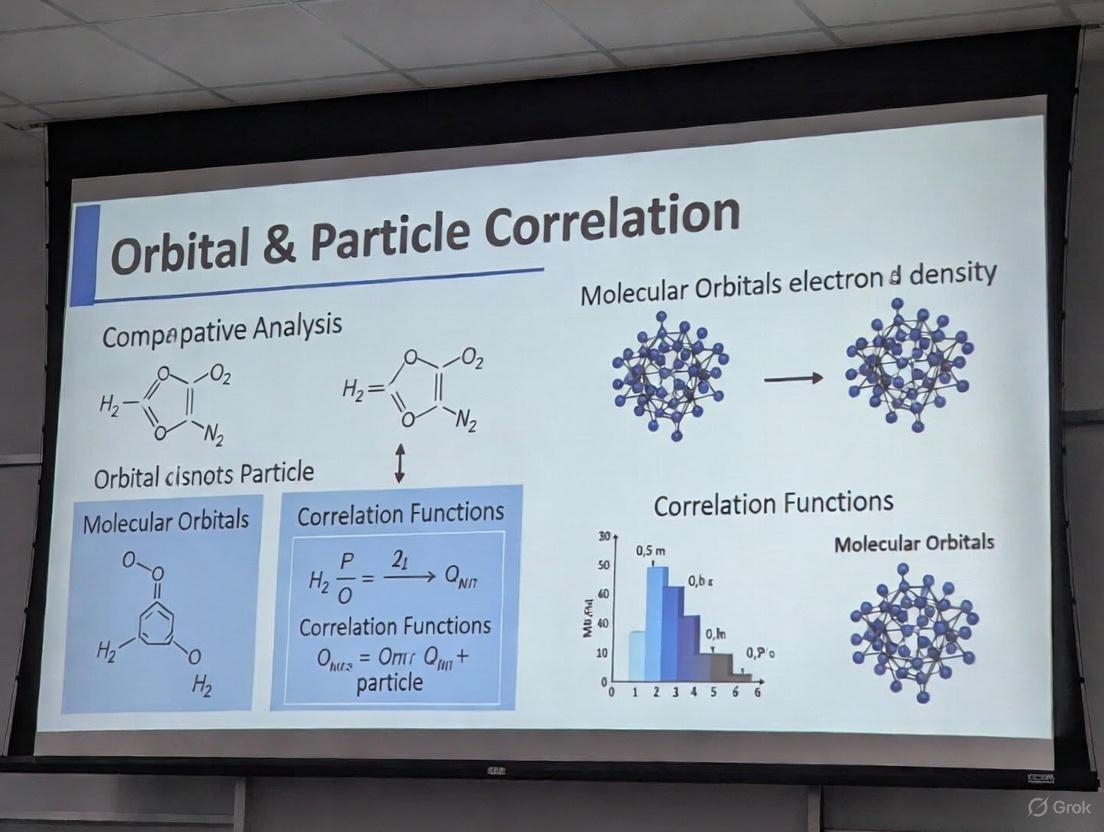
This article provides a comprehensive analysis of orbital and particle correlation, essential quantum phenomena in computational drug discovery.
Orbital and Particle Correlation in Drug Discovery: A Comparative Analysis of Methods and Applications
Abstract
This article provides a comprehensive analysis of orbital and particle correlation, essential quantum phenomena in computational drug discovery. It explores foundational theories, compares advanced methodologies like Density Functional Theory (DFT) and the Fragment Molecular Orbital (FMO) method, and addresses key challenges such as computational cost and electron correlation handling. Through practical applications in targeting protein-protein interactions and prion diseases, it validates these approaches and benchmarks their performance. Aimed at researchers and drug development professionals, this review serves as a guide for leveraging quantum mechanical calculations to overcome challenges in targeting undruggable proteins and designing precision therapeutics.
Unraveling Quantum Foundations: The Principles of Orbital and Particle Correlation
Defining Orbital Correlation, Particle Correlation, and Electron Entanglement in Molecular Systems
In quantum chemistry, electron correlation represents a central challenge for accurate computational methods, as the mean-field approximation fails to capture the complex, correlated motion of electrons. This guide provides a comparative analysis of three fundamental concepts—orbital correlation, particle correlation, and electron entanglement—that are essential for understanding and modeling electronic structure in molecular systems. These concepts differ in their theoretical foundations, quantitative measures, and implications for predicting chemical phenomena.
Orbital correlation describes the dependency between electrons occupying specific molecular orbitals, particularly crucial in strongly correlated systems like transition metal complexes and during bond-breaking processes. Particle correlation quantifies the deviation from the Hartree-Fock approximation due to correlated electron motion, directly impacting excitation energies and reaction barriers. Electron entanglement captures the non-classical correlations between electronic degrees of freedom that cannot be described by local hidden variable theories. Within the context of orbital correlation particle correlation comparative analysis research, understanding these distinctions enables researchers to select appropriate computational methods for studying molecular systems ranging from drug candidates to quantum materials.
Theoretical Definitions and Comparative Framework
Conceptual Foundations
Orbital Correlation refers to the statistical dependence between electronic occupations of different molecular orbitals. These correlations arise from electron-electron interactions and are quantified through reduced density matrices of orbital subspaces. In practical terms, orbital correlation helps explain phenomena such as static correlation in transition metal complexes and bond dissociation processes where multiple electronic configurations become nearly degenerate. The strength of orbital correlation is system-dependent and is significantly influenced by the choice of orbital basis, with localized bases often providing more chemically intuitive pictures [1] [2].
Particle Correlation encompasses the deviation from the mean-field approximation where electrons move independently in an average potential. This includes both dynamical correlation (short-range electron-electron repulsion) and static correlation (near-degeneracy effects). Particle correlation is directly responsible for the accuracy of methods like coupled cluster theory and configuration interaction in predicting molecular properties, reaction energies, and spectroscopic parameters. Unlike orbital correlation, particle correlation is a global property of the electronic wavefunction rather than a measure between specific subsystems.
Electron Entanglement represents the quantum mechanical phenomenon where the quantum states of electrons cannot be described independently, even when separated by large distances. This non-classical correlation violates local realism and is quantified through quantum information measures such as von Neumann entropy and mutual information. For electrons, entanglement must respect the fermionic superselection rules which prohibit superpositions of different particle numbers, significantly affecting the quantification of orbital entanglement [1] [2].
Table 1: Fundamental Characteristics of Correlation Types in Molecular Systems
| Feature | Orbital Correlation | Particle Correlation | Electron Entanglement |
|---|---|---|---|
| Theoretical Origin | Electron interactions in orbital subspaces | Deviation from mean-field independent electron motion | Quantum non-separability violating classical probability |
| Primary Quantifiers | Orbital mutual information, reduced density matrices | Correlation energy, density cumulants | Von Neumann entropy, entanglement entropy, concurrence |
| Dependence on Basis | Strong (localized vs. canonical orbitals) | Weak (intensive property) | Moderate (affected by orbital choice but basis-independent in principle) |
| Role of Superselection Rules | Reduces measured correlations | Not applicable | Essential for physical meaning; removes unphysical entanglement |
| Chemical Manifestations | Multi-configurational states, bond-breaking | Dispersion forces, dynamic polarizability | Quantum coherence in molecular qubits, radical pairs |
Quantitative Measures and Relationships
The quantitative description of these correlation types employs distinct mathematical frameworks. Orbital correlation is commonly measured through the quantum mutual information between orbital pairs, derived from the von Neumann entropy of one- and two-orbital reduced density matrices (RDMs). For orbitals A and B, the mutual information is given by I(A:B) = S(ρA) + S(ρB) - S(ρ_AB), where S(ρ) = -Tr(ρ ln ρ) is the von Neumann entropy [1] [2].
Particle correlation is typically quantified by the correlation energy, defined as Ecorr = EHF - Eexact, where EHF is the Hartree-Fock energy and E_exact is the true ground state energy. More sophisticated measures include density cumulants and the connected components of reduced density matrices.
Electron entanglement is quantified through various entanglement measures adapted from quantum information theory. The von Neumann entropy of orbital subsystems serves as a primary measure, while the entanglement of formation and concurrence provide alternative quantifications. Recent research has demonstrated that when proper superselection rules are accounted for, the total correlation between orbitals is predominantly classical, with quantum entanglement playing a surprisingly minor role in many chemical bonds [2].
Experimental and Computational Methodologies
Protocols for Quantum Computation of Orbital Entanglement
Quantum computers offer a promising approach for quantifying orbital correlations and entanglement that would be prohibitively expensive for classical computation. The following protocol has been demonstrated for calculating von Neumann entropies and orbital entanglement on trapped-ion quantum processors [1]:
System Preparation: Select a strongly correlated molecular system. For the vinylene carbonate + O₂ reaction system, apply the AVAS (atomic valence active space) method to project onto relevant atomic orbitals (oxygen p-orbitals), yielding an active space of 6 electrons in 9 molecular orbitals.
Wavefunction Preparation: Encode the fermionic problem into qubits using Jordan-Wigner transformation. Prepare the ground state wavefunction at different reaction coordinates using an optimized variational quantum eigensolver (VQE) ansatz.
Orbital Reduced Density Matrix (ORDM) Measurement:
- Construct measurement circuits for one- and two-orbital reduced density matrices.
- Apply fermionic superselection rules to reduce measurement overhead by restricting to physically accessible sectors.
- Group Pauli operators into commuting sets to further minimize measurement requirements.
- Execute measurement circuits on quantum hardware (e.g., Quantinuum H1-1 trapped-ion processor).
Noise Mitigation: Apply post-measurement noise reduction techniques:
- Use thresholding to filter small singular values from noisy ORDMs.
- Apply maximum likelihood estimation to reconstruct physical ORDMs.
Entropy Calculation: Compute von Neumann entropies from the eigenvalues of the noise-reduced ORDMs to obtain orbital correlations and entanglement.
Quantum Computation of Orbital Entanglement
Classical Computational Approaches
Traditional computational chemistry offers well-established protocols for quantifying particle and orbital correlations:
Complete Active Space Self-Consistent Field (CASSCF) for Orbital Correlation:
Geometry Optimization: Use nudged elastic band (NEB) method with DFT (PBE/def2-SVP) to determine minimum energy paths for reactions [1].
Active Space Selection: Apply AVAS projection to identify strongly correlated orbitals. For the VC+O₂ system, project onto O₂ p-orbitals to obtain 6 electrons in 9 orbitals, then select a (4,6) active space subset [1].
Wavefunction Optimization: Perform CASSCF calculations with spin constraints (〈S²〉=0 for singlets) to optimize both CI coefficients and molecular orbitals [1].
Orbital Entropy Calculation: Construct one- and two-orbital reduced density matrices from CASSCF wavefunction and compute orbital entropies and mutual information.
High-Level Electron Correlation Methods for Particle Correlation:
Reference Calculation: Perform Hartree-Fock calculation to establish baseline energy.
Dynamic Correlation Treatment: Apply perturbation theory (MP2, CCSD(T)) or coupled cluster methods to capture dynamic correlation.
Benchmarking: Compare with experimental results or higher-level theories to validate correlation energy recovery.
Table 2: Comparison of Correlation Quantification Methods
| Method | Target Correlation | System Size Limit | Key Metrics | Experimental Validation |
|---|---|---|---|---|
| Quantum Hardware (e.g., H1-1) | Orbital entanglement | Small active spaces (4-12 qubits) | Von Neumann entropy, mutual information | Excellent agreement with noiseless simulation [1] |
| CASSCF | Orbital correlation, static correlation | ~16 electrons in 16 orbitals | Orbital entropies, configuration weights | Spectroscopy, bond dissociation energies |
| CCSD(T) | Particle correlation (dynamic) | ~50 atoms with triple-zeta basis | Correlation energy, reaction barriers | Thermochemistry (kcal/mol accuracy) |
| DMRG | Strong electron correlation | Large active spaces (100+ orbitals) | Block entropy, entanglement spectrum | Material properties, multireference systems |
Research Applications and Case Studies
Strongly Correlated Molecular Systems
The vinylene carbonate + O₂ → dioxetane reaction provides an excellent case study for orbital correlation analysis. This reaction is relevant to lithium-ion battery degradation where singlet oxygen attacks carbonate solvents. Quantum computations revealed distinctive orbital correlation patterns across different reaction stages [1]:
- Reactants: Moderate orbital correlations in O₂ π and π* orbitals.
- Transition State: Strongly enhanced correlations as oxygen bonds stretch and align with the C-C bond of carbonate, characteristic of static correlation in bond-breaking.
- Product (Dioxetane): Reduced correlations in the closed-shell singlet product.
The quantum computation successfully captured this correlation dynamics, with von Neumann entropies showing excellent agreement with noiseless benchmarks. This demonstrates the capability of quantum processors to track correlation-driven chemical transformations [1].
Correlation-Driven Materials Design
In quantum materials, orbital correlations drive emergent phenomena in correlated electron molecular orbital (CEMO) materials. The Nb₃X₈ (X = Cl, Br, I) series exemplifies symmetry and correlation-driven trimer formation in Kagome lattices [3]:
- Electronic Requirements: Triangular trimer stability requires 6-8 electrons occupying molecular orbitals derived from transition metal d-states.
- Correlation Strength: Intermediate correlation strength is essential—strong enough for local molecular orbital formation but weak enough to prevent charge ordering.
- Orbital Symmetry: Breathing distortions optimize bonding/antibonding occupation, enhancing stability by ~181 meV/atom.
This principles framework enables rational design of quantum materials with tailored magnetic and electronic properties through correlation engineering [3].
Table 3: Key Computational Tools and Resources for Correlation Analysis
| Tool/Resource | Primary Function | Application Context | Key Features |
|---|---|---|---|
| PySCF | Electronic structure package | CASSCF, orbital entanglement | Open-source, Python-based, AVAS implementation [1] |
| Quantinuum H1-1 | Trapped-ion quantum computer | Orbital RDM measurement | High-fidelity operations, mid-circuit measurement [1] |
| DFT+U | Density functional theory with Hubbard correction | Strongly correlated materials | Parameterized electron localization [3] |
| Multi-Dimensionally Constrained CDFT | Nuclear structure calculations | Octupole correlations in nuclei | Shape deformation analysis [4] |
| NCI Orbital Decomposition | Non-covalent interaction analysis | Intermolecular forces | Orbital-pair interaction energy decomposition [5] |
Orbital correlation, particle correlation, and electron entanglement represent distinct yet interconnected frameworks for understanding electron interactions in molecular systems. While particle correlation has traditionally dominated quantum chemistry methods for recovering correlation energies, orbital correlation provides a chemically intuitive picture of electron interactions in specific orbital subspaces. Electron entanglement offers the most fundamental quantum information perspective but appears less dominant in chemical bonding when proper physical constraints are applied.
The emerging capability to measure these correlations on quantum processors represents a significant advancement, particularly for strongly correlated systems intractable to classical computation. As quantum hardware advances, the integrated understanding of these correlation phenomena will enable more accurate predictions of molecular behavior across drug discovery, materials design, and quantum technology development. Future research directions include developing more efficient measurement strategies for orbital RDMs, extending correlation analysis to larger molecular systems, and establishing clearer connections between orbital entanglement measures and chemical reactivity predictions.
The Critical Role of Correlation in Modeling Bond Breaking, Transition States, and Strongly Correlated Electrons
In computational chemistry and materials science, accurately describing electron correlation is paramount for modeling complex quantum phenomena. This is particularly true for processes involving bond breaking, transition states, and strongly correlated materials, where conventional single-reference quantum chemical methods often fail. Electron correlation encompasses both dynamic correlation (arising from the instantaneous Coulomb repulsion between electrons) and static correlation (resulting from near-degeneracies of electronic configurations) [6]. The significance of static correlation is profound—it has substantial nonlocal contributions to potential energy surfaces and can qualitatively alter their shape, making its accurate treatment essential for studying chemical reactions and correlated materials [6].
This guide provides a comparative analysis of computational methods designed to handle strong electron correlation. We objectively evaluate their performance, supported by experimental and benchmark data, and detail the protocols essential for their application. Framed within a broader thesis on orbital and particle correlation analysis, this resource is tailored for researchers, scientists, and drug development professionals who require robust computational tools to model challenging electronic structures.
Theoretical Foundations: From Bond Breaking to Correlated Materials
The Nature of Transition States and Bond Breaking
A transition state is a transient, high-energy configuration occurring during a chemical reaction where bonds are partially broken and partially formed. It exists at a local energy maximum on the reaction coordinate, characterized by partial bonds and an extremely short lifetime on the order of femtoseconds (10⁻¹⁵ seconds), making it experimentally unisolable [7]. In the SN2 reaction between NaOH and CH₃Br, for instance, the transition state features a trigonal bipyramidal geometry where the nucleophile and leaving group share partial bonds with the central carbon atom, violating ideal tetrahedral geometry [7].
Bond dissociation represents a classic case of strong static correlation. As a bond stretches, electronic configurations that were negligible at equilibrium geometry become near-degenerate with the ground state. Conventional density functional theory (DFT) with standard functionals often fails qualitatively here, while single-reference wavefunction methods like coupled-cluster theory face immense challenges [6].
Strongly Correlated Electron Systems
In materials science, strongly correlated materials are those where electron-electron interactions dominate physical properties, rendering conventional one-electron models like standard DFT inadequate [8]. The competition between kinetic energy and electron-electron repulsion in these systems gives rise to a rich tapestry of quantum phases, including:
- High-temperature superconductivity
- Magnetism
- Mott metal-insulator transitions [9]
These phenomena are ubiquitous in materials with partially filled d or f electron shells, such as transition metal oxides (e.g., vanadium and nickel oxides) and rare-earth metals [10]. In these systems, the motion of one electron is highly dependent on the positions and states of others, leading to remarkable emergent behaviors.
Comparative Analysis of Computational Methods
The following table summarizes the key features, strengths, and limitations of different computational approaches for handling strong correlation.
Table 1: Comparison of Computational Methods for Strongly Correlated Systems
| Method | Theoretical Basis | Key Features | Strengths | Limitations |
|---|---|---|---|---|
| CASSCF [6] | Multiconfigurational wavefunction | Full CI within active orbital space; orbital optimization | Gold standard for static correlation; symmetry-adapted | Exponential scaling with active space size; active space selection non-trivial |
| DFT+U [8] | Density Functional Theory | Adds Hubbard U to treat on-site Coulomb interaction | Corrects self-interaction error in DFT; computationally efficient | Static treatment of correlation; U parameter choice is empirical |
| Dynamical Mean Field Theory (DMFT) [10] [8] | Many-body perturbation theory | Maps lattice problem to impurity model; handles dynamic correlations | Non-perturbative; captures Kondo physics & Mott transitions | Computationally demanding; impurity solver required |
| Unrestricted Natural Orbital (UNO) [6] | UHF natural orbitals | Uses fractional occupancy (0.02-1.98) to define active space | Inexpensive; excellent approximation to CASSCF orbitals | Can be discontinuous if symmetry breaks; historically required UHF convergence |
| Atomic Valence Active Space (AVAS) [6] | Projection to atomic orbitals | Projects molecular orbitals to user-defined atomic orbitals | Automates active space selection; chemically intuitive | Requires initial orbital choice; can yield larger spaces |
| Quantum Computing (VQE) [1] | Variational quantum algorithms | Quantum hardware stores wavefunction; measures orbital entropy | Bypasses exponential classical cost; direct entanglement measurement | Current hardware limitations (noise, qubit count) |
Performance Benchmarks and Application Data
Table 2: Performance Comparison for Different Chemical Systems
| Chemical System | Strong Correlation Origin | Recommended Method(s) | Key Performance Metrics |
|---|---|---|---|
| Diatomic Molecule Bond Breaking (e.g., F₂, N₂) [6] | Stretched bonds; near-degeneracy | CASSCF, UNO-CAS | UNO error typically <1 mEh/active orbital vs. CASSCF [6] |
| Transition Metal Complexes (e.g., Hieber's anion, ferrocene) [6] | Partially filled d-orbitals | CASSCF, DMFT, UNO-CAS | UNO provides identical active space to expensive approximate full CI [6] |
| Organic Reactions (e.g., Bergman cyclization) [6] | Transition state bond rearrangements | CASSCF, UNO-CAS | Correctly describes biradical character at transition state |
| Conjugated Polymers (e.g., polyacenes) [6] | Small HOMO-LUMO gap | CASSCF, UNO-CAS | Handles growing static correlation with system size |
| Li-ion Battery Materials (e.g., Li-doped V₂O₅) [8] | Polarons; electron localization | DFT+DMFT | Captures dual nature (free/bound) of polarons; explains conduction mechanism [8] |
| Mott Insulators (e.g., transition metal oxides) [9] | Strong on-site Coulomb repulsion | DMFT, DFT+DMFT | Correctly predicts insulating behavior where DFT fails |
| VC + O₂ Reaction [1] | Transition state static correlation | VQE on quantum processor | Calculated orbital entropies agree with noiseless benchmarks [1] |
Experimental and Computational Protocols
Protocol 1: Transition State Analysis via Kinetic Isotope Effects (KIEs)
This protocol determines enzymatic transition state structures using experimental kinetic isotope effects combined with computational chemistry [11].
Detailed Methodology:
- KIE Measurement: Compare reaction rates of isotope-labeled and natural abundance reactants. Competitive reactions yield KIEs on ( k{cat}/Km ), encompassing all steps from free reactants to the first irreversible step [11].
- Intrinsic KIE Determination: Correct measured KIEs for rate-limiting steps not involving the chemical step (e.g., product release) to obtain intrinsic KIEs, which report solely on the bonding environment at the transition state [11].
- Computational Matching: Use quantum chemistry software (e.g., Gaussian) to locate reactants, transition state, and products. Computational methods like B3LYP/6-31G* are common. The transition state is identified by a single imaginary frequency [11].
- KIE Fitting: Fix bonds along the reaction coordinate and relax other geometric parameters. Compute KIEs for each trial structure using specialized software (e.g., QUIVER or ISOEFF98). Iterate until computed KIEs match experimental intrinsic KIEs [11].
- Electrostatic Potential Mapping: Use programs like CUBE in Gaussian to generate molecular electrostatic potential surfaces of the transition state for analog design [11].
Protocol 2: Active Space Selection for Multiconfigurational Calculations
This protocol outlines the UNO method for selecting active orbitals for CASSCF calculations [6].
Detailed Methodology:
- UHF Calculation: Perform an Unrestricted Hartree-Fock calculation, seeking broken-symmetry solutions. Modern analytical methods accurate to fourth order in orbital rotation angles have largely solved historical convergence problems [6].
- Natural Orbital Transformation: Diagonalize the UHF charge density matrix to obtain Unrestricted Natural Orbitals (UNOs) [6].
- Active Orbital Selection: Identify fractionally occupied orbitals, typically those with occupancies between 0.02 and 1.98 (or 0.01 and 1.99). These orbitals span the active space [6].
- CASSCF Calculation: Use the selected active space to perform a CASSCF calculation. The UNO orbitals typically provide an excellent starting point, with energies often within 1 mEh of the fully optimized CASSCF energy [6].
Protocol 3: Orbital Entanglement Measurement on a Quantum Computer
This protocol measures orbital correlation and entanglement using a quantum computer, as demonstrated for the VC + O₂ reaction [1].
Detailed Methodology:
- Classical Pre-processing:
- Use DFT with the PBE functional and a def2-SVP basis set to optimize reaction pathway geometries (e.g., via Nudged Elastic Band method) [1].
- Perform AVAS projection onto relevant atomic orbitals (e.g., O₂ p orbitals) to define a chemically relevant active space (e.g., 6 electrons in 9 orbitals) [1].
- Run CASSCF calculations to obtain reference wavefunctions and configuration interaction coefficients [1].
- Quantum State Preparation:
- Quantum Measurement and Post-processing:
- Execute measurement circuits on the quantum computer (e.g., Quantinuum H1-1 trapped-ion processor) to reconstruct Orbital Reduced Density Matrices (ORDMs). Group Pauli operators into commuting sets, considering fermionic superselection rules to reduce measurement counts [1].
- Apply noise reduction techniques: use thresholding to filter small singular values from noisy ORDMs, followed by a maximum likelihood estimate to reconstruct physical ORDMs [1].
- Calculate von Neumann entropies from the eigenvalues of the cleaned ORDMs to quantify orbital correlation and entanglement [1].
The diagram below illustrates the core workflow for analyzing strongly correlated systems, integrating both classical and quantum computational approaches.
The Scientist's Toolkit: Essential Research Reagents and Materials
Table 3: Key Computational and Experimental Reagents for Correlation Studies
| Item / Resource | Type | Primary Function | Example Applications |
|---|---|---|---|
| Gaussian Suite [11] | Software | Quantum chemical package for electronic structure | Transition state optimization; KIE matching; electrostatic potential mapping [11] |
| PySCF [1] | Software | Python-based quantum chemistry framework | CASSCF calculations; AVAS active space selection [1] |
| Quantinuum H1-1 [1] | Hardware | Trapped-ion quantum computer | Measuring orbital entanglement; preparing correlated wavefunctions [1] |
| ISOEFF98 / QUIVER [11] | Software | Calculates isotope effects from molecular structures | Matching computed KIEs to experimental values for transition state analysis [11] |
| Nudged Elastic Band (NEB) [1] | Algorithm | Locates minimum energy paths and transition states | Mapping reaction coordinates for VC + O₂ → dioxetane [1] |
| Jordan-Wigner Transform [1] | Algorithm | Encodes fermionic operators into qubit operators | Preparing molecular Hamiltonians for quantum computation [1] |
| Variational Quantum Eigensolver (VQE) [1] | Algorithm | Hybrid quantum-classical ground state energy calculation | Preparing ground state wavefunctions on quantum hardware [1] |
| Dynamical Mean-Field Theory (DMFT) [10] [8] | Theoretical Framework | Non-perturbative treatment of correlated electrons | Studying Mott transitions in transition metal oxides [10] |
The accurate modeling of bond breaking, transition states, and strongly correlated electrons demands a methodical approach that respects the profound role of electron correlation. No single method universally outperforms all others; rather, the choice depends on the specific system, the property of interest, and available computational resources. CASSCF with carefully selected active spaces remains the gold standard for molecular quantum chemistry, while DMFT excels for extended solid-state systems. Promisingly, emerging quantum computing approaches now enable direct measurement of orbital entanglement, offering a new paradigm for quantifying correlation. As computational power increases and algorithms refine, the integration of these methods will continue to push the boundaries of our understanding and control of complex chemical and materials systems.
In the realm of computational drug discovery, the concepts of dynamic and static correlation represent two fundamentally distinct approaches to predicting molecular behavior and interactions. Static correlation typically refers to simplified, time-averaged models that use fixed parameters for rapid screening, while dynamic correlation encompasses more complex, time-evolving models that account for physiological variability and changing conditions. This distinction is particularly crucial in orbital correlation analysis, where the accurate representation of electron behavior in molecular systems directly impacts the predictive accuracy of drug-target interactions, binding affinities, and metabolic pathways. The pharmaceutical industry increasingly relies on these computational approaches to prioritize compounds for expensive synthetic and experimental testing, making the choice between static and dynamic correlation methods a critical determinant of research efficiency and success rates.
The broader thesis of orbital correlation particle correlation comparative analysis research provides essential context for understanding these methodologies. At the quantum level, electron correlation—the interaction between electrons in a molecular system—manifests differently in static and dynamic contexts. Static correlation arises when a single electronic configuration inadequately describes a system, requiring multiple configurations for accuracy, particularly in bond-breaking or transition states. Dynamic correlation, in contrast, accounts for the instantaneous correlations between electrons as they move and interact. This fundamental distinction at the quantum level parallels the methodological differences in drug discovery applications, where each approach offers distinct advantages and limitations for specific research scenarios.
Theoretical Foundations: Orbital Correlation Principles
Quantum Chemical Basis of Electron Correlation
The accurate description of electron behavior in molecular orbitals represents a cornerstone of predictive computational chemistry. Static correlation dominates in systems with near-degeneracy, where multiple electron configurations contribute significantly to the ground state wavefunction. This is particularly evident in bond dissociation processes, transition metal complexes, and biradical systems where a single-configuration description fails dramatically. In contrast, dynamic correlation accounts for the instantaneous repulsion between electrons that is inadequately described by mean-field approaches. Most molecular systems require both types of correlation for quantitatively accurate predictions, though practical computational constraints often force researchers to prioritize one approach based on the specific application.
Quantum information theory has provided powerful tools for quantifying orbital correlation and entanglement in molecular systems. Recent research has demonstrated procedures for obtaining orbital von Neumann entropies from orbital reduced density matrices (ORDMs), enabling direct measurement of correlation strength between molecular orbitals [1]. These measures have revealed fascinating insights—for instance, one-orbital entanglement vanishes unless opposite-spin open shell configurations are present in the wavefunction when superselection rules are properly accounted for [1]. This fundamental understanding directly informs the selection of appropriate computational methods for drug discovery applications where accurate prediction of molecular reactivity and binding is paramount.
From Quantum Principles to Practical Prediction Methods
The theoretical framework of electron correlation translates directly to practical computational methods used in pharmaceutical research. Wavefunction-based methods like complete active space self-consistent field (CASSCF) explicitly handle static correlation by considering multiple configurations, while perturbation theories (e.g., MP2, CCSD(T)) or density functional methods primarily address dynamic correlation. The balance between these approaches in practical drug discovery reflects fundamental trade-offs between computational cost and predictive accuracy, with different methodologies appropriate for different stages of the drug development pipeline.
The implications for drug discovery are profound, as the choice of correlation treatment affects predictions of protein-ligand binding, reaction barriers in metabolic pathways, and electronic properties relevant to photopharmacology. For instance, studies on strongly correlated systems like uranium monoxide have revealed orbital-selective electronic transitions driven by relativistic spin-orbit coupling, leading to metallic 5f5/2 states and insulating 5f7/2 states [12]. Such nuanced electronic behavior would be completely missed by inadequate correlation treatments, potentially leading to faulty predictions of reactivity or binding in drug candidates targeting metalloenzymes.
Methodological Comparison: Static vs. Dynamic Modeling Approaches
Static Models in Drug Discovery Applications
Static models employ simplified, time-averaged parameters to predict drug behavior and interactions. In the context of drug-drug interaction (DDI) prediction, mechanistic static models use fixed inhibitor concentrations such as unbound average steady-state systemic concentration (Isys) or maximum steady-state systemic concentration (Imax) to estimate interaction magnitude [13]. These approaches provide rapid screening capabilities that are particularly valuable in early drug discovery when elimination routes of the victim compound and the role of gut extraction are not well defined [13].
The computational efficiency of static models enables broad screening of chemical space but comes with significant limitations. Static models systematically overlook temporal dynamics of drug concentration, inter-individual physiological variability, and complex interactions occurring at specific timepoints during drug administration. For DDI prediction, static equations using Isys have demonstrated reasonable accuracy (84% of interactions predicted within 2-fold in one analysis) [13], but this performance comes with important caveats regarding their application scope.
Dynamic Models in Drug Discovery Applications
Dynamic models incorporate time-dependent parameters and population variability to create more physiologically realistic simulations. Physiologically based pharmacokinetic (PBPK) modeling platforms like Simcyp represent the state-of-the-art in dynamic modeling, using time-variable concentrations of perpetrator and victim drugs in various organs and the systemic circulation as driver concentrations [14]. This approach enables incorporation of inter-individual variability through covariates such as CYP enzyme polymorphisms, age, eliminating organ function, and pathologies affecting gut wall abundance of enzymes and transporters [14].
The key advantage of dynamic models lies in their ability to identify vulnerable patient populations who may experience extreme DDIs—individuals unlikely to be adequately represented in typical clinical trials. One comprehensive simulation study demonstrated that using a 'vulnerable patient' representative showed discrepancy rates of up to 37.8% between static and dynamic predictions [14]. This capacity to model special populations makes dynamic approaches particularly valuable for informing regulatory decisions and prescribing information when clinical data in these populations are lacking.
Table 1: Fundamental Characteristics of Static and Dynamic Modeling Approaches
| Characteristic | Static Models | Dynamic Models |
|---|---|---|
| Time Handling | Time-averaged parameters | Time-varying parameters |
| Concentration Representation | Fixed values (e.g., Isys, Imax) | Continuously changing concentrations |
| Population Variability | Limited or no variability | Incorporates physiological variability |
| Computational Demand | Low | High |
| Typical Application Stage | Early discovery | Late discovery/development |
| Regulatory Acceptance | Screening purposes | Label recommendations |
Quantitative Performance Comparison in Key Applications
Drug-Drug Interaction Prediction Accuracy
Direct comparisons between static and dynamic models reveal significant differences in prediction accuracy across different scenarios. A retrospective analysis of 19 clinical interactions from 11 proprietary compounds found that static equations using unbound average steady-state systemic inhibitor concentration (Isys) performed better than Simcyp V11 (84% versus 58% of interactions predicted within 2-fold) [13]. However, this advantage must be interpreted in context—the superior performance came with specific implementation choices, including using a fixed fraction of gut extraction and neglecting gut extraction in the case of induction interactions.
In contrast, a large-scale simulation study examining 30,000 DDIs between hypothetical substrates and inhibitors of CYP3A4 found that static and dynamic models are not equivalent for predicting metabolic DDIs arising from competitive CYP inhibition [14]. The highest rate of discrepancy in the 'population' representative was 85.9% when using Cavg,ss as the inhibitor driver concentration, with the vulnerable patient representative showing IMDR >1.25 discrepancies up to 37.8% of the time [14]. These results highlight the context-dependent nature of model performance and the critical importance of the specific patient population being modeled.
Table 2: Performance Comparison for DDI Prediction
| Performance Metric | Static Models | Dynamic Models | Study Context |
|---|---|---|---|
| Predictions within 2-fold | 84% | 58% | 19 clinical interactions from 11 compounds [13] |
| Inter-model discrepancy (IMDR <0.8) | - | - | Up to 85.9% in population representative [14] |
| Inter-model discrepancy (IMDR >1.25) | - | - | Up to 37.8% in vulnerable patient representative [14] |
| Recommended Variability | Fixed variability of 40% of predicted mean AUC ratio [13] | Incorporates physiological variability sources | Population-based simulation [13] |
Protein-Ligand Interaction and Binding Prediction
The static-dynamic distinction extends beyond DDI prediction to fundamental aspects of drug-target interactions. Traditional structure-based drug discovery often relies on static protein structures, which provide limited information about the conformational flexibility essential for protein function. The emerging paradigm recognizes that "protein function is not solely determined by static three-dimensional structures but is fundamentally governed by dynamic transitions between multiple conformational states" [15].
Innovative approaches that integrate both static structural information and dynamic correlations from molecular dynamics trajectories demonstrate significant improvements over structure-based approaches across multiple tasks, including atomic adaptability prediction, binding site detection, and binding affinity prediction [16]. This fusion of static and dynamic information provides complementary signals for understanding protein-ligand interactions, offering new possibilities for drug design [16]. The performance advantage demonstrates that dynamic information captures essential aspects of molecular behavior that static snapshots cannot represent.
Experimental Protocols and Methodologies
Protocol for Comparative DDI Prediction Studies
Well-designed benchmarking studies follow specific methodologies to ensure fair comparison between static and dynamic approaches. For DDI prediction, a typical protocol involves several key steps. First, a diverse set of victim and perpetrator drugs is selected, encompassing reversible or time-dependent inhibition or induction of relevant enzymes like CYP3A4 or CYP2D6 [13]. Clinical interaction studies that involve inhibition of drug transporters may be excluded to focus specifically on metabolic interactions.
All input data except for gut interaction parameters are kept identical for both static and dynamic models to ensure fair comparison [13]. For static models, equations typically use unbound average steady-state systemic inhibitor concentration (Isys) with a fixed fraction of gut extraction. For dynamic models, platforms like Simcyp implement population-based simulations incorporating demographic and genetic variability sources. Performance is evaluated by comparing predicted area under the concentration-time curve ratios (AUCr) to clinically observed values, with predictions within 2-fold of observed values generally considered acceptable [13].
Protocol for Protein-Ligand Interaction Studies
The integration of static and dynamic information for protein-ligand interaction prediction follows a distinct methodological framework. Researchers first gather static structural information from experimental sources like protein data bank (PDB) or computational predictions from tools like AlphaFold [16] [15]. Dynamic information is then obtained from molecular dynamics (MD) simulations, which provide trajectories of protein motion over time [16].
These static and dynamic components are integrated into a heterogeneous graph representation, which is processed using relational graph neural networks (RGNNs) to generate predictions [16]. Performance is evaluated across specific tasks like atomic adaptability prediction, binding site detection, and binding affinity prediction, with the combined static-dynamic approach compared against methods using only static structural information [16]. This protocol demonstrates how hybrid approaches can leverage the complementary strengths of both methodologies.
Diagram 1: Experimental workflow for comparing static and dynamic models in drug discovery applications. The protocol emphasizes identical input parameters and context-specific interpretation of results.
Table 3: Key Research Reagent Solutions for Correlation Analysis
| Tool/Resource | Type | Primary Function | Application Context |
|---|---|---|---|
| Simcyp Simulator | Software Platform | Population-based PBPK modeling | Dynamic DDI prediction, special populations [13] [14] |
| ATLAS Database | Data Resource | Protein molecular dynamics trajectories | Protein dynamic conformation analysis [15] |
| GPCRmd Database | Specialized Database | GPCR molecular dynamics data | Membrane protein dynamics, drug targeting [15] |
| ChEMBL Database | Compound Activity Data | Bioactivity data from literature | Benchmarking compound activity prediction [17] |
| CARA Benchmark | Evaluation Framework | Compound activity assessment | Evaluating prediction models in real-world contexts [17] |
| Quantum Computers | Hardware Platform | Wavefunction storage and computation | Orbital correlation and entanglement calculation [1] |
| AlphaFold | AI Tool | Protein structure prediction | Static structure generation as basis for dynamics [15] |
Implications for Drug Discovery Accuracy and Decision-Making
Impact on Predictive Accuracy Across Development Stages
The choice between static and dynamic correlation approaches has stage-specific implications for predictive accuracy throughout the drug development pipeline. In early discovery, when metabolic routes and gut extraction roles are poorly defined, static models provide valuable screening utility with minimal computational investment [13]. The AURA framework exemplifies how standardized statistical methodologies can enhance early-stage drug optimization by integrating diverse data types and offering flexible visualizations for cross-functional teams [18].
As compounds advance toward clinical development, the limitations of static approaches become more consequential. The failure to identify vulnerable populations at high DDI risk represents a significant accuracy limitation with potential clinical consequences [14]. Dynamic models excel in these later stages by incorporating physiological variability and identifying worst-case scenarios, though they require more extensive compound characterization and computational resources.
Strategic Implementation in Pharmaceutical R&D
The most effective implementation of correlation methodologies involves strategic application of both approaches according to their complementary strengths. Static models serve as efficient filters for prioritizing compounds in data-poor environments, while dynamic models provide rigorous assessment of clinical risk in data-rich environments. This strategic approach acknowledges that "static models are not equivalent to dynamic models for predicting metabolic DDIs via competitive CYP inhibition across diverse drug parameter spaces, particularly for vulnerable patients" [14].
Emerging methodologies that fuse static and dynamic information offer promising avenues for enhanced accuracy. For protein modeling, frameworks that integrate static structural information with dynamic correlations from molecular dynamics trajectories demonstrate "significant improvements over structure-based approaches across three distinct tasks: atomic adaptability prediction, binding site detection, and binding affinity prediction" [16]. This hybrid approach exemplifies the future direction of computational drug discovery—leveraging the respective strengths of both methodologies while mitigating their individual limitations.
The distinction between dynamic and static correlation methodologies represents more than a technical computational choice—it reflects fundamental decisions about how molecular complexity is represented in pharmaceutical research. Static approaches offer efficiency and simplicity valuable in early discovery, while dynamic approaches provide physiological realism essential for clinical risk assessment. Rather than an either-or proposition, the most effective drug discovery pipelines strategically integrate both approaches according to specific research questions and development stages.
The evolving paradigm recognizes that proteins and drug molecules are inherently dynamic entities, and their interactions cannot be fully captured by static representations alone. As the field progresses, hybrid approaches that fuse static structural information with dynamic behavioral data offer promising avenues for enhanced predictive accuracy. By understanding the distinct strengths, limitations, and appropriate applications of each methodology, drug discovery researchers can make informed decisions that optimize predictive accuracy while efficiently allocating computational resources across the development pipeline.
Theoretical Foundations and Key Concepts
Quantum information theory provides powerful tools for analyzing complex electronic structures in molecular systems by quantifying correlation and entanglement between molecular orbitals. These tools are increasingly vital for studying strongly correlated systems that challenge traditional computational methods, with significant implications for drug discovery and materials science [19] [1] [20].
The von Neumann entropy serves as the foundational concept for quantifying orbital entanglement. For a quantum system described by density matrix ρ, it is defined as S(ρ) = -Tr(ρ log ρ) = -Σwₚ log wₚ, where wₚ are the eigenvalues of the density matrix [19]. When applied to molecular orbitals, we consider individual orbitals as subsystems and compute their orbital entropy by tracing the full wavefunction over the remaining "environment" orbitals [19]. For a single orbital i, the reduced density matrix is obtained through ρᵢ = Trₑᵢ|Ψ⟩⟨Ψ|, where ℰᵢ represents all other orbitals except i [19].
Mutual information extends this concept to measure the correlation between specific orbital pairs. For two orbitals i and j, the mutual information Iᵢⱼ quantifies their total correlation and is defined as Iᵢⱼ = (sᵢ⁽¹⁾ + sⱼ⁽¹⁾ - sᵢⱼ⁽²⁾)(1 - δᵢⱼ), where sᵢ⁽¹⁾ and sⱼ⁽¹⁾ are single-orbital entropies, sᵢⱼ⁽²⁾ is the two-orbital entropy, and δᵢⱼ is the Kronecker delta [21]. This formulation captures both classical correlations and quantum entanglement between orbitals, providing crucial insights into bonding patterns and correlation structures within molecules [1] [21].
Recent theoretical advances include the development of spin-free orbital entropy and mutual information, which simplify entanglement analysis and are invariant with respect to the Mₛ component of spin multiplet states [19]. This approach helps distinguish static correlation due to spin couplings from genuine strong correlation arising from multiconfigurational character in wavefunctions [19].
Comparative Analysis of Measurement Methodologies
Classical Computational Approaches
Traditional quantum chemistry methods employ density matrix renormalization group (DMRG) calculations to compute orbital entropies and mutual information, particularly for strongly correlated systems [21]. This approach effectively handles multireference systems where multiple Slater determinants contribute significantly to the wavefunction [19] [21]. The DMRG method achieves near-full configuration interaction accuracy within active spaces, making it suitable for systems with quasidegenerate orbitals such as transition metal complexes and molecules undergoing bond breaking [19] [21].
Machine learning approaches have recently emerged as efficient alternatives to direct DMRG calculations. These models predict mutual information patterns for strongly correlated systems at significantly reduced computational cost, enabling rapid determination of correlation structures and optimal orbital ordering for subsequent high-accuracy calculations [21]. For aromatic molecules like p-xylene and p-quinine, ML models successfully reproduce the expected electron distribution patterns, though they may partially underestimate values for some orbital pairs [21].
Table 1: Comparison of Classical Computational Methods for Orbital Entropy and Mutual Information
| Method | Theoretical Basis | Key Applications | Measurement Requirements | Limitations |
|---|---|---|---|---|
| DMRG | Matrix product states | Strongly correlated systems, transition metal complexes [19] [21] | Wavefunction optimization with bond dimension ~2000 [21] | Computationally expensive for large active spaces [21] |
| Post-DMRG | DMRG-adiabatic connection, downfolding CC [21] | Systems requiring dynamic correlation | Additional correlation calculations beyond active space [21] | Increased complexity and computational cost [21] |
| Machine Learning | Trained on DMRG data [21] | Correlation pattern prediction, orbital ordering [21] | Pre-trained model inference | Potential underestimation for specific orbital pairs [21] |
| CASSCF/AVAS | Active space methods with orbital optimization [1] | Reaction pathways, transition states | Orbital localization and active space selection [1] | Dependency on active space selection [1] |
Quantum Computing Approaches
Quantum computers offer a fundamentally different approach to measuring orbital correlations by directly preparing molecular wavefunctions and measuring reduced density matrices. Recent implementations on trapped-ion quantum computers, such as Quantinuum's H1-1 system, have successfully calculated von Neumann entropies for molecular orbitals in strongly correlated systems like the vinylene carbonate + O₂ reaction relevant to lithium-ion batteries [1].
A critical consideration in quantum computation of entanglement measures is the implementation of fermionic superselection rules (SSRs), which account for fundamental fermionic symmetries [1]. These rules significantly reduce the number of quantum circuits required for measurements and prevent overestimation of entanglement [1]. When SSRs are properly incorporated, they lead to an important physical result: one-orbital entanglement vanishes unless opposite-spin open shell configurations are present in the wavefunction [1].
Table 2: Quantum Computing Protocols for Orbital Correlation Measurements
| Component | Implementation | Key Innovation | Impact |
|---|---|---|---|
| State Preparation | VQE with JW transformation [1] | Fermionic encoding into qubits | Accurate ground state wavefunctions |
| Measurement | Pauli operator commuting sets [1] | Accounting for superselection rules | Reduced circuit counts, physical results |
| Noise Mitigation | Singular value thresholding + maximum likelihood [1] | Post-measurement noise reduction | Experimental accuracy matching noiseless benchmarks |
| System | Quantinuum H1-1 trapped-ion quantum computer [1] | High-fidelity quantum operations | Reliable entropy calculation for moderate systems |
Experimental Protocols and Workflows
Classical DMRG Workflow
The standard protocol for computing orbital entropies and mutual information via DMRG begins with molecular geometry optimization using methods like Nudged Elastic Band for reaction pathways [1]. Next, researchers perform active space selection typically using atomic valence active space projection to identify orbitals most relevant to strong correlation, often targeting specific atomic orbitals like oxygen p orbitals in O₂ reactions [1].
The core computational phase involves DMRG wavefunction optimization with sufficient bond dimension (typically 2000 for small systems) to achieve convergence [21]. Finally, entropy calculations proceed by constructing one- and two-orbital reduced density matrices from the optimized wavefunction and computing their eigenvalues to obtain orbital entropies and mutual information [19] [21].
Classical DMRG Workflow for Orbital Entropy Calculation
Quantum Computing Measurement Protocol
Quantum approaches employ a different workflow beginning with Hamiltonian encoding using Jordan-Wigner or similar transformations to map fermionic operators to qubit operators [1]. Next, ansatz optimization uses variational quantum eigensolver to prepare ground states with offline optimization of circuit parameters [1].
The critical measurement phase involves executing quantum circuits grouped by commuting Pauli operators while respecting superselection rules to efficiently reconstruct orbital reduced density matrices [1]. Finally, error mitigation applies post-measurement noise reduction through singular value thresholding and maximum likelihood estimation to obtain physical density matrices [1].
Applications in Pharmaceutical Research
Quantum information measures of orbital correlation are revolutionizing pharmaceutical research by enabling more accurate simulation of complex molecular interactions central to drug discovery. The iron-sulfur bound complexes exemplify systems where orbital entropy analysis provides crucial insights - these biologically essential complexes facilitate electron transfer in processes like nitrogen fixation and photosynthesis, but challenge computational methods due to partially occupied 3d-shells and many closely lying states of different spin multiplicity [19]. For such transition metal compounds, orbital entanglement patterns help distinguish between high-spin states dominated by single configurations and low-spin states with more complicated multiconfigurational character [19].
In drug-protein binding studies, quantum-powered tools model interaction dynamics with unprecedented accuracy by accounting for electron correlation effects at the orbital level [22]. This approach is particularly valuable for studying water molecules that mediate protein-ligand binding processes, as quantum algorithms can efficiently evaluate numerous configurations of water placement within protein pockets, even in challenging buried regions [22]. Companies like Qubit Pharmaceuticals and Pasqal have demonstrated successful implementation of hybrid quantum-classical approaches for analyzing protein hydration, marking significant advances in computational drug discovery [22].
The Alzheimer's disease research community has embraced these techniques through initiatives like the Quanta-Bind platform, where quantum methods study protein-metal interactions tied to neurodegeneration [23]. By applying quantum information analysis to these systems, researchers can identify correlation patterns that illuminate the electronic structure factors contributing to pathological processes, potentially accelerating therapeutic development [23].
Table 3: Pharmaceutical Applications of Orbital Correlation Analysis
| Application Area | System Studied | Quantum Information Tool | Impact |
|---|---|---|---|
| Enzyme Simulation | Cytochrome P450 [24] | Quantum entanglement measures | Improved drug metabolism prediction |
| Neurodegenerative Disease | Protein-metal interactions [23] | Orbital correlation analysis | Insights into Alzheimer's mechanisms |
| Battery Material Degradation | Vinylene carbonate + O₂ [1] | Orbital entropy along reaction path | Understanding of battery degradation |
| Protein-Ligand Binding | Hydration site prediction [22] | Quantum-assisted molecular docking | More accurate binding affinity prediction |
Essential Research Tools and Reagents
Computational Software and Platforms
The PySCF package provides essential infrastructure for performing active space calculations and orbital localization through methods like Foster-Boys or Pipek-Mezey, which help avoid overestimation of correlation from delocalized orbital bases [1] [21]. DMRG implementations such as those in CheMPS2 or Block2 enable high-accuracy wavefunction optimization for strongly correlated systems, with capabilities for calculating one- and two-orbital reduced density matrices [21]. Quantum computing frameworks including Qiskit, Cirq, and PennyLane offer tools for mapping chemical problems to quantum circuits and executing them on hardware like Quantinuum's H1-1 trapped-ion systems [1].
Quantum Hardware Systems
Trapped-ion quantum computers like the Quantinuum H1-1 provide high-fidelity gates essential for accurate measurement of orbital reduced density matrices, with current implementations successfully calculating von Neumann entropies for moderate system sizes [1]. Superconducting quantum processors including Google's Willow chip and IBM's Quantum systems demonstrate rapid progress in qubit count and error correction, with algorithmic advances reducing quantum error correction overhead by up to 100 times [24]. Neutral-atom platforms from companies like Atom Computing and Pasqal offer alternative approaches with recent demonstrations of utility-scale quantum operations relevant to molecular simulation [22] [24].
Research Tools for Orbital Entropy Studies
Orbital entropy and mutual information represent powerful concepts from quantum information theory that are transforming how researchers analyze electronic structure in complex molecular systems. As both classical algorithms and quantum computing hardware continue to advance, these measures provide increasingly detailed insights into correlation patterns essential for understanding drug-receptor interactions, catalytic mechanisms, and materials properties. The integration of machine learning with quantum information analysis offers particularly promising avenues for accelerating drug discovery pipelines and developing more targeted therapeutics for complex diseases.
In computational drug discovery, strong electron correlation presents a significant challenge for accurately modeling complex biological systems. This is particularly true for two important classes of drug targets: metalloproteins containing transition metals and large protein-protein interfaces. Strong correlation effects arise in systems with nearly degenerate electronic states, making them difficult to treat with conventional computational methods. Transition metals exhibit complex electronic structures due to their partially filled d-orbitals, while extensive π-stacking and charge transfer at protein-protein interfaces also introduce significant correlation effects.
Understanding these challenging targets requires advanced computational approaches that can properly describe their electronic structures. This guide provides a comparative analysis of methodologies for studying these systems, summarizes experimental validation protocols, and presents the essential toolkit for researchers working at the intersection of quantum chemistry and drug discovery.
Computational Methodologies for Strong Correlation
Quantum Mechanical Approaches
Table 1: Comparison of Computational Methods for Strongly-Correlated Systems
| Method | Theoretical Basis | Strengths | Limitations | Applicable Targets |
|---|---|---|---|---|
| Fragment Molecular Orbital (FMO) | Divides system into fragments; calculates inter-fragment interactions [25] | Scalable to large systems; provides energy decomposition (electrostatics, charge transfer, dispersion) [26] | Accuracy depends on fragmentation scheme; parameterization required | GPCR-ligand complexes, Prion protein binders [26] |
| Density Functional Theory (DFT) | Electron density functional theory | Favorable cost/accuracy balance; widely available | Standard functionals fail for strong correlation; requires advanced functionals | Metalloprotein active sites, catalytic centers |
| Molecular Dynamics (MD) | Newtonian mechanics with classical force fields | Microsecond timescales; conformational sampling | Limited by force field accuracy; missing quantum effects | PPIs, allosteric mechanisms, protein folding |
| Hybrid ML/Quantum (PinMyMetal) | Ensemble machine learning with geometric constraints [27] | High accuracy for metal positioning (0.19-0.56 Å deviation); certainty scoring [27] | Training data dependent; limited to characterized geometries | Transition metal binding sites in proteins [27] |
The FMO method has proven particularly valuable for protein-ligand systems, as it enables quantum mechanical calculations on large biological complexes by dividing the system into smaller fragments [25]. The method provides pair interaction energy decomposition analysis (PIEDA), which breaks down interactions into electrostatic, exchange-repulsion, charge transfer, and dispersion components [25] [26]. This decomposition is crucial for understanding the nature of binding in strongly correlated systems.
For transition metal centers, hybrid machine learning approaches like PinMyMetal have demonstrated remarkable accuracy in predicting metal ion positions with median deviations of 0.19 Å for structural sites and 0.33 Å for catalytic sites [27]. These methods combine geometric constraints with ensemble learning to address the challenges of metal coordination complexity.
Specialized Methods for Transition Metals
Transition metals in biological systems present unique challenges due to their variable coordination geometries, oxidation states, and spin states. The coordination environment significantly influences metal function in proteins:
- Tetrahedral sites: Often involve Cysteine (C) and Histidine (H) residues, common for structural zinc ions [27]
- Octahedral sites: Typically involve Glutamate (E), Aspartate (D), and Histidine (H) residues, frequent in catalytic centers [27]
- Low-coordination sites: Regulatory metal binding sites often feature reduced coordination numbers (2-3 ligands) [27]
Different computational strategies are required for these coordination geometries. CH-focused approaches work well for tetrahedral coordination, while EDH-based methods are more appropriate for octahedral sites [27].
Diagram 1: Computational workflow for predicting transition metal binding sites in proteins, integrating geometric constraints with machine learning scoring.
Protein-Protein Interactions as Drug Targets
Classification and Detection Methods
Protein-protein interactions represent another class of challenging targets where correlation effects play an important role in binding. PPIs can be classified based on experimental detection methods:
- Binary methods: Detect direct physical interactions between specific protein pairs (e.g., yeast two-hybrid) [28]
- Indirect methods: Identify interactions within protein complexes without distinguishing direct partners (e.g., co-immunoprecipitation) [28]
Table 2: Experimentally Verified PPI Database Coverage Comparison
| Database | Experimentally Verified PPIs | Coverage of Curated Interactions | Special Features |
|---|---|---|---|
| STRING | High | ~70% | Integrates experimental and predicted interactions [29] |
| UniHI | High | N/A | Human interactome focus [29] |
| APID | ~21% of all reported PPIs [28] | ~70% [29] | Unified interactomes; binary interaction emphasis [28] |
| HIPPIE | Medium | ~70% | Context-specific interaction data [29] |
| hPRINT | Lower for experimental | High for total PPIs | Comprehensive predicted interactions [29] |
Database integration is crucial for PPI research. Combined use of STRING and UniHI retrieves approximately 84% of experimentally verified PPIs, while adding hPRINT and IID captures about 94% of total available PPIs [29].
Experimental Validation and Case Studies
Protocols for Metalloprotein Drug Discovery
Experimental validation of computational predictions for metalloprotein targets follows rigorous protocols:
Standard Scrapie Cell Assay (SSCA) for Prion Disease Targets:
- Cells are exposed to candidate compounds and passaged multiple times (typically six passages)
- Cells are collected and subjected to proteinase K (PK) digestion
- PrPSc levels are determined to evaluate antiprion activity [26]
- Western blot (WB) verification confirms inhibitory concentrations [26]
Binding Site Mutation Studies:
- Site-directed mutagenesis of predicted metal-binding residues (e.g., Asn159, Val189, Thr192, Lys194, Glu196 in PrPC) [26]
- Isothermal titration calorimetry (ITC) to measure binding affinity changes
- Functional assays to correlate metal binding with protein function
Crystallographic Validation:
- X-ray crystallography with resolution ≤ 2.0 Å for metal coordination assessment [30]
- Anomalous scattering to confirm metal identity (e.g., Zn, Cu, Mn)
- Validation tools like CheckMyMetal to assess metal binding site geometry [27]
Case Study: FMO-Driven Discovery of Natural Products for Prion Disease
The integration of FMO calculations with experimental validation successfully identified natural products with antiprion activity:
- Pharmacophore Development: FMO calculations on PrPC-GN8 complex identified key interacting residues (Arg136, Arg156, Tyr157, Pro158, Asn159, Gln160, His187, Lys194) [26]
- Virtual Screening: In-house natural product database screened against FMO-derived pharmacophore model
- Experimental Validation: Two compounds (BNP-03 and BNP-08) reduced PrPSc levels at 12.5 µM concentration in SSCA [26]
The FMO analysis provided critical insights into interaction energies, with dispersion components contributing significantly to binding (e.g., -14.64 kcal/mol for Glu196) despite repulsive electrostatic components [26].
Table 3: Key Research Reagent Solutions for Strong Correlation Studies
| Category | Specific Tools | Function | Application Context |
|---|---|---|---|
| Computational Tools | PinMyMetal [27] | Predicts transition metal localization and environment | Metalloprotein engineering, functional annotation |
| FMO Software [25] [26] | Quantum mechanical calculation of protein-ligand interactions | Binding energy decomposition, SAR analysis | |
| Databases | APID [28] | Unified protein interactomes with experimental evidence | PPI network analysis, target identification |
| STRING [29] | Integrated PPI database with confidence scoring | Pathway analysis, functional annotation | |
| RCSB PDB [30] | Experimentally determined macromolecular structures | Metal binding site analysis, homology modeling | |
| Experimental Resources | CheckMyMetal [27] | Validates metal binding sites in protein structures | Quality control for crystallographic data |
| Gold-standard PPI set [29] | Literature-curated experimentally proven PPIs | Method benchmarking, database validation |
Comparative Performance Analysis
Accuracy Metrics Across Methodologies
Table 4: Quantitative Performance Comparison of Prediction Methods
| Method | System Type | Accuracy Metric | Performance | Reference |
|---|---|---|---|---|
| PinMyMetal | Transition metal sites | Median position deviation | 0.19 Å (structural), 0.33 Å (catalytic), 0.36 Å (regulatory) | [27] |
| FMO | GPCR-ligand complexes | Correlation with experimental affinity | High correlation with measured values | [25] |
| Homology Modeling | Metal sites | Transfer accuracy | Limited for novel motifs without homologous templates | [27] |
| Geometric Predictors | Metal binding sites | Recall at IoUR ≥ 0.5 | >90% for most transition metals | [27] |
| Database Integration | PPI networks | Coverage of verified interactions | 84% with STRING+UniHI; 94% total PPIs with additional databases | [29] |
The performance data demonstrates that hybrid approaches combining physical principles with machine learning generally outperform single-method strategies. For metal binding site prediction, PinMyMetal achieves high accuracy by employing separate strategies for different coordination geometries and coordination numbers [27]. For PPIs, integrated database approaches provide the most comprehensive coverage [29].
Diagram 2: Decision framework for selecting computational methods based on target properties and correlation challenges.
The study of strongly correlated systems in drug discovery requires specialized approaches that go beyond conventional computational methods. For transition metal-containing targets, hybrid machine learning systems that account for coordination geometry and electronic effects show particular promise, with accuracy exceeding traditional homology-based methods. For protein-protein interactions, integrated database strategies provide the most comprehensive coverage, though experimental validation remains essential.
Future advancements will likely come from improved quantum mechanical methods that more efficiently handle strong correlation, better integration of machine learning with physical principles, and more comprehensive databases that incorporate structural, kinetic, and thermodynamic data. As these methods mature, they will increasingly enable the targeting of challenging biological systems that have previously been considered undruggable.
Computational Tools in Action: A Comparative Guide to Correlation Methods
Density Functional Theory (DFT) is a foundational computational method for predicting ground-state electronic properties in materials science and chemistry. This guide compares the accuracy and efficiency of various DFT software and methodologies, helping researchers select the optimal approach for calculating properties such as lattice constants, band structures, and formation energies.
Software and Functional Selection Guide
The choice of DFT software and exchange-correlation functional profoundly impacts the accuracy of ground-state property predictions. The table below summarizes leading DFT software options.
Table 1: Comparison of Representative DFT Software for Ground-State Calculations
| Software | Main Target System | Key Features | License |
|---|---|---|---|
| VASP [31] | Solid | Industry standard for solid-state/periodic system calculations | Paid |
| Quantum Espresso [31] | Solid | Free, open-source software for solid-state calculations | Free |
| Gaussian [31] | Molecular | Industry standard for molecular system calculations; GUI available | Paid |
| GAMESS [31] | Molecular | Free software with active feature development | Free |
| ORCA [31] | Molecular | Strong in optical properties and high-precision calculations; free for academic use | Paid (Academic free) |
The selection of the exchange-correlation functional is equally critical. Benchmark studies reveal the performance of different functionals for specific properties:
Table 2: Functional Performance for Key Ground-State Properties
| Functional | Typical Application | Performance & Accuracy Notes |
|---|---|---|
| PBE (GGA) [32] | General purpose, structural properties | Good for lattice constants but tends to overestimate them; often underestimates band gaps severely. |
| HSE06 (Hybrid) [32] | Band gaps, electronic properties | Significantly improves band gap accuracy and lattice parameter prediction over PBE. |
| PBE+U [32] | Systems with localized d/f electrons | Can improve properties for correlated electrons but may underestimate lattice parameters. |
| LDA [33] | - | Known to over-bind, typically underestimating lattice constants. |
Experimental Protocols and Benchmarking Data
Benchmarking Lattice Constants and Band Gaps
A benchmark study on bulk MoS₂ provides a clear protocol for evaluating functional performance.
Computational Protocol [32]:
- Software & Method: Calculations performed using the Quantum ESPRESSO simulation package.
- Pseudopotentials: Optimized Norm-Conserving Vanderbilt (ONCV) pseudopotentials.
- Plane-Wave Cutoff: A kinetic energy cutoff of 80 Ry was used for the plane-wave basis set.
- k-point Grid: A 12×12×3 Monkhorst-Pack k-point grid sampled the Brillouin zone.
- Convergence: Structures were relaxed until the force on each atom was less than 0.001 eV/Å and the energy change between steps was below 10⁻⁸ eV.
Quantitative Results [32]:
- PBE: Overestimated the lattice constant
aof MoS₂ by approximately 0.5% compared to experimental data. - HSE06: Reduced the percentage error in the lattice constant, providing a more accurate value, and delivered a much more accurate band gap.
- PBE: Overestimated the lattice constant
Protocol for Enhancing DFT Efficiency
Reducing the computational cost of DFT without sacrificing accuracy is a key research area.
- Efficiency Optimization Protocol [33]:
- Objective: Minimize the number of self-consistent field (SCF) iterations required for convergence by optimizing charge mixing parameters.
- Algorithm: Use Bayesian Optimization (BO), a data-efficient, derivative-free algorithm, to find the optimal parameter set.
- Implementation: This procedure can be applied alongside standard convergence tests for cutoff energy and k-points.
- Outcome: This approach demonstrated a significant reduction in SCF iterations and total simulation time for insulating, semiconducting, and metallic systems compared to default parameters in VASP [33].
The Rise of Machine Learning Potentials
Neural Network Potentials (NNPs) are emerging as a powerful alternative, offering near-DFT accuracy at a fraction of the computational cost.
Table 3: Emerging Machine Learning Potentials for Material Simulation
| Model/Platform | Description | Reported Performance |
|---|---|---|
| EMFF-2025 [34] | A general NNP for C, H, N, O-based high-energy materials. | Achieves DFT-level accuracy in predicting structures, mechanical properties, and decomposition pathways [34]. |
| Egret-1 (Rowan) [35] | An open-source family of NNPs. | Matches or exceeds quantum-mechanics-based simulation accuracy while running orders-of-magnitude faster [35]. |
| OMol25 NNPs [36] | NNPs (eSEN, UMA) trained on Meta's large-scale dataset. | Can predict charge-related properties (e.g., electron affinity) with accuracy comparable to or better than low-cost DFT methods for certain species [36]. |
Workflow and Logical Pathways
The following diagram illustrates a decision pathway for selecting a computational method based on project goals, system size, and required accuracy.
The Scientist's Toolkit
This table details essential computational "reagents" for performing DFT calculations.
Table 4: Essential Research Reagents for DFT Simulations
| Tool Category | Examples | Function & Purpose |
|---|---|---|
| DFT Software [31] | VASP, Quantum ESPRESSO, Gaussian, ORCA | Core engines that perform the electronic structure calculations by solving the Kohn-Sham equations. |
| Visualization & Modeling [31] | VESTA, Avogadro, GaussView | Used to build atomic structures, create input files, and visualize results like electron densities and molecular orbitals. |
| Pseudopotentials [37] | Ultrasoft, PAW, Norm-Conserving | Replace core electrons to reduce computational cost while accurately representing the effect of the nucleus and core electrons on valence electrons. |
| Basis Sets | Plane-Waves, Gaussian-Type Orbitals | Mathematical functions used to describe electron wavefunctions. Plane-waves are standard for solids, while Gaussian functions are common for molecules. |
| Exchange-Correlation Functional [33] [32] | PBE, HSE06, LDA, PBE+U | Approximates the quantum mechanical exchange and correlation energy, which is the key unknown in DFT that determines accuracy. |
| Machine Learning Potentials [34] [35] | EMFF-2025, Egret-1, OMol25 NNPs | Pre-trained models that learn from DFT data to predict energies and forces with high speed and accuracy, enabling large-scale simulations. |
In quantum chemistry, the pursuit of high-accuracy predictions for molecular structure and properties hinges on effectively solving the electronic Schrödinger equation. The central challenge lies in accounting for electron correlation—the instantaneous repulsive interactions between electrons that are neglected in simple independent-particle models [38]. This comparative analysis examines the evolution of wavefunction-based ab initio methods, from the foundational Hartree-Fock approach to sophisticated post-Hartree-Fock and Coupled-Cluster theories, framing their development within a broader thesis on orbital and particle correlation. For computational chemists and drug development professionals, the selection of an appropriate method represents a critical trade-off between computational cost and predictive accuracy, particularly when modeling complex interactions such as protein-ligand binding or chemical reaction mechanisms [39].
The Hartree-Fock (HF) method provides a qualitative starting point for molecular simulations but suffers from a fundamental limitation: it treats electrons as moving in an average field of others, thereby neglecting electron correlation [39] [38]. This missing correlation energy, defined as the difference between the exact and HF energy, particularly affects systems where accurate energetics are crucial, including dispersion-bound complexes, transition states, and open-shell systems [38]. Post-HF methods systematically recover this correlation, with Coupled-Cluster theory representing the current gold standard for chemical accuracy in many applications [40].
Theoretical Framework and Computational Protocols
Fundamental Wavefunction Theories
Wavefunction methods share a common foundation in the time-independent Schrödinger equation, Hψ = Eψ, where H is the Hamiltonian operator, ψ is the wavefunction, and E is the energy eigenvalue [39]. The Born-Oppenheimer approximation, which assumes stationary nuclei relative to electron motion, enables separation of electronic and nuclear coordinates, making computational solutions tractable for molecular systems [41] [39].
Hartree-Fock Theory approximates the many-electron wavefunction as a single Slater determinant of molecular orbitals, obtained through the Self-Consistent Field (SCF) procedure [39]. The HF equations, f̂φᵢ = εᵢφᵢ, describe electrons moving in the average field of others, where f̂ is the Fock operator and φᵢ are molecular orbitals with energies εᵢ [39]. While HF incorporates exchange correlation via antisymmetrization, it completely lacks dynamic correlation, leading to systematic errors in binding energies and reaction barriers [39] [38].
Post-Hartree-Fock Methods introduce electron correlation through two principal approaches: configuration interaction-based methods that correct the single-determinant approximation, and perturbation-based methods that introduce correlation energy through perturbative treatment of electron-electron interactions [40].
Coupled-Cluster Theory expresses the wavefunction through an exponential ansatz, ψCC = e^T ψHF, where T is the cluster operator that generates excited determinants from the HF reference [40]. The method's accuracy and size-consistency (the correct description of dissociated fragments) make it particularly valuable for studying molecular processes where bonding patterns change significantly [40].
Experimental Protocols for Method Benchmarking
Robust benchmarking of wavefunction methods requires carefully designed protocols to assess performance across diverse chemical systems. The following experimental framework ensures meaningful comparisons:
Reference Data Generation: For small model systems (≤10 non-hydrogen atoms), Full Configuration Interaction (FCI) with large basis sets provides the exact solution within the basis set limit and serves as the highest-quality reference [40]. For larger systems, experimental data such as well-established bond energies, spectroscopic constants, or molecular geometries provide validation, though careful attention must be paid to error sources like relativistic effects or experimental uncertainty [42].
Basis Set Selection and Extrapolation: Calculations employ hierarchical basis set families (e.g., Dunning's cc-pVXZ or Karlsruhe def2 series) to enable systematic extrapolation to the complete basis set (CBS) limit [42]. Basis sets are selected based on the target property—energy differences typically require triple- or quadruple-zeta basis sets, while molecular properties may need specialized basis sets with diffuse or polarization functions [42].
Property-Specific Benchmarking: Different molecular properties place distinct demands on electron correlation treatment:
- Total Energies: Assess method performance for absolute energies, though these are rarely chemically significant alone.
- Energy Differences: Calculate reaction energies, barrier heights, and binding energies to evaluate performance for chemically relevant transformations.
- Molecular Properties: Evaluate accuracy for geometric parameters, vibrational frequencies, dipole moments, and spectroscopic properties.
- Weak Interactions: Specifically test performance for dispersion-bound complexes, critical in drug-receptor interactions [39].
Statistical Analysis: For comprehensive benchmarking studies, calculate root-mean-square deviations (RMSD), mean absolute errors (MAE), and maximum errors relative to reference data across a diverse test set [38]. This statistical approach provides a more complete picture of method performance than single-molecule comparisons.
The diagram below illustrates the hierarchical relationship between these wavefunction methods and their fundamental theoretical approaches:
Figure 1: Theoretical hierarchy of wavefunction methods, showing progression from fundamental theory to specific computational approaches.
Comparative Performance Analysis of Wavefunction Methods
Method Formulations and Computational Scaling
Table 1: Fundamental Characteristics of Wavefunction Methods
| Method | Theoretical Approach | Electron Correlation Treatment | Computational Scaling | Key Limitations |
|---|---|---|---|---|
| Hartree-Fock (HF) | Single Slater determinant, mean-field approximation | Only Fermi (exchange) correlation via antisymmetrization | O(N⁴) | Neglects electron correlation; inaccurate binding energies |
| Møller-Plesset 2nd Order (MP2) | Rayleigh-Schrödinger perturbation theory | Dynamic correlation through 2nd order perturbation | O(N⁵) | Poor for systems with strong correlation; non-variational |
| Configuration Interaction Singles/Doubles (CISD) | Linear combination of HF with singly/doubly excited determinants | Static and limited dynamic correlation | O(N⁶) | Not size-consistent; truncated excitation |
| Coupled-Cluster Singles/Doubles (CCSD) | Exponential cluster operator (T₁ + T₂) | Extensive dynamic correlation | O(N⁶) | Expensive for large systems; inadequate for strong correlation |
| CCSD with Perturbative Triples (CCSD(T)) | CCSD with non-iterative triple excitations | Gold standard for single-reference systems | O(N⁷) | High computational cost; reference-dependent |
Hartree-Fock theory serves as the reference point for all correlated methods, with its single-determinant wavefunction [39]. While computationally efficient relative to post-HF methods, HF's neglect of electron correlation leads to systematic errors, particularly underestimation of binding energies in weakly-bound complexes relevant to pharmaceutical applications [39] [38].
Møller-Plesset perturbation theory (MP2) provides the most computationally accessible entry into correlated methods, capturing approximately 80-90% of the correlation energy at a relatively modest O(N⁵) computational scaling [40]. However, MP2 performs poorly for systems with significant static correlation, such as transition metal complexes or bond-breaking processes, where the perturbative approach becomes questionable [40].
Coupled-Cluster theory, particularly CCSD(T), achieves remarkable accuracy for molecular systems where the HF determinant provides a qualitatively correct reference [40]. The inclusion of connected triple excitations in CCSD(T) captures subtle correlation effects, making it the preferred method for achieving "chemical accuracy" (±1 kcal/mol) in energy predictions [40]. The primary limitation remains its O(N⁷) computational scaling, restricting application to small or medium-sized molecules with current computational resources.
Quantitative Performance Across Molecular Properties
Table 2: Performance Benchmarks for Molecular Properties (Typical Errors)
| Property | HF | MP2 | CCSD | CCSD(T) | Experimental Reference |
|---|---|---|---|---|---|
| Bond Lengths (Å) | ±0.02 | ±0.01 | ±0.005 | ±0.001 | Spectroscopy |
| Vibrational Frequencies (cm⁻¹) | ±10% | ±5% | ±2% | <1% | IR/Raman spectroscopy |
| Binding Energies (kcal/mol) | 20-30% error | ±5-10% | ±2-5% | ±1-2% | Thermochemistry |
| Reaction Barrier Heights | 30-50% error | ±10-15% | ±5-8% | ±1-2% | Kinetic measurements |
| Rotation Barriers | ±3-5 kcal/mol | ±1-2 kcal/mol | ±0.5-1 kcal/mol | <0.5 kcal/mol | Spectroscopy |
The tabulated data demonstrates the systematic improvement in predictive accuracy across the hierarchy of wavefunction methods. For geometric parameters such as bond lengths, HF typically overestimates distances due to insufficient electron bonding, while CCSD(T) achieves exceptional agreement with experimental values [40]. Similarly, for vibrational frequencies—critical for spectroscopic prediction—CCSD(T) consistently delivers sub-percent errors, making it reliable for assigning experimental spectra.
In drug discovery applications, binding energy prediction represents a particularly challenging benchmark. HF's neglect of dispersion interactions leads to errors of 20-30% in binding affinities, while CCSD(T) reduces these errors to the 1-2% range, approaching experimental uncertainty [39]. This accuracy comes at tremendous computational cost, with CCSD(T) calculations on drug-sized molecules requiring extensive computational resources.
Performance Across Chemical System Types
Table 3: Method Performance Across Chemical System Classes
| System Type | HF Performance | MP2 Performance | CCSD Performance | CCSD(T) Performance | Recommended Method |
|---|---|---|---|---|---|
| Main Group Closed-Shell | Moderate | Good | Very Good | Excellent | CCSD(T)/CBS |
| Weakly-Interacting Complexes | Poor | Good (with dispersion) | Very Good | Excellent | CCSD(T)/CBS |
| Transition Metal Compounds | Poor | Variable | Good | Very Good | Multireference+CC |
| Radicals/Open-Shell | Poor to Fair | Fair to Good | Good | Very Good | CCSD(T) |
| Bond Dissociation | Poor | Poor | Fair | Good | Multireference |
The performance of wavefunction methods varies significantly across different chemical system classes. For main group closed-shell molecules, where a single determinant dominates, the coupled-cluster hierarchy provides exceptional accuracy [40]. Weakly-bound complexes, particularly those dominated by dispersion interactions, present challenges for HF and MP2, with CCSD(T) providing the most reliable treatment of these subtle forces critical to drug-receptor interactions [39].
Transition metal complexes and open-shell systems often exhibit strong correlation effects (multireference character), which challenge single-reference methods like conventional CCSD(T) [40]. In these cases, multireference approaches such as CASSCF or CASPT2 may be necessary for qualitative accuracy before applying coupled-cluster refinements [40]. Bond dissociation processes represent another challenge, as the static correlation becomes increasingly important at stretched bond lengths.
Successful application of high-accuracy wavefunction methods requires careful selection of computational tools and parameters. The following toolkit outlines essential components for effective research in this domain:
Table 4: Essential Computational Tools for Wavefunction Methods
| Tool Category | Specific Examples | Function/Purpose | Key Considerations |
|---|---|---|---|
| Electronic Structure Packages | Gaussian, Q-Chem, Psi4, Molpro, COLUMBUS | Implement wavefunction methods for molecular systems | Varying capabilities for post-HF methods; efficiency for large systems |
| Basis Set Libraries | Dunning (cc-pVXZ), Karlsruhe (def2), Pople | Atomic orbital basis for molecular orbital construction | Balance between accuracy and cost; system-specific requirements |
| Analysis & Visualization | Molden, GaussView, Multiwfn | Wavefunction analysis; orbital visualization | Interpretation of electron correlation effects |
| High-Performance Computing | Linux clusters with MPI/OpenMP | Computational resources for demanding calculations | Memory, disk space, and processor requirements scale with system size |
Basis Set Selection Strategy: The choice of atomic orbital basis set critically impacts the accuracy of wavefunction calculations [42]. For consistent benchmarking, hierarchical basis set families (e.g., cc-pVDZ → cc-pVTZ → cc-pVQZ) enable systematic extrapolation to the complete basis set limit [42]. While larger basis sets improve description of electron correlation, they dramatically increase computational cost, necessitating careful balance in project planning.
Active Space Selection for Multireference Cases: Systems with strong correlation effects require careful selection of active orbitals and electrons in multiconfigurational approaches [40]. This process demands chemical insight and often involves iterative testing to ensure adequate description of near-degenerate states.
Convergence Criteria and Numerical Stability: Post-HF methods require careful attention to convergence thresholds for energy, wavefunction, and integral evaluations. Tight convergence (10⁻¹⁰-10⁻¹² Hartree) ensures numerical stability, particularly for energy differences. The iterative nature of these methods also necessitates monitoring for convergence difficulties, which may occur in systems with near-degeneracies or complex electronic structures.
Experimental Workflow for High-Accuracy Calculations
The following diagram illustrates a robust computational workflow for executing high-accuracy wavefunction calculations, from initial setup to final result interpretation:
Figure 2: Comprehensive workflow for high-accuracy wavefunction calculations, highlighting decision points for method selection.
This workflow emphasizes the critical assessment of reference wavefunction quality before proceeding to expensive correlated calculations. For systems where the HF determinant dominates (>90% weight in FCI expansion), single-reference methods like CCSD(T) are appropriate [38]. For systems with significant multireference character (multiple determinants with substantial weights), multiconfigurational approaches must precede correlation treatment.
The basis set study phase involves systematic increase of basis set size (preferably triple-zeta and larger) with extrapolation to the CBS limit [42]. This eliminates basis set incompleteness error, isolating the method error for clearer benchmarking. Final analysis should include comparison with reliable experimental data or higher-level theoretical references where available, with proper uncertainty quantification for both computational and experimental values.
This comparative analysis demonstrates a clear accuracy hierarchy across wavefunction methods, with CCSD(T) emerging as the definitive benchmark for molecular systems where computational cost permits its application. The progressive incorporation of electron correlation—from HF's mean-field approximation to CCSD(T)'s sophisticated treatment of connected triple excitations—systematically improves predictive accuracy for molecular structures, energies, and spectroscopic properties.
For drug discovery researchers, method selection requires careful balance between computational feasibility and required accuracy. While CCSD(T) provides unparalleled accuracy for binding energy prediction and reaction modeling, its computational demands restrict application to model systems or key fragments of pharmaceutical relevance [39]. Emerging approaches like wavefunction matching [43] and embedding methods offer promising pathways to extend high-accuracy quantum chemical treatments to larger biologically relevant systems.
The ongoing challenge in orbital correlation and particle correlation research remains extending gold-standard accuracy to the complex, multifunctional molecular systems that define modern drug discovery. Integration of wavefunction methods with molecular mechanics (QM/MM) and machine learning potentials represents the most immediately promising approach to bridge this scale gap, bringing chemical accuracy to bear on the challenging problems of pharmaceutical development.
The accurate computational description of biomolecular systems necessitates sophisticated approaches that can handle the complex interplay of orbital correlations and particle interactions across multiple scales. Classical molecular mechanics (MM) force fields, while efficient, treat atoms as point masses with fixed charges and fail to capture essential quantum phenomena such as electron correlation, charge transfer, and polarization [44]. For a comprehensive understanding of electronic structures and interactions in biological systems, quantum mechanical (QM) methods are indispensable. However, the computational cost of full QM calculations on entire biomolecules remains prohibitive. This has driven the development of hybrid and multiscale approaches, primarily Quantum Mechanics/Molecular Mechanics (QM/MM) and the Fragment Molecular Orbital (FMO) method, which strategically balance computational feasibility with quantum accuracy [44] [45]. Within the context of orbital correlation particle correlation comparative analysis research, these methods provide distinct frameworks for partitioning the computational burden while maintaining a chemically accurate description of electronic interactions in the critical regions of the system.
Theoretical Foundations and Comparative Framework
Fundamental Methodological Principles
The QM/MM and FMO methods are founded on different partitioning strategies, each with distinct implications for handling orbital and particle correlations:
QM/MM Methodology: This approach divides the entire system into two distinct regions [44]. A small, chemically active region (e.g., an enzyme's active site or a reaction center) is treated with a quantum mechanical method, which explicitly computes the electronic structure and captures orbital correlations. The surrounding environment is treated with a molecular mechanics force field. The total energy is expressed as
E_total = E_QM + E_MM + E_QM-MM[46], where the coupling termE_QM-MMdescribes the interactions between the quantum and classical regions. This boundary can sometimes introduce artifacts, and the method's accuracy is heavily dependent on the size of the QM region and the level of theory used [44].FMO Methodology: Instead of a physical partition, the FMO method employs a fragmentation scheme. The entire system is divided into smaller, computationally tractable fragments, typically at the residue level for proteins [47] [25]. The electronic structure of the entire system is then reconstructed through a series of calculations on individual fragments and fragment pairs. The total energy includes the energies of monomers and the pair interaction energies (PIEs) between them [47]. A key advantage is the ability to perform Pair Interaction Energy Decomposition Analysis (PIEDA), which breaks down interactions into chemically intuitive components: electrostatic (ES), exchange-repulsion (EX), charge transfer (CT), and dispersion (DI) [47] [25]. This provides a detailed picture of the orbital interactions and particle correlations between all fragments.
Comparative Analysis: QM/MM vs. FMO
Table 1: Core methodological comparison between QM/MM and FMO approaches.
| Feature | QM/MM Approach | FMO Approach |
|---|---|---|
| System Partitioning | Physical division into QM and MM regions [44] | Systemic fragmentation into multiple small pieces [47] |
| Orbital Correlation Handling | Full correlation within the QM region; none in MM region [44] | Approximated via many-body expansion; calculated for fragments and pairs [47] |
| Typical System Size | ~10,000 atoms (depends on QM region size) [44] | Thousands of atoms (entire proteins) [47] [44] |
| Computational Scaling | O(N³) for QM region [44] | O(N²) [44] |
| Key Outputs | Energies, geometries, reaction paths for QM region [48] | Total energy, detailed inter-fragment interaction energies (IFIEs/PIEs) [47] |
| Best Applications | Enzyme catalysis, chemical reactions, spectroscopic properties [44] [48] | Protein-ligand binding decomposition, interaction analysis in large biomolecules [44] [25] |
Experimental Protocols and Performance Benchmarks
Representative QM/MM Protocol: Zinc Metalloprotease Inhibition
A study investigating inhibitors of pseudolysin (PLN), a zinc metalloprotease, provides a clear protocol for QM/MM optimization [48].
- System Setup: The initial structure of the PLN-inhibitor complex was obtained from X-ray crystallography.
- Region Definition: The QM region included the zinc ion, its coordinating residues, the inhibitor molecule, and key water molecules. The remainder of the protein and solvent constituted the MM region.
- QM/MM Optimization: The geometry of the entire complex was optimized using the QM/MM method. The study verified that the QM/MM-optimized structure closely resembled the experimental X-ray structure, validating the protocol.
- Interaction Analysis (via FMO): The optimized structure was then subjected to an ab initio FMO calculation to perform a high-precision, electronic-level analysis of the specific interactions between PLN and each inhibitor.
- Results: The FMO results reproduced the experimental trend of inhibitory efficacy. The computational insights enabled the researchers to propose a novel inhibitor with a higher predicted binding affinity for PLN [48].
Representative FMO Protocol: GPCR Ligand Binding
A study on the human orexin-2 receptor (OX2R) demonstrates a typical FMO workflow for analyzing ligand binding interactions [25].
- Structure Preparation: A 3D model of the GPCR (G-protein-coupled receptor) bound to a ligand was generated using a hierarchical modeling protocol (HGMP), as a crystal structure was unavailable.
- Fragmentation: The receptor-ligand complex was divided into fragments. Each amino acid residue was treated as a single fragment, and the ligand was typically treated as one or more fragments.
- Ab Initio Calculation: FMO calculations were performed at the MP2/6-31G* level of theory. The calculation included all residues within a 4.5 Å radius of the ligand.
- Energy Decomposition: PIEDA was conducted for each ligand-residue fragment pair, decomposing the interaction energy into ES, EX, CT+mix, and DI components.
- Results: Interactions with an absolute PIE greater than or equal to 3.0 kcal/mol were considered significant. The approach successfully identified key residue interactions and provided a chemical rationale for the ligand's binding affinity and selectivity [25].
Performance and Accuracy Benchmarking
Table 2: Summary of performance data from case studies applying QM/MM and FMO methods.
| Case Study | Method | Key Performance Metric | Result |
|---|---|---|---|
| Tankyrase 2 Inhibitors [49] | MFMO (Multilayer FMO) | Correlation (R) with experimental binding affinity | R > 0.856 |
| hCA II Inhibitors [50] | FMO2/GRID/Machine Learning | Correlation (R²) with experimental binding free energy | R² = 0.76 - 0.95 |
| FMO Complex (Light Harvesting) [51] | QM/MM with PPC charges | Spectral density parameter (λ) | λ in optimal range for high EET efficiency |
| PLN Zinc Metalloprotease [48] | QM/MM Geometry Optimization | Structural fidelity (vs. X-ray) | Optimized structure closely resembled X-ray |
Computational Workflows and Signaling Pathways
The application of QM/MM and FMO methods follows structured computational pathways. The diagram below illustrates the generalized workflows for both approaches, highlighting their parallel stages and key decision points.
Diagram 1: Generalized computational workflows for QM/MM and FMO methods.
For the FMO method, the PIEDA process provides a detailed signaling pathway of quantum interactions, breaking down the total interaction energy into its fundamental physical components as shown below.
Diagram 2: The PIEDA signaling pathway for quantum interaction decomposition in FMO.
The Scientist's Toolkit: Essential Research Reagents and Computational Solutions
Successful implementation of QM/MM and FMO studies requires a suite of specialized software tools and computational resources.
Table 3: Essential research reagent solutions for hybrid and multiscale quantum chemistry.
| Tool Category | Specific Examples | Function & Application |
|---|---|---|
| FMO Software | GAMESS [47], ABINIT-MP [47] | Specialized software packages that implement the FMO method for fragment-based quantum calculations on biomolecules. |
| QM/MM Software | AMBER, CHARMM, Gaussian, Qiskit [44] | Integrated suites or hybrid setups that enable the partitioning of a system into QM and MM regions for simulation. |
| Databases | FMODB (FMO Database) [47] | Public repositories containing pre-computed FMO data (e.g., inter-fragment interaction energies) for thousands of protein structures, facilitating machine learning and analysis. |
| Quantum Computing | Qiskit [44], Variational Quantum Eigensolver (VQE) [46] | Emerging platforms and algorithms for leveraging quantum computers to solve the electronic Schrödinger equation for molecular fragments. |
| Analysis & Visualization | PIEDA scripts [47] [25], Molecular viewers | Custom scripts and software to decompose and visualize interaction energies (ES, EX, CT, DI) from FMO calculations. |
The comparative analysis of QM/MM and FMO methods reveals a complementary landscape for addressing orbital and particle correlation challenges in biomolecular simulation. QM/MM is the established methodology for simulating chemical reactions and processes where a well-defined, active region undergoes electronic changes, benefiting from a direct and physically intuitive partition [44] [48]. In contrast, the FMO method excels in providing a comprehensive, residue-by-residue quantum-mechanical map of interactions across entire proteins, making it particularly powerful for drug design and decomposing binding affinities [49] [25] [50]. The choice between them is not one of superiority but of strategic alignment with the research question. As the field progresses, the integration of these methods with machine learning [52] [50] and the nascent power of quantum computing [46] is poised to further expand the frontiers of computational chemistry and biology, enabling ever-more accurate studies of complex molecular systems.
Fragment-based drug discovery (FBDD) has emerged as a powerful complementary approach to traditional high-throughput screening (HTS) for identifying novel therapeutic compounds. Unlike HTS, which screens large libraries of drug-like molecules (typically with molecular weights of 400-650 Da), FBDD involves screening smaller, less complex molecular fragments (molecular weight <300 Da) that adhere to the "Rule of 3" [53]. These fragments, despite having low initial affinity for protein targets, display more efficient binding interactions per atom than larger molecules and provide superior coverage of chemical space, making them excellent starting points for drug optimization [54]. The FBDD process typically begins with identifying initial fragment hits that bind to the target protein, often using biophysical methods like surface plasmon resonance (SPR) or differential scanning fluorimetry (DSF), followed by structural characterization using X-ray crystallography to understand binding modes, and subsequent fragment elaboration into higher-affinity leads [53] [55].
Bromodomains are evolutionarily conserved protein modules that function as "readers" of acetylated lysine (KAc) residues on histones and other proteins, playing essential roles in transcriptional regulation, chromatin remodeling, and cell proliferation [56]. The Bromodomain and Extra-Terminal (BET) family, comprising BRD2, BRD3, BRD4, and BRDT, has garnered significant therapeutic interest, particularly BRD4, which is frequently dysregulated in cancers, inflammatory conditions, and central nervous system disorders [56] [57]. BET proteins contain two bromodomains (BD1 and BD2) that recognize acetylated lysine motifs, with BD1 and BD2 exhibiting differential functions and binding preferences despite high sequence similarity [57]. The development of selective BET inhibitors represents a promising therapeutic strategy, especially for challenging targets like neuroblastoma [57].
Theoretical Framework: Orbital-Based Analysis in Drug Design
The Fragment Molecular Orbital (FMO) Method
The Fragment Molecular Orbital (FMO) method is a computational quantum-mechanical approach that enables detailed analysis of molecular interactions by calculating the electronic structure of a system decomposed into fragments. In the context of drug design, FMO provides valuable insights into protein-ligand interactions by decomposing the complex into fragments and calculating inter-fragment interaction energies (IFIEs) [58]. This method allows researchers to quantify the contribution of individual amino acid residues to ligand binding, identify key interactions, and understand the electronic basis for molecular recognition. The FMO method is particularly valuable for studying protein-protein interaction (PPI) inhibitors, such as BET bromodomain inhibitors, because it can elucidate interaction mechanisms that are difficult to discern through empirical methods alone [58].
Comparative Analysis with Traditional Computational Methods
Traditional structure-based drug design typically relies on molecular docking and molecular dynamics (MD) simulations, which provide information about binding poses and conformational changes but offer limited electronic-level insights. Docking-based virtual screening employs scoring functions to predict binding affinities, with functions like PMF (Potential of Mean Force) demonstrating better correlation with inhibition constants (r²=0.614) for BRD4 inhibitors compared to other scoring functions [59]. While these methods are valuable for screening large compound libraries, they lack the quantum mechanical precision of FMO calculations. The FMO method complements these approaches by providing detailed energy decomposition analysis, enabling researchers to understand not just that a fragment binds, but why it binds with specific affinity and selectivity [58].
Table 1: Comparison of Computational Methods in Drug Discovery
| Method | Theoretical Basis | Key Outputs | Advantages | Limitations |
|---|---|---|---|---|
| FMO | Quantum Mechanics | Inter-fragment interaction energies, charge transfer analysis | Electronic-level insight, high accuracy for interaction energies | Computationally intensive, requires expertise |
| Molecular Docking | Empirical scoring functions | Binding poses, predicted binding affinities | High throughput, suitable for virtual screening | Limited electronic structure information |
| Molecular Dynamics | Classical mechanics | Trajectories, binding free energies, conformational dynamics | Accounts for protein flexibility and solvation | Time-consuming for large systems, force field dependent |
| Pharmacophore Modeling | Chemical feature mapping | Pharmacophore models, virtual screening hits | Captures essential interaction features, fast screening | Dependent on initial template, may miss novel scaffolds |
Case Study: FMO Application to BET Bromodomain Inhibitors
Experimental Protocol and Workflow
The application of FMO to BET bromodomain inhibitor discovery follows a structured workflow that integrates computational and experimental approaches:
Fragment Library Screening: A quality-controlled fragment library adhering to the "Rule of 3" (MW <300, HBD ≤3, HBA ≤3, cLogP ≤3) is screened against the target bromodomain using biophysical methods such as surface plasmon resonance (SPR) or differential scanning fluorimetry (DSF) [54] [53]. Domainex's fragment library of >1000 fragments exemplifies such a carefully designed collection [53].
X-ray Crystallography: Protein-fragment complexes for promising hits are solved using X-ray crystallography to determine binding modes at atomic resolution. This step is crucial for understanding how fragments occupy the KAc binding pocket [55].
FMO Analysis: The crystal structures serve as input for FMO calculations, which decompose the protein-ligand complex into fragments and compute inter-fragment interaction energies. This analysis identifies key residues contributing to binding and quantifies their energetic contributions [58].
Fragment Optimization: Using insights from FMO analysis, fragments are systematically elaborated or combined to improve affinity and selectivity, with iterative structural and computational validation [58].
Validation: Optimized compounds undergo biochemical and cellular assays to validate inhibitory activity and selectivity profiles [57].
Key Findings from FMO Analysis of BET Inhibitors
Application of the FMO method to BET bromodomain inhibitors has yielded several critical insights for drug design:
Native Interaction Analysis: FMO analysis of peptide ligands containing ε-N-acetyl-lysine (εAc-Lys) revealed the native protein-protein interactions that small-molecule inhibitors should mimic or disrupt. The calculations quantified the contributions of key hydrogen bonds with the conserved asparagine residue (Asn140 in BRD4 BD1) that anchors the KAc group [56] [58].
Fragment Binding Evaluation: For tetrahydroquinazoline-6-yl-benzenesulfonamide derivatives identified through FBDD, FMO analysis enabled direct comparison with native peptide ligands in terms of inter-fragment interaction energy. This revealed whether fragments recapitulated native interactions or engaged alternative binding mechanisms [58].
CH/π Interaction Assessment: Analysis of high-affinity benzodiazepine derivatives (such as (+)-JQ1) highlighted the importance of CH/π interactions with specific amino acid residues. FMO calculations quantified the energetic contributions of these often-overlooked interactions, providing explanations for affinity differences between analogs [58].
Charge Transfer Analysis: FMO-based charge analysis revealed how different ligands perturb the electron distribution of binding site residues, correlating these changes with binding affinity and selectivity profiles [58].
Hydration Site Evaluation: Water profiles within the binding site calculated using FMO informed strategies for displacing unfavorable water molecules or incorporating water-mediated interactions during fragment optimization [58].
Table 2: Key Interactions Identified through FMO Analysis of BET Bromodomain Inhibitors
| Interaction Type | Key Residues | Energetic Contribution (kcal/mol) | Role in Binding |
|---|---|---|---|
| Hydrogen Bonding | Asn140 (BRD4 BD1) | -5.2 to -7.8 | Anchors acetyl lysine mimetic |
| CH/π Interactions | Tyr97, Pro82, Phe83 | -1.5 to -3.2 | Stabilizes aromatic moieties |
| Van der Waals | Leu92, Leu94 | -0.8 to -2.1 | Provides hydrophobic enclosure |
| Water-Mediated | Catalytic water | Variable | Can be targeted for displacement |
| Charge Transfer | Zinc-binding site | Complex | Affects selectivity between BDs |
Comparative Performance Analysis
FMO vs. Traditional Virtual Screening for BRD4 Inhibitors
Recent studies enable direct comparison of FMO-enhanced FBDD with traditional virtual screening approaches for BRD4 inhibitor discovery. A comprehensive docking-based virtual screening study evaluated 73 crystal structures of BRD4 (BD1) complexes, comparing LibDock and CDOCKER protocols with seven different scoring functions [59]. The CDOCKER method achieved a docking accuracy rate of 86.3% (based on RMSD ≤2.0 Å between docked and crystal poses), with the PMF scoring function showing the highest correlation with experimental inhibition constants (r²=0.614) [59]. Another study used pharmacophore-based virtual screening of five databases followed by molecular docking, identifying compounds with binding affinities ranging from -9.623 to -8.894 kcal/mol [57].
In contrast, the FMO approach provides significantly more detailed interaction energy data, enabling rational optimization of fragment hits that would be difficult with docking alone. For instance, FMO analysis explained why certain fragment scaffolds with suboptimal docking scores could be optimized into high-affinity inhibitors through targeted modifications that enhanced specific CH/π or charge-transfer interactions [58]. The table below summarizes the comparative performance of these approaches.
Table 3: Performance Comparison of Computational Methods for BRD4 Inhibitor Discovery
| Method | Success Rate | Key Strengths | Hit Affinity Range | Selectivity Prediction |
|---|---|---|---|---|
| FMO-Enhanced FBDD | N/A (Design Tool) | Detailed interaction analysis, rational optimization | Low μM to nM after optimization | Excellent (residue-level insights) |
| Docking-Based VS | 86.3% (pose accuracy) [59] | High throughput, rapid screening | -9.62 to -8.89 kcal/mol (docking score) [57] | Moderate (depends on scoring function) |
| Pharmacophore-Based VS | ~5% hit rate [53] | Scaffold hopping, ligand-based design | Variable, requires experimental validation | Limited to known pharmacophores |
| HTS | ~1% hit rate [53] | Target-agnostic, diverse chemical space | Low μM typically | Poor (requires secondary assays) |
Experimental Validation and Optimization Pathways
The true value of FMO analysis is realized when its predictions are experimentally validated and implemented in optimization campaigns. For BET bromodomain inhibitors, multiple optimization pathways have been demonstrated:
Fragment Linking: FMO analysis identified complementary fragments binding to adjacent subpockets of the BRD4 binding site, enabling rational design of linked compounds with substantially improved affinity [58].
Selectivity Engineering: By comparing FMO calculations for BRD4 BD1 versus BD2 and other BET family members, researchers designed inhibitors with enhanced selectivity profiles, potentially reducing off-target effects [57] [58].
Scaffold Optimization: FMO-derived interaction energies guided the systematic optimization of fragment scaffolds, such as tetrahydroquinazolines and benzodiazepines, by highlighting which structural modifications would yield the greatest energetic benefits [58].
The impact of these approaches is reflected in the development of clinical-stage BET inhibitors, such as Molibresib, Birabresib, CPI-0610, and PLX51107, which are currently in trials for various cancers [56]. While not all these compounds originated from FMO-guided design, the method provides a powerful tool for optimizing such chemotypes.
Research Reagent Solutions and Essential Materials
Successful implementation of FMO-enhanced FBDD for BET bromodomain inhibitors requires specific research reagents and computational resources:
Table 4: Essential Research Reagents and Tools for FMO-Enhanced FBDD
| Category | Specific Tools/Reagents | Function/Purpose | Key Considerations |
|---|---|---|---|
| Fragment Libraries | Rule-of-3 compliant libraries (e.g., Domainex 1000+ fragments) [53] | Provide starting points for screening | Quality control, diversity, solubility |
| Biophysical Screening | Surface Plasmon Resonance (SPR), MicroScale Thermophoresis (MST), Differential Scanning Fluorimetry (DSF) [53] | Detect fragment binding | Sensitivity, protein consumption, false positives |
| Structural Biology | X-ray crystallography resources, cryo-cooling systems | Determine protein-fragment structures | Resolution, throughput, fragment solubility |
| Computational Infrastructure | FMO software (e.g., GAMESS, ABINIT-MP), docking software (e.g., Glide, CDOCKER) [59] [57] [58] | Perform quantum mechanical calculations and virtual screening | Processing power, memory, storage capacity |
| Protein Production | BRD4 constructs (BD1, BD2, full-length), expression systems | Provide target proteins for screening and crystallization | Stability, purity, post-translational modifications |
| Cell-Based Assays | Reporter assays, proliferation assays, FRET-based cellular assays [60] [61] | Validate inhibitor activity in physiological contexts | Cell permeability, toxicity, target engagement |
The application of the Fragment Molecular Orbital method to fragment-based drug discovery for BET bromodomain inhibitors represents a powerful integration of quantum computational chemistry and empirical drug design. By providing detailed insights into the electronic structure and energy components of protein-ligand interactions, FMO analysis enables more rational and efficient optimization of fragment hits into lead compounds. The method's ability to quantify CH/π interactions, charge transfer effects, and hydration energetics addresses limitations of traditional structure-based design approaches.
While FMO calculations are computationally intensive and require specialized expertise, their value in explaining and predicting binding affinities and selectivity profiles makes them particularly valuable for challenging targets like BET bromodomains. As computational power increases and FMO methodologies become more accessible, this approach is likely to see expanded application in early-stage drug discovery, potentially in combination with machine learning approaches to further accelerate the identification and optimization of novel therapeutics for cancer, inflammatory diseases, and other conditions mediated by bromodomain-containing proteins.
Prion diseases, or transmissible spongiform encephalopathies, are fatal neurodegenerative disorders affecting humans and various mammals [62]. These diseases are caused by the conformational conversion of the normal, cellular prion protein (PrPC) into a pathogenic, misfolded isoform (PrPSc) [26] [63]. This misfolded protein aggregates, leading to characteristic neuropathological features such as spongiform vacuolation, neuronal loss, and progressive neurological decline [62]. A significant challenge in treating these diseases is that by the time clinical symptoms appear, extensive and likely irreversible brain damage has already occurred [64].
Despite decades of research, no effective therapy exists for prion diseases [64] [26] [65]. The development of treatments has been hampered by several factors, including the rare incidence of human cases, which limits patient recruitment for clinical trials, and the existence of different prion strains with distinct conformations, which may not respond uniformly to a single therapeutic approach [64]. Historically, many compounds that showed promise in initial in vitro or animal studies, such as quinacrine, flupirtine, and doxycycline, failed to demonstrate significant benefits in human clinical trials [64] [65].
A pivotal shift in therapeutic strategy has been to target the native PrPC structure to prevent its initial conversion into the pathogenic form. The "hot spot" region of PrPC, often comprising residues like Asn159, Val189, Thr192, Lys194, and Glu196, has been identified as a critical site for this conversion and a prime target for stabilizing drugs [26] [63]. In this context, the Fragment Molecular Orbital (FMO) method has emerged as a powerful computational tool. This ab initio quantum chemical approach enables highly accurate calculation of protein-ligand interaction energies, providing deeper insights into the chemical nature and binding characteristics than traditional molecular docking alone [26] [63]. This case study examines how FMO-driven virtual screening is being applied to discover novel therapeutics for prion disease, comparing its performance against other computational and experimental methods.
FMO Methodology and Workflow
Principles of the Fragment Molecular Orbital Method
The Fragment Molecular Orbital (FMO) method is an advanced computational approach that overcomes the high computational cost associated with traditional quantum-mechanical (QM) calculations for large biological systems like proteins [26]. Its core principle involves dividing the target protein, along with a bound ligand, into smaller, manageable fragments—typically individual amino acid residues [26] [63]. Each fragment is subjected to self-consistent field (SCF) calculations, and their interactions are systematically reconstructed to provide a comprehensive picture of the entire system's electronic structure [26].
The primary output of an FMO calculation for drug discovery is the Pair Interaction Energy (PIE). The PIE decomposes the total binding energy between the ligand and each protein residue into specific physical components via Pair Interaction Energy Decomposition Analysis (PIEDA) [26]. These components are highly informative for rational drug design, as detailed in the table below.
Table: Components of Pair Interaction Energy Decomposition Analysis (PIEDA)
| Energy Component | Physical Interpretation | Role in Drug Design |
|---|---|---|
| Electrostatic (ES) | Attraction between permanent charges (e.g., salt bridges, hydrogen bonds) | Guides optimization of polar interactions and hydrogen bonding. |
| Exchange Repulsion (EX) | Steric clash due to Pauli exclusion principle | Informs on steric constraints and potential clashes. |
| Charge Transfer (CT) + Mixing (MX) | Delocalization of electrons between fragments (often combined as CT) | Critical for understanding strong, specific interactions like covalent bonding or strong donor-acceptor pairs. |
| Dispersion (DI) | van der Waals attraction from correlated electron fluctuations | Key for evaluating hydrophobic interactions and general binding affinity. |
This granular level of detail allows researchers to identify "hotspot" residues that contribute most significantly to ligand binding, moving beyond a simple docking score to a mechanistic understanding of the interaction [26] [63]. For instance, FMO analysis of the known antiprion compound GN8 bound to PrPC revealed that residues like Asn159, Gln160, and Lys194 formed strong attractive interactions, while also detecting repulsive interactions with residues like Leu130 and Val161, information crucial for optimizing lead compounds [26].
Integrated Virtual Screening Workflow
The application of FMO in prion drug discovery is most effective when integrated into a multi-step virtual and experimental screening workflow. This process systematically narrows down thousands of candidate compounds to a handful of promising leads for biological testing.
Diagram: This workflow illustrates the sequential integration of FMO calculations into a comprehensive drug discovery pipeline, from initial virtual screening to final experimental validation.
As shown in the diagram, the workflow typically begins with pharmacophore filtering, where a large compound library is screened against a 3D pharmacophore model derived from a known inhibitor (e.g., GN8) to identify molecules with complementary chemical features [26]. This is followed by molecular docking, where the filtered compounds are computationally posed into the defined "hot spot" binding site on PrPC [63]. The most promising docked complexes are then subjected to rigorous FMO calculation to rank them based on accurate binding energies and to understand key residue interactions [26] [63]. Finally, the top-ranked candidates from the FMO analysis proceed to in vitro and in vivo experimental validation [26] [63].
Comparative Analysis of FMO with Other Methods
The discovery of anti-prion therapeutics relies on a suite of complementary methods, each with distinct strengths and limitations. The following table provides a comparative overview of these techniques.
Table: Comparison of Methods for Anti-Prion Drug Discovery
| Method | Key Advantages | Key Limitations | Role in FMO Workflow |
|---|---|---|---|
| FMO Calculation | - Provides ab initio quantum chemical accuracy- Decomposes interactions into physicochemical components- Identifies key hotspot residues | - Computationally intensive- Not suitable for initial screening of vast libraries | Core ranking & analysis step |
| Molecular Docking | - Fast screening of large compound libraries- Provides putative binding poses | - Relies on approximate scoring functions- Limited accuracy in affinity prediction | Pre-screening step to generate poses for FMO |
| Classical MD Simulations | - Models protein and ligand dynamics/flexibility- Studies binding stability over time | - Does not provide electronic structure details- Force field inaccuracies can affect results | Pre- or post-processing for FMO (structure sampling) |
| PMCA/RT-QuIC | - Ultra-sensitive, biologically relevant prion replication- Useful for high-throughput compound screening- Can study strain-specific effects [64] [66] | - Only studies protein-compound interactions- Does not model full biological complexity [64] | Downstream experimental validation |
| Cell-Based Assays (SSCA) | - Allows toxicity assessment- Studies intracellular mechanisms [64] [26] | - Available for a limited number of prion strains [64] | Downstream experimental validation |
| Bioassays (Animal Models) | - Most reliable for therapeutic evaluation- Analyzes full spectrum of in vivo mechanisms [64] | - Long incubation periods, expensive, ethical concerns- Not suitable for large-scale screening [64] | Final preclinical validation |
Performance Data from Case Studies
The value of FMO is demonstrated by its success in identifying compounds with validated anti-prion activity. Research groups have employed FMO-integrated workflows to discover novel inhibitors, with several advancing to experimental testing.
Table: Experimental Performance of FMO-Identified Anti-Prion Compounds
| Compound | Discovery Method | In Vitro Performance (PrPSc Reduction) | In Vivo Performance (Survival Extension) | Key Interactions Identified by FMO |
|---|---|---|---|---|
| NPR-130 [63] | SBDD with FMO | Significant reduction in prion-infected cells | Significant prolongation in mice | High affinity largely dependent on nonpolar (van der Waals) interactions |
| NPR-162 [63] | SBDD with FMO | Significant reduction in prion-infected cells | Significant prolongation in mice | High affinity largely dependent on nonpolar (van der Waals) interactions |
| BNP-03 [26] | Pharmacophore + Docking + FMO | Effective clearance in SSCA at 12.5 µM | Not reported | Binds hotspot site (Asn159, Gln160, Lys194, Glu196) |
| BNP-08 [26] | Pharmacophore + Docking + FMO | Effective clearance in SSCA at 12.5 µM | Not reported | Binds hotspot site (Asn159, Gln160, Lys194, Glu196) |
The data show that FMO-driven discovery can yield compounds with potent efficacy. For example, NPR-130 and NPR-162 not only reduced PrPSc levels in cells but also significantly prolonged survival and suppressed disease-specific pathology in prion-infected mouse models, suggesting a strong potential for clinical translation [63].
Detailed Experimental Protocols
In Silico Screening and FMO Analysis Protocol
Objective: To identify small-molecule compounds that bind tightly to the "hot spot" region of human PrPC and inhibit its conversion to PrPSc.
Materials & Software:
- Protein Structure: NMR structure of human PrPC (e.g., PDB ID: 2LSB, residues 125-230) [63].
- Compound Library: Commercially available or in-house database (e.g., ~690,000 compounds from ASINEX) [63].
- Docking Software: Nagasaki University Docking Engine (NUDE) or other docking programs [63].
- FMO Software: PAICS or other FMO-capable software [63].
- Computing Resources: High-performance computing (HPC) cluster with GPU nodes (e.g., DEGIMA supercomputer) [63].
Procedure:
- Structure Preparation: Prepare the PrPC structure by adding hydrogen atoms and capping the N- and C-termini. Define the docking search region as a 15 Å × 15 Å × 15 Å cube encompassing the known "hot spot" [63].
- Virtual Screening: Perform molecular docking of the entire compound library against the defined PrPC binding site using NUDE. Retain the top-ranked compounds based on the docking score (e.g., LigScore1 > 2) [26] [63].
- FMO Calculation:
- Fragment Definition: Treat each amino acid residue and the candidate ligand as individual fragments [63].
- Quantum Chemical Calculation: Perform FMO calculations at the MP2/cc-pVDZ level of theory [63].
- Energy Decomposition: Calculate the Pair Interaction Energy (PIE) and perform PIEDA for the ligand with each residue in the binding pocket.
- Hit Selection: Analyze the FMO results to select final candidates. Prioritize compounds with strong total binding energies and favorable interactions with key hotspot residues (e.g., Asn159, Gln160, Lys194, Glu196) [26] [63].
In Vitro Validation Protocol (Standard Scrapie Cell Assay - SSCA)
Objective: To evaluate the efficacy of hit compounds in reducing PrPSc levels in persistently prion-infected cells.
Materials & Reagents:
- Cell Line: Persistently prion-infected cell line (e.g., M2B cells for BSE) [26].
- Test Compounds: Hit compounds dissolved in DMSO.
- Antibodies: Anti-PrP antibodies for Western Blot (e.g., M20, SAF83) and immunofluorescence (e.g., SAF61) [63].
- Lysis Buffer: Cell lysis buffer containing detergents.
- Proteinase K (PK): For digesting the normal PrPC, leaving the PK-resistant PrPSc.
Procedure:
- Cell Treatment: Culture prion-infected cells and expose them to the test compounds at various concentrations (e.g., 12.5 µM). Maintain the treatment over multiple cell passages (e.g., six passages) to assess sustained efficacy [26].
- Cell Lysis and PK Digestion: Harvest the cells and lyse them. Divide the lysate and treat one portion with PK to digest PrPC, leaving PrPSc intact.
- Detection of PrPSc:
- Western Blotting: Separate proteins from the PK-treated lysate by SDS-PAGE, transfer to a membrane, and probe with an anti-PrP antibody. The presence and intensity of the PrPSc band indicate the level of infection [26] [63].
- Immunofluorescence: Fix treated cells and stain with anti-PrP antibodies to visualize the reduction of PrPSc aggregates (aggresomes) within the cells [63].
- Cytotoxicity Assay: Perform a parallel cytotoxicity assay (e.g., MTT assay) to ensure that the reduction in PrPSc is not due to compound toxicity [26].
The Scientist's Toolkit: Essential Research Reagents and Materials
Successful FMO-driven discovery and validation of anti-prion compounds rely on a suite of specific reagents, software, and biological tools.
Table: Key Research Reagent Solutions for FMO-Driven Prion Drug Discovery
| Item Name | Function/Application | Specific Examples & Notes |
|---|---|---|
| Recombinant PrP Protein | In vitro binding assays (e.g., SPR) to confirm compound interaction. | Human or mouse PrP (125-231); used in SPR analysis to measure binding affinity [63]. |
| Persistent Infected Cell Lines | In vitro efficacy testing (SSCA) for PrPSc reduction. | M2B cells (for BSE), ScN2a cells; allow quantification of PrPSc clearance after compound treatment [26] [63]. |
| Prion-Specific Antibodies | Detection of PrPSc in Western Blot, immunofluorescence, and immunohistochemistry. | SAF83 (WB), SAF61 (IF), SAF32 (IHC); M20 (WB); 6H4, ICSM18 (anti-PrP antibodies) [63]. |
| Specialized Software (NUDE) | Docking simulation engine for virtual screening. | Nagasaki University Docking Engine; optimized for prion protein and large-scale screening on GPU clusters [63]. |
| FMO Software (PAICS) | Performing ab initio FMO calculations for binding energy analysis. | Enables PIE and PIEDA calculations to dissect ligand-residue interactions at the quantum mechanical level [63]. |
| HPC Infrastructure (DEGIMA) | Provides computational power for large-scale docking and FMO. | Supercomputer system with >100 GPUs; essential for processing thousands of compounds in a reasonable time [63]. |
| Prion-Infected Animal Models | Final preclinical validation of therapeutic efficacy and survival. | Mice infected with RML, ME7, or 263K prion strains; used to assess survival prolongation and reduction of brain pathology [63]. |
The integration of the Fragment Molecular Orbital method into the virtual screening pipeline represents a significant advancement in the rational design of therapeutics for prion diseases. By providing quantum mechanical accuracy in evaluating protein-ligand interactions, FMO moves beyond the limitations of classical docking, enabling researchers to identify and optimize lead compounds with a higher probability of success. The documented efficacy of FMO-derived compounds like NPR-130 and NPR-162 in both cellular and animal models of prion disease validates this approach and highlights its potential to deliver much-needed candidates for clinical development. As computational power increases and FMO methodologies become more accessible, their role in accelerating the discovery of treatments for prion and other protein-misfolding diseases is poised to expand, offering new hope in combating these intractable neurodegenerative disorders.
The precise calculation of orbital entropy and correlation is fundamental to understanding complex chemical processes in strongly correlated molecular systems, such as those encountered in drug development and materials science. Traditional classical computational methods often face prohibitive challenges in accurately storing and processing the quantum wavefunctions required for these tasks. The emergence of quantum computing offers a transformative paradigm, providing a potentially more efficient platform for storing chemical wavefunctions and directly quantifying quantum effects. This guide provides an objective comparison of this nascent technology against classical benchmarks, detailing experimental protocols and presenting quantitative data on its current performance for calculating orbital-wise correlations [1] [67] [68].
Theoretical Foundations of Orbital Entropy
Orbital entropy, particularly the von Neumann entropy, serves as a primary metric for quantifying electron correlation and entanglement in molecular systems. Within quantum information theory, the entanglement between a specific orbital and the rest of the system is measured by the von Neumann entropy of its reduced density matrix. For an orbital i, this entropy S(i) is calculated as: S(i) = -Tr[ρ(i) log ρ(i)] where ρ(i) is the one-orbital reduced density matrix (1-ORDM). The total correlation between two orbitals p and q can be quantified by the quantum mutual information, I(p:q) = S(p) + S(q) - S(p,q), which captures both classical and quantum correlations [69] [68].
A critical consideration for accurate quantification is the choice of orbital basis. Recent studies reveal that the apparent quantum correlation is significantly influenced by this choice. When analyses are performed in the basis of Natural Orbitals (which diagonalize the one-body reduced density matrix), the difference between classical and quantum mutual information decreases dramatically—by approximately 100-fold—compared to the Hartree-Fock canonical basis. This suggests that electron correlations, when viewed through the appropriate orbital lens, are predominantly classical, which has profound implications for simplifying computational tasks in quantum chemistry [68].
Quantum Computing Protocol for Orbital Entropy
The following workflow, implemented on the Quantinuum H1-1 trapped-ion quantum computer, demonstrates a complete protocol for calculating orbital von Neumann entropies for a strongly correlated molecular system [1] [67].
Experimental Workflow Explained
System Definition & Classical Pre-processing: The process begins with a strongly correlated model system relevant to lithium-ion batteries: vinylene carbonate interacting with an O₂ molecule. The minimum-energy path for the reaction is first determined using classical Density Functional Theory (DFT) with the Nudged Elastic Band (NEB) method. An Atomic Valence Active Space (AVAS) projection is then used to identify the most relevant molecular orbitals—in this case, the oxygen p orbitals of the O₂ molecule—resulting in an active space of 6 electrons in 9 orbitals. A subset of 4 energetically shallowest molecular orbitals is selected for subsequent quantum computation via Complete Active Space Self Consistent Field (CASSCF) calculations [1].
Quantum State Preparation and Measurement: The fermionic Hamiltonian, encoding the electronic structure problem, is mapped to qubit operators using a Jordan-Wigner transformation. The ground state wavefunction is prepared using an optimized Variational Quantum Eigensolver (VQE) ansatz. A key innovation that reduces measurement overhead is the partitioning of measurable Pauli operators into commuting sets while accounting for fermionic superselection rules (SSRs), which respect fundamental fermionic symmetries. This strategy significantly reduces the number of quantum circuits required to construct the Orbital Reduced Density Matrices (ORDMs) [1] [67].
Noise Mitigation and Entropy Calculation: To address hardware noise on the quantum computer, a low-overhead post-measurement noise reduction scheme is applied to the measured ORDMs. This involves a thresholding method to filter out small singular values, followed by a maximum likelihood estimate to reconstruct physical ORDMs. The orbital von Neumann entropies are finally calculated from the eigenvalues of these cleaned ORDMs [1] [67].
The Scientist's Toolkit
Table 1: Essential Research Reagents and Computational Tools
| Item Name | Type | Function in Experiment |
|---|---|---|
| Quantinuum H1-1 | Hardware | Trapped-ion quantum computer for executing quantum circuits [1] [67]. |
| PySCF | Software | Classical quantum chemistry package for DFT, AVAS, and CASSCF calculations [1]. |
| AVAS (Atomic Valence Active Space) | Method | Projects canonical orbitals onto targeted atomic orbitals to define a chemically relevant, localized active space [1] [70]. |
| Jordan-Wigner Transformation | Algorithm | Encodes fermionic operators (electrons) into qubit operators for quantum computation [1]. |
| VQE Ansatz | Algorithm | A hybrid quantum-classical algorithm for preparing the ground state wavefunction on the quantum processor [1]. |
| Fermionic Superselection Rules (SSRs) | Physical Principle | Fundamental symmetries that, when enforced, reduce measurement overhead and prevent overestimation of entanglement [1] [67]. |
Performance Comparison & Experimental Data
The performance of the quantum computing paradigm is evaluated through its ability to accurately reproduce classically computed orbital entropies and to provide novel chemical insights.
Quantum vs. Classical Fidelity
The quantum computation demonstrated excellent agreement with noiseless classical simulations, indicating that correlations and entanglement between molecular orbitals can be accurately estimated from a quantum computer. The study reported that von Neumann entropies calculated on the Quantinuum H1-1 were in "excellent agreement with noiseless benchmarks" [1] [67].
Table 2: Key Experimental Results from Quantum Computation
| Metric | Result | Significance |
|---|---|---|
| Measurement Overhead | Significantly reduced by using commuting Pauli sets and Superselection Rules (SSRs) [1] [67]. | Makes the protocol more efficient and scalable on near-term hardware. |
| Noise Resilience | Von Neumann entropies agreed excellently with noiseless benchmarks after low-overhead error mitigation [1] [67]. | Demonstrates feasibility of achieving accurate results on current noisy hardware. |
| One-Orbital Entanglement | Vanishes unless opposite-spin open shell configurations are present in the wavefunction [1] [67]. | Provides a fundamental chemical insight into the origin of orbital entanglement. |
| Orbital Entropy Trend | Successfully captured the strongly correlated transition state (images 7-10) and settling to a weakly correlated ground state (image 16) [1]. | Validates the method's ability to map chemical reactivity and correlation changes. |
Orbital Basis Selection: A Critical Parameter
The choice of orbital basis has a profound impact on the nature of observed correlations, which is a critical parameter for both classical and quantum computations.
As illustrated, analysis using Hartree-Fock canonical orbitals shows a notable distinction between classical and quantum mutual information. However, when the same analysis is performed using Natural Orbitals, this difference decreases by approximately 100-fold. This finding indicates that electron correlation in these molecular wavefunctions is essentially classical in nature when viewed through the correct orbital basis. This insight is pivotal for quantum computing applications, as it suggests that employing Natural Orbitals can dramatically simplify the computational problem, potentially reducing the quantum resources required to achieve accurate results [68].
Quantum computing represents a valid and emerging paradigm for calculating orbital entropy and correlation, as demonstrated by its successful application to a strongly correlated chemical system relevant to energy storage. Current protocols, which integrate sophisticated classical pre-processing with quantum execution enhanced by noise mitigation and measurement reduction strategies, can deliver results in excellent agreement with classical benchmarks. The performance of this approach is highly dependent on the selection of the orbital basis, with evidence indicating that Natural Orbitals expose a predominantly classical structure in electron correlations, offering a path to significant computational simplification. For researchers in drug development and materials science, these advances signal a growing potential for quantum computers to elucidate complex electronic processes that are currently intractable for purely classical computational methods.
Navigating Computational Challenges: Error Mitigation and Performance Optimization
The Hartree-Fock (HF) method, a foundational mean-field approach in quantum chemistry, provides a tractable framework for solving the electronic Schrödinger equation but fundamentally neglects the instantaneous, correlated motion of electrons. This limitation, known as the electron correlation problem, leads to significant inaccuracies in predicting energies and molecular properties, particularly for systems with degenerate states, stretched bonds, or transition metal complexes. This guide objectively compares the performance of post-Hartree-Fock methodologies—including Configuration Interaction, Møller–Plesset Perturbation Theory, Coupled Cluster, and Multi-Reference methods—against HF and each other. Supported by experimental and benchmark data, we delineate the precision, computational cost, and applicability of these methods, providing researchers with a framework for selecting appropriate electronic structure models for drug development and materials science.
A critical challenge in computational chemistry is the accurate and efficient solution of the electronic Schrödinger equation. The Hartree-Fock (HF) method approximates this by considering each electron to move in an average static field created by all other electrons and nuclei [71] [72]. While this mean-field approach is computationally feasible, it neglects electron correlation—the instantaneous, Coulombic repulsion between electrons that influences their relative positions [73]. The energy discrepancy between the HF result and the exact, non-relativistic energy is defined as the correlation energy [71].
The failure to account for electron correlation manifests in two primary forms [73] [40]:
- Dynamic Correlation: Arises from the short-range repulsion that prevents electrons from occupying the same region of space simultaneously. It is a global effect involving rapid fluctuations in electron positions.
- Static (Non-Dynamical) Correlation: Occurs in systems where multiple electronic configurations are nearly degenerate in energy, such as in bond-breaking processes, diradicals, or many transition metal complexes. A single Slater determinant, as used in HF, is qualitatively inadequate for describing these systems [71] [40].
The limitations of the HF method are not merely academic; they directly impact the predictive power of computational models in designing novel pharmaceuticals and materials. Inaccurate reaction barriers, bond dissociation energies, and electronic spectra can misguide experimental efforts. The following sections detail the quantitative performance of various post-Hartree-Fock methods developed to overcome these limitations.
Experimental & Methodological Comparison of Post-Hartree-Fock Methods
This section provides a detailed, data-driven comparison of the primary methods used to address electron correlation, summarizing their core methodologies, performance, and computational demands.
Methodologies and Protocols
1. Configuration Interaction (CI)
The CI method constructs a correlated wavefunction as a linear combination of the HF determinant and excited determinants [40]:
|ΨCI⟩ = c0|Ψ0⟩ + ∑i,a cia|Ψia⟩ + ∑i<j,a<b cijab|Ψijab⟩ + ...
The coefficients c are determined variationally by minimizing the energy [40]. Full CI (FCI) includes all possible excitations and provides the exact solution within the chosen basis set, but its cost scales exponentially with system size [73]. Truncated methods like CISD (including single and double excitations) are more feasible but are not size-consistent, meaning the energy of two infinitely separated molecules is not equal to the sum of their individual energies [40].
2. Møller–Plesset Perturbation Theory (MPn) MPn is a non-variational approach that treats electron correlation as a perturbation to the HF Hamiltonian [72] [40]. The second-order correction (MP2) is the most widely used, capturing a substantial amount of dynamic correlation at a relatively low computational cost. Higher-order corrections (MP3, MP4) improve accuracy but with significantly increased scaling [74].
3. Coupled Cluster (CC)
The Coupled Cluster method uses an exponential ansatz for the wavefunction: |ΨCC⟩ = e^T |Ψ0⟩, where the cluster operator T generates all singly, doubly, etc., excited determinants [75]. The CCSD method includes single and double excitations, while the gold standard for chemical accuracy is often CCSD(T), which adds a perturbative treatment of triple excitations. CCSD(T) typically delivers accuracy within a few tenths of 1 kcal/mol for atomization energies but scales as N7, limiting its application to small- to medium-sized molecules [75].
4. Multi-Reference Methods (MCSCF/CASPT2) For systems with strong static correlation, Multi-Configurational Self-Consistent Field (MCSCF) is employed. A prominent variant is Complete Active Space SCF (CASSCF), which performs a full CI within a carefully selected active space of orbitals and electrons [73] [40]. CASSCF provides a qualitatively correct reference wavefunction, which can be subsequently refined for dynamic correlation using second-order perturbation theory in methods like CASPT2 [75].
Performance Benchmarking Data
The following tables summarize the quantitative performance and computational characteristics of these methods based on benchmark studies.
Table 1: Accuracy and Computational Scaling of Electronic Structure Methods
| Method | Formal Computational Scaling | Correlation Type Addressed | Key Accuracy Benchmark (Atomization Energy) | Size-Consistent? |
|---|---|---|---|---|
| Hartree-Fock (HF) | N⁴ | None (only exchange) | N/A (Reference) | Yes |
| MP2 | N⁵ | Dynamic | Moderate | Yes |
| CCSD(T) | N⁷ | Dynamic | High (~0.1-1 kcal/mol error) [75] | Yes |
| CASSCF | Exponential (with active space) | Static | Qualitative (good for degenerate states) | Yes |
| CASPT2 | Exponential + N⁵ | Static & Dynamic | High for multi-reference systems [75] | Yes |
| CISD | N⁶ | Primarily Dynamic | Moderate | No [40] |
Table 2: Comparative Performance on Specific Chemical Properties [75]
| Property | HF | MP2 | CCSD(T) | B3LYP (DFT) |
|---|---|---|---|---|
| Equilibrium Geometries | Moderate | Good | Excellent [75] | Excellent [75] |
| Reaction Barrier Heights | Poor | Variable | Excellent | Good, but variable |
| Non-bonded Interactions | Poor | Excellent (~0.3 kcal/mol error) [75] | Excellent | Good, but can be inferior to MP2 [75] |
| Bond Dissociation | Poor (qualitatively wrong) | Poor | Good for single bonds | Variable |
| Transition Metal Complexes | Poor | Poor for spin-states [40] | Good (when single-reference applies) | Moderate (~3-5 kcal/mol error) [75] |
Workflow for Method Selection
The following diagram illustrates a logical decision pathway for selecting an appropriate electronic structure method based on the chemical system and property of interest.
The Scientist's Toolkit: Essential Research Reagents & Materials
Selecting appropriate computational "reagents" is as crucial as choosing laboratory materials. The table below details key components for performing high-quality post-HF calculations.
Table 3: Essential "Research Reagent Solutions" for Electron Correlation Studies
| Item / Concept | Function / Role in Calculation | Examples / Notes |
|---|---|---|
| Basis Sets | A set of one-electron functions used to expand molecular orbitals; determines the resolution of the calculation. | Pople-style (e.g., 6-31G*), Dunning's correlation-consistent (e.g., cc-pVDZ, cc-pVTZ). Larger basis sets are needed for correlated methods [40]. |
| Active Space (for MCSCF) | The selection of orbitals and electrons to be treated with a full CI; critical for capturing static correlation. | Denoted as (n, m) for n electrons in m orbitals. Selection requires chemical intuition (e.g., using AVAS projection [1]) and can be system-dependent [40]. |
| Localized Orbitals | Orbitals transformed to be localized in space; used to reduce computational cost via local correlation methods. | Enables methods like LMP2 and LCCSD(T), which show near-linear scaling for large systems [74] [75]. |
| Density Fitting (DF) | A technique to approximate four-center electron repulsion integrals, reducing storage and computational time. | Also known as the "Resolution of the Identity" (RI). Often used as a prefix, e.g., df-MP2 [74]. |
| Quantum Chemistry Packages | Software implementations of the algorithms and methods described above. | Popular packages include PySCF [1], Molpro, COLUMBUS [40], CFOUR, and NWChem. |
The limitations of mean-field Hartree-Fock theory are well-understood and quantitatively significant, driving the development of a sophisticated hierarchy of post-Hartree-Fock methods. The choice of method is a trade-off between computational cost and accuracy, guided by the system's electronic structure. Coupled Cluster theory, particularly CCSD(T), stands as the benchmark for accuracy in single-reference systems, while multi-reference methods like CASPT2 are indispensable for problems involving quasi-degeneracy and static correlation. For larger systems where these methods become prohibitive, MP2 and modern DFT functionals offer a practical compromise, though their performance must be validated for the specific property of interest. As computational power increases and algorithms evolve, the integration of these advanced correlation treatments into the study of biologically relevant molecules and complex materials will continue to enhance their predictive reliability in drug development and beyond.
In computational chemistry and physics, the accurate simulation of many-body systems—whether composed of interacting electrons or solid particles—is fundamental to progress in fields ranging from drug development to materials science. A significant and pervasive challenge in this endeavor is the scalability bottleneck, where the computational cost of simulations grows prohibitively with the physical size of the system under study. This guide provides a comparative analysis of modern computational strategies designed to overcome this bottleneck, focusing on two distinct but analogous domains: the treatment of orbital correlation in electronic structure theory and the modeling of particle correlation in fluid dynamics.
The core of the scalability problem lies in the mathematical formulation of these systems. In quantum chemistry, the full configuration interaction (FCI) wavefunction scales factorially with the number of electrons and orbitals, making exact solutions impossible for all but the smallest molecules. Similarly, in particle-laden flow simulations, the naive approach to detecting and resolving collisions in a four-way coupled Euler-Lagrange framework scales quadratically with the number of particles, quickly becoming intractable for dense suspensions. This guide objectively compares the performance of emerging methods against conventional alternatives, providing researchers with the data needed to select appropriate tools for their specific scalability challenges.
Orbital Correlation Methods: Taming Electronic Complexity
Conventional Methods and Their Limitations
Traditional approaches to the electron correlation problem, such as Density Functional Theory (DFT) and coupled cluster theory, offer a compromise between accuracy and computational cost. Standard DFT functionals, while computationally efficient, often fail to describe systems with strong static correlation, such as bond-breaking processes or open-shell transition metal complexes [76]. Conventional wavefunction methods like CCSD(T) provide higher accuracy but scale steeply (often as the seventh power of system size), severely limiting their application to large molecules or complex materials.
Emerging Scalable Approaches
Pair Coupled Cluster Doubles (pCCD) represents a promising alternative that strategically reduces computational overhead. By restricting electron excitations to pairs within the same spatial orbital, pCCD significantly reduces the number of amplitudes to optimize compared to full CCD [76]. When combined with an orbital optimization protocol, pCCD can reliably describe strong correlation in π-conjugated systems relevant to organic photovoltaics at a fraction of the cost of conventional coupled cluster methods. Its computational scaling is notably reduced, making it applicable to larger molecular systems than previously possible.
The cQTP25 functional represents a specialized DFT-based approach designed specifically for core-electron ionization energies [77]. Unlike universal functionals, cQTP25 optimizes range-separation parameters by restricting the orbital space to core 1s electrons only. This targeted parameterization enables more accurate predictions of properties measured by X-ray photoelectron spectroscopy while maintaining DFT's favorable computational scaling.
Quantum computing approaches offer a fundamentally different pathway for tackling the scalability problem. By leveraging quantum hardware to store the chemical wavefunction, methods like the Variational Quantum Eigensolver (VQE) can, in principle, handle strongly correlated systems that are prohibitive for classical computers [1]. Current implementations on trapped-ion quantum computers have successfully calculated orbital von Neumann entropies to quantify correlation and entanglement in molecular systems, though these remain limited to small active spaces.
Performance Comparison of Orbital Correlation Methods
Table 1: Comparison of Orbital Correlation Methods for Molecular Systems
| Method | Computational Scaling | Key Application Strengths | System Size Limitations | Accuracy Performance |
|---|---|---|---|---|
| pCCD with orbital optimization | Reduced vs. CCD | Strong correlation, bond breaking, π-conjugated systems | Medium to large organic molecules | Reliable charge gaps for organic acceptors [76] |
| cQTP25 Functional | DFT-like (O(N³)) | Core-electron ionization energies | System-agnostic for K-edge XPS | Best performance for 1s IPs within Koopmans' framework [77] |
| Quantum Computation (VQE) | Polynomial for specific tasks | Orbital entanglement, strongly correlated reaction pathways | Currently small active spaces (e.g., 4 orbitals, 6 electrons) [1] | Excellent agreement with noiseless benchmarks for entropies [1] |
| Conventional CCSD(T) | O(N⁷) | Weak correlation, equilibrium geometries | Small molecules (<50 atoms) | High accuracy for domains without strong correlation |
| AVAS/CASSCF | Exponential in active space | Multireference character, reaction pathways | Limited by active space size (<18 orbitals) | Good for static correlation but misses dynamic correlation |
Experimental Protocols for Orbital Correlation Studies
Protocol 1: pCCD Orbital Energy Calculation
- Perform an initial Hartree-Fock calculation to obtain a reference wavefunction.
- Solve the pCCD equations to obtain the pair correlation amplitudes.
- Optimize the molecular orbitals specifically for the pCCD wavefunction.
- Compute the orbital energies using the extended Koopmans' theorem approach.
- Calculate ionization potentials and electron affinities as differences between these orbital energies [76].
Protocol 2: Quantum Computation of Orbital Entropy
- Use classical NEB and CASSCF to determine important molecular geometries and active spaces.
- Prepare the ground state wavefunction on quantum hardware using VQE with an optimized ansatz.
- Measure the orbital reduced density matrices (ORDMs) using commuting sets of Pauli operators.
- Apply noise reduction techniques (thresholding and maximum likelihood estimation) to the noisy ORDMs.
- Calculate von Neumann entropies from the eigenvalues of the physical ORDMs [1].
Diagram 1: pCCD Orbital Energy Workflow. This diagram illustrates the computational workflow for calculating orbital energies and subsequent properties using the pCCD method.
Particle Correlation Methods: Managing Many-Body Interactions
Conventional Euler-Lagrange Approaches
In computational fluid dynamics, the simulation of particle-laden flows presents analogous scalability challenges. The basic Euler-Lagrange framework tracks individual particles through a fluid continuum, with computational cost heavily dependent on the number of particles and the complexity of their interactions. For one-way and two-way coupled systems (where particle-particle collisions are neglected), the computational cost is manageable, but these simplifications fail for dense suspensions where inter-particle collisions dominate the system's behavior [78].
Advanced Collision Detection Algorithms
The development of efficient element-based neighbor list approaches represents a significant advancement for four-way coupled simulations (accounting for particle-fluid and particle-particle interactions). Unlike naive implementations that check all possible particle pairs (O(N²) scaling), this method restricts collision partner searches to particles located in the same or adjacent mesh elements [79] [78]. This spatial partitioning dramatically reduces the number of potential collision pairs that need evaluation each time step.
The implementation of MPI+MPI hybrid parallelization further enhances scalability by efficiently distributing the computational load across high-performance computing (HPC) architectures. This approach uses intranode data exchange through direct load/store operations and internode communication via one-sided messaging, enabling the simulation of dense particle-laden flows on arbitrary core counts while maintaining time-resolution [78].
When combined with high-order discontinuous Galerkin methods for the fluid phase, this framework allows for accurate treatment of highly compressible flows with complex geometries. The hybrid discretization operator maintains numerical accuracy while efficiently handling the particle-fluid coupling through compact projection kernels [79].
Performance Comparison of Particle Simulation Methods
Table 2: Comparison of Particle-Laden Flow Simulation Methods
| Method | Computational Scaling | Coupling Type | Particle Concentration | Key Features |
|---|---|---|---|---|
| Element-Based Neighbor List + MPI+MPI | Near-linear with efficient parallelization | Four-way | Dense suspensions | Exact binary collisions; Complex geometries [78] |
| Bin/Virtual Cell Neighbor Lists | O(N log N) to O(N²) in practice | Four-way | Moderate to dense | Uniform bin distribution; Memory-intensive [78] |
| Particle Neighbor Lists | O(N²) without optimizations | Four-way | Low to moderate | Memory-intensive; Redundant information [78] |
| Two-Way Coupling | Linear with particle number | Two-way | Dilute | No collision handling; Limited physical accuracy [78] |
| One-Way Coupling | Linear with particle number | One-way | Very dilute | Particles do not affect fluid; Simplest model [78] |
Experimental Protocols for Particle Correlation Studies
Protocol 1: Element-Based Collision Detection
- Map each particle to its corresponding computational mesh element.
- Build an element neighbor list containing all adjacent mesh elements.
- For each particle, identify potential collision partners from the same element and adjacent elements.
- Perform precise distance checks between candidate particle pairs.
- Resolve confirmed collisions using a hard-sphere (binary collision) model.
- Update particle velocities and positions post-collision [78].
Protocol 2: Hybrid Parallel Implementation
- Decompose the computational domain across multiple processors using standard domain decomposition.
- Identify and tag particles in halo regions for inter-node communication.
- Use direct load/store operations for intranode data exchange between processors on the same node.
- Implement one-sided MPI communication for internode particle data exchange.
- Employ dynamic load balancing to handle localized regions of high particle concentration.
- Combine collision operations with particle-fluid coupling through high-order projection kernels [78].
Diagram 2: Particle Collision Detection Workflow. This diagram shows the sequence for efficient detection and resolution of particle collisions using element-based neighbor lists.
Cross-Domain Comparative Analysis
Commonalities in Scalability Solutions
Despite addressing fundamentally different physical systems, the most successful approaches in both domains share strategic commonalities:
Domain-Specific Approximations: Both pCCD in electronic structure and element-based neighbor lists in particle dynamics introduce physically-motivated constraints to reduce computational complexity. pCCD restricts electron excitations to paired configurations, while element-based methods limit collision searches to local neighborhoods. These domain-aware simplifications maintain physical fidelity while dramatically improving scalability.
Hybrid Methodologies: The combination of different mathematical formulations appears consistently across domains. The marriage of pCCD with orbital optimization, discontinuous Galerkin methods with finite volume operators, and MPI+MPI hybrid parallelization all demonstrate how strategic hybridization can overcome limitations inherent to any single approach.
Specialized Hardware Utilization: Both fields are increasingly leveraging specialized computing architectures. Quantum computing for orbital entanglement measurements and HPC-scale MPI implementations for particle collisions represent targeted use of non-standard hardware to overcome classical scalability barriers.
Performance Trade-offs
The comparative data reveals consistent trade-offs between generality, accuracy, and computational cost across both domains:
System Size vs. Physical Completeness: Methods that scale to larger systems typically achieve this through domain restriction—pCCD focuses on paired correlations, while element-based methods consider only local interactions. In both cases, the choice of appropriate method depends critically on which physical interactions dominate the system behavior being studied.
Accuracy vs. Computational Demand: In electronic structure, the highly accurate CCSD(T) method remains limited to small systems, while more approximate DFT functionals handle larger molecules. Similarly, in particle simulations, four-way coupling provides higher fidelity but demands greater computational resources than one-way coupling. The selection of an appropriate method requires careful consideration of which physical processes are essential to the phenomenon under investigation.
The Scientist's Toolkit: Essential Research Reagents
Table 3: Key Computational Tools and Frameworks
| Tool/Resource | Domain | Function/Purpose | Implementation Considerations |
|---|---|---|---|
| pCCD Algorithm | Orbital Correlation | Efficient treatment of strong electron correlation | Requires orbital optimization; Compatible with standard quantum chemistry packages [76] |
| Element-Based Neighbor Lists | Particle Correlation | Efficient collision detection in dense suspensions | Requires computational mesh; More efficient than bin-based methods for complex geometries [78] |
| MPI+MPI Hybrid Parallelization | Cross-Domain | Scalable HPC implementation | Combines intranode and internode communication; Requires dynamic load balancing [78] |
| Orbital Optimization | Orbital Correlation | Improves wavefunction quality with reduced active space | Essential for pCCD performance; Increases computational cost per iteration [76] |
| Classical Shadows/ML | Quantum Many-Body | Efficient classical representation of quantum states | Reduces measurement overhead; Enables property prediction [80] |
| AVAS/CASSCF | Orbital Correlation | Active space selection for strongly correlated systems | Provides chemically intuitive orbitals; Exponential scaling with active space size [1] |
| Discontinuous Galerkin Method | Particle Correlation | High-order accurate fluid discretization | Compatible with complex geometries; Higher cost per element than finite volume [78] |
The scalability bottleneck in computational science persists across domains, but methodological innovations continue to push the boundaries of tractable system sizes. For orbital correlation problems, pCCD-based methods and specialized density functionals like cQTP25 offer promising pathways for studying larger molecular systems with strong correlation, while quantum computing approaches represent an emerging frontier. For particle correlation challenges, advanced neighbor list algorithms combined with hybrid parallelization strategies enable previously infeasible simulations of dense particle-laden flows.
The choice between these methods involves thoughtful trade-offs between computational cost, system size, and physical accuracy. No single approach dominates all metrics, underscoring the importance of method selection based on specific research requirements. As both domains continue to evolve, the cross-pollination of ideas—particularly in algorithm optimization and parallel implementation—will likely yield further advances in overcoming the fundamental challenge of scalability in computational science.
In the pursuit of accurate electronic structure calculations for molecular and solid-state systems, researchers face the fundamental challenge of balancing computational accuracy with practical resource constraints. This balancing act centers on two critical methodological choices: the selection of an appropriate basis set and the definition of an active space for correlated wavefunction methods. The basis set determines the spatial flexibility of molecular orbitals, while the active space selection dictates which electrons and orbitals receive explicit treatment for electron correlation effects. Both decisions directly control the trade-off between computational feasibility and chemical accuracy, particularly for complex systems relevant to drug discovery and materials science where multiple configurations and strong electron correlations play essential roles.
The expansion of the chemical space to tangible libraries containing billions of synthesizable molecules opens exciting opportunities for drug discovery, but simultaneously challenges the power of computer-aided drug design to prioritize the best candidates [45]. This directly impacts quantum mechanics (QM) methods, which provide chemically accurate properties but are subject to small-sized system limitations due to their computational demands. Within this context, the careful selection of basis sets and active spaces becomes paramount for preserving accuracy while optimizing computational cost, forming the heart of many efforts to develop high-quality, efficient QM-based strategies reflected in refined algorithms and computational approaches [45].
Basis Set Selection: Fundamental Considerations and Modern Approaches
Core Principles of Basis Set Selection
Basis sets form the mathematical foundation for expanding molecular orbitals in electronic structure calculations, with their composition directly determining the accuracy and computational cost of simulations. Several key considerations guide the selection process, beginning with the size and zeta-quality of the basis set. Generally, a triple-zeta basis set is recommended for most applications, while researchers would use a double-zeta basis set if the cost of using a triple-zeta basis set would be prohibitive, reserving larger basis sets for situations requiring better accuracy where computational resources permit [81]. The transition from double-zeta to triple-zeta can transform calculations from routine computations feasible on personal laptops to resource-intensive operations requiring high-performance computing infrastructure.
The type of functions employed constitutes another fundamental choice, with Gaussian-type orbitals (GTOs) representing the most widely used option in quantum chemistry software packages due to their computational convenience and well-established integral formulations [81]. For specific applications, particularly periodic systems, plane waves offer distinct advantages, while Slater-type orbitals (STOs) and explicitly correlated Gaussians (ECGs) serve specialized niches despite their limited software support and practical applications [81].
The inclusion of specific function types dramatically impacts performance for targeted chemical properties. Diffuse functions (indicated by "aug-" prefixes in Dunning basis sets) prove especially valuable for modeling anions, excited states, weak interactions, and other scenarios involving electron density distant from nuclei [81]. Polarization functions (angular momentum beyond what is required for the ground state) are "almost always important" for accurately describing molecular geometries and bonding environments [81]. For properties involving core electrons, core-valence (CV) basis sets provide enhanced accuracy, though they may introduce linear dependence issues in larger systems [81].
Table 1: Comparison of Common Basis Set Types and Their Applications
| Basis Set Type | Key Characteristics | Recommended Applications | Computational Cost |
|---|---|---|---|
| Pople-style (e.g., 6-31G(d)) | Split-valence with polarization functions | Initial geometry optimizations, medium-sized systems | Low to Moderate |
| Dunning (cc-pVXZ) | Correlation-consistent, systematic convergence | High-accuracy energetics, CBS extrapolations | Moderate to High |
| Karlsruhe (def2-series) | Systematically designed, wide element coverage | General DFT applications, especially with Turbomole | Moderate |
| Jensen (pcseg-n) | Optimum for specific electronic structure methods | DFT calculations with focus on accuracy/cost balance | Moderate |
| ANO (Atomic Natural Orbital) | Compact, based on atomic correlated calculations | Multireference systems, CASSCF/CASPT2 calculations | High |
Practical Selection Guidelines and Resource-Aware Strategies
For researchers operating under resource constraints, several practical strategies can guide basis set selection. When using density functional theory (DFT), selecting a basis set that has been specifically optimized for the electronic structure method being employed, and potentially tuned for the target property, generally provides optimal performance [81]. The computational community has developed specialized basis sets like the pcseg-n family for DFT applications, which offer favorable accuracy-to-cost ratios for specific methodological pairings [81].
Modern datasets and workflows increasingly provide guidance through established protocols. The massive Open Molecules 2025 (OMol25) dataset, comprising over 100 million quantum chemical calculations, standardized its data generation using the ωB97M-V functional with the def2-TZVPD basis set, providing a robust reference point for method selection [82]. This combination represents a carefully considered choice balancing accuracy and computational feasibility for broad chemical space coverage, with calculations run using a large pruned (99,590) integration grid to ensure accurate treatment of non-covalent interactions and gradients [82].
Basis set selection justification typically follows several established pathways: (1) benchmarking studies demonstrating performance for specific system types; (2) precedent from previous studies with theoretical considerations (e.g., geometry convergence at double-zeta level); or (3) practical necessities dictated by computational resource limitations [81]. As one researcher notes, "You can use a large basis set without justification, but you need to justify the use a small basis set" [81], highlighting the burden of proof placed on methodological reductions rather than expansive treatments.
Active Space Selection: Strategies for Managing Computational Complexity
Theoretical Framework for Active Space Definition
The active space concept addresses the exponential scaling of wavefunction-based electron correlation methods by restricting explicit correlation treatment to a subset of chemically relevant electrons and orbitals. In formal terms, active space embedding approaches separate a subset of electrons and orbitals (the fragment) to be embedded in an effective potential generated by the remaining electrons and all ion cores (the environment) [83]. This separation enables the definition of a fragment Hamiltonian that focuses computational resources on the electronically interesting regions of a system:
[ {\hat{H}}^{{\rm{frag}}}=\sum {uv}{V}{uv}^{\text{emb}\,}{\hat{a}}{u}^{\dagger }{\hat{a}}{v}+\frac{1}{2}\sum {uvxy}{g}{uvxy}{\hat{a}}{u}^{\dagger }{\hat{a}}{x}^{\dagger }{\hat{a}}{y}{\hat{a}}{v} ]
where the sums are limited to active orbitals, and the one-electron integrals are replaced by an embedding potential ((V_{uv}^{\text{emb}})) that accounts for interactions between inactive and active electrons [83].
The selection of active space involves two interdependent parameters: the number of active electrons and the number of active orbitals, typically denoted as (electrons, orbitals). This choice represents a fundamental trade-off—too small an active space misses essential correlation effects, while too large an active space becomes computationally prohibitive. The general framework for active space embedding methods can treat both molecular and periodic systems, supporting spin-polarized and unpolarized calculations, with core electrons treated either explicitly or through pseudopotentials [83].
Practical Protocols for Active Space Determination
In real-world drug design applications, such as studying covalent inhibition processes or prodrug activation mechanisms, researchers often employ active space approximation to simplify the quantum mechanics region into manageable systems, such as a two electron/two orbital system for implementation on current quantum computing hardware [84]. This reduction enables the application of variational quantum eigensolver (VQE) approaches on limited-qubit quantum devices while retaining essential chemical accuracy for the processes under investigation.
Table 2: Active Space Selection Strategies for Different Chemical Systems
| System Type | Recommended Starting Active Space | Key Considerations | Common Challenges |
|---|---|---|---|
| Organic Diradicals | (2 electrons, 2 orbitals) | Frontier orbitals determining spin state | Dynamic correlation effects |
| Transition Metal Complexes | (d- or f-electron count, 5-7 orbitals) | Metal-ligand covalency, spin state energetics | Rapid growth with metal orbitals |
| Bond Breaking/Forming | (electrons in bonds, corresponding orbitals) | Reaction coordinate following | Changing orbital character along path |
| Drug-Target Covalent Bonds | (2 electrons, 2 orbitals) | Bond formation/cleavage mechanisms | Embedding in protein environment |
| Solid-State Defects | (electrons in defect, localized orbitals) | Band gap predictions, defect states | Embedded cluster model design |
For the accurate description of systems with strong electron correlation, such as the neutral oxygen vacancy in magnesium oxide demonstrated in recent quantum-classical embedding approaches, active space selection must carefully balance the competing demands of chemical accuracy and computational tractability [83]. These implementations extend range-separated DFT embedding schemes to enable embedding not only into molecular but also into periodic environments, with the active space treated using quantum circuit ansatzes executed through interfaces between electronic structure packages (e.g., CP2K) and quantum computing frameworks (e.g., Qiskit Nature) [83].
Comparative Analysis: Methodological Trade-offs and Performance Benchmarks
Quantitative Performance Assessment Across Methods
Recent advancements in dataset generation and machine learning interatomic potentials (MLIPs) provide robust benchmarking data for evaluating the performance of different methodological choices. The OMol25 dataset, representing over 6 billion CPU hours of computation, offers unprecedented reference data for method validation across diverse chemical spaces including biomolecules, electrolytes, and metal complexes [85] [82]. Surprisingly, neural network potentials (NNPs) trained on OMol25 demonstrate accuracy comparable to or exceeding low-cost DFT and semiempirical quantum mechanical (SQM) methods for predicting experimental reduction-potential and electron-affinity values across main-group and organometallic species [86].
Table 3: Performance Comparison of Computational Methods for Molecular Properties
| Method | Basis Set/Active Space | Accuracy (WTMAD-2) | Computational Cost | Best Applications |
|---|---|---|---|---|
| ωB97M-V/def2-TZVPD | def2-TZVPD | Reference | High (6B CPU hours for dataset) | Benchmark calculations |
| OMol25-trained NNP | Implicit in training | Essentially perfect [82] | Low (after training) | Large system screening |
| Double-Zeta DFT | e.g., 6-31G(d) | Moderate | Low | Geometry optimizations |
| Triple-Zeta DFT | e.g., def2-TZVPD | High | Moderate | Single-point energies |
| CASSCF | (n electrons, m orbitals) | Variable | Very high | Multiconfigurational systems |
| Quantum Computing VQE | Minimal active space | Comparable to CASCI [84] | Depends on qubit count | Bond breaking in drug candidates |
The performance advantages of modern NNPs are particularly evident in their application to large biologically relevant systems. User feedback indicates that OMol25-trained models provide "much better energies than the DFT level of theory I can afford" and "allow for computations on huge systems that I previously never even attempted to compute" [82], highlighting the practical impact of these methodological advances for research applications where traditional high-accuracy methods remain computationally prohibitive.
Experimental Protocols for Method Validation
Well-designed experimental protocols and benchmarks are essential for validating methodological choices in basis set selection and active space definition. The OMol25 project established thorough evaluations to analyze how well models can accurately complete useful tasks, with results ranked publicly to drive innovation through friendly competition [85]. These evaluations include specialized benchmarks like:
- Wiggle150 benchmark: Assessing conformational energy accuracy across diverse molecular shapes [82]
- GMTKN55 WTMAD-2: Evaluating general main-group thermochemistry, kinetics, and non-covalent interactions [82]
- Reduction potential and electron affinity validation: Comparing predicted against experimental electrochemical properties [86]
For active space methods, validation typically involves comparing against experimental spectroscopic data or high-level theoretical references. For instance, in studying the neutral oxygen vacancy in magnesium oxide, researchers validated their periodic range-separated DFT coupled to quantum circuit ansatz through accurate prediction of the optical properties, particularly the excellent agreement with experimental photoluminescence emission peaks [83].
Integrated Workflows and Emerging Methodologies
Hybrid Quantum-Classical Workflows
The integration of basis set selection and active space definition occurs within increasingly sophisticated computational workflows, particularly in emerging hybrid quantum-classical approaches. These workflows leverage the complementary strengths of different computational regimes, as exemplified by recent applications in real-world drug discovery problems [84]. A typical pipeline for drug design applications might include:
Workflow for Hybrid Quantum-Classical Drug Discovery Calculations
This workflow has demonstrated practical utility in studying the carbon-carbon bond cleavage in β-lapachone prodrug activation and the covalent inhibition of KRAS G12C, representing real-world drug design challenges where accurate energy profiles are essential for predicting biological activity [84]. The implementation includes solvation effects through polarizable continuum models (PCM) and thermal Gibbs corrections computed at the Hartree-Fock level with 6-311G(d,p) basis sets, showcasing the integration of multiple methodological components into a cohesive computational strategy [84].
Machine Learning Accelerators and Universal Models
Recent advances in machine learning interatomic potentials (MLIPs) create new opportunities for balancing accuracy and computational resources. The Universal Model for Atoms (UMA) architecture, trained on OMol25 and complementary datasets, introduces a novel Mixture of Linear Experts (MoLE) approach that enables knowledge transfer across disparate chemical domains without significantly increasing inference times [82]. This architecture demonstrates that conservative-force prediction models generally outperform their direct-force counterparts across validation splits and metrics, though these improvements come with computational costs that scale with model size [82].
The emergence of these pre-trained models offers researchers access to high-accuracy energy and force predictions without the need for system-specific electronic structure calculations, effectively decoupling the cost of initial training from subsequent applications. For many research scenarios, particularly screening studies of large molecular systems, these MLIPs provide a favorable alternative to traditional basis set selection and active space definition decisions, offering consistent accuracy across diverse chemical spaces while maintaining computational feasibility.
Table 4: Key Computational Resources for Electronic Structure Calculations
| Resource Name | Type | Primary Function | Application Context |
|---|---|---|---|
| OMol25 Dataset | Reference Data | 100M+ DFT calculations for training/validation | MLIP development, method benchmarking |
| Universal Model for Atoms (UMA) | Pre-trained NNP | Transfer learning across chemical domains | Large system screening, multi-element applications |
| eSEN Models | Architecture | Equivariant transformer with smooth PES | Molecular dynamics, geometry optimization |
| CP2K | Software | Atomistic simulations, hybrid QM/MM | Periodic systems, solid-state defects |
| Qiskit Nature | Quantum Library | Quantum algorithm implementation | Active space solvers for quantum computers |
| def2-TZVPD | Basis Set | Balanced accuracy/cost for DFT | General-purpose molecular calculations |
| pcseg-n | Basis Set Family | Optimized for specific DFT functionals | Property-specific accuracy enhancement |
| TenCirChem | Quantum Package | VQE implementation for chemistry | Prodrug activation studies, bond cleavage |
The strategic selection of basis sets and active spaces remains a cornerstone of effective computational research across chemistry, materials science, and drug discovery. While fundamental principles guide these choices—prioritizing triple-zeta basis sets where feasible, ensuring adequate polarization and diffuse functions for target properties, and carefully selecting active spaces to capture essential correlation effects—the field continues to evolve through emerging methodologies. Machine learning potentials and hybrid quantum-classical workflows offer promising pathways for extending accurate simulations to larger and more complex systems than previously possible. By understanding the comparative strengths, limitations, and appropriate applications of different strategies, researchers can make informed decisions that balance accuracy demands with computational constraints, maximizing scientific insight within available resources.
The pursuit of accurate and computationally efficient exchange-correlation (XC) functionals remains a central challenge in density functional theory (DFT). While semilocal functionals like those in the PBE family offer a favorable balance of cost and accuracy for many systems, their limitations in describing electron correlation can lead to significant errors in predicting key electronic properties. Correlated Orbital Theory (COT) has emerged as a promising framework that imposes rigorous physical constraints on Kohn-Sham eigenvalues, thereby directly incorporating essential electron correlation into molecular orbitals. This article examines the specific question of whether COT can enhance the performance of PBE-like functionals, objectively comparing its performance against other modern approaches for functional improvement. We situate this analysis within the broader context of orbital correlation and particle correlation comparative analysis research, providing experimental data and methodologies to guide researchers in selecting appropriate computational strategies for materials discovery and drug development applications.
Performance Comparison: COT vs. Alternative Approaches
The following tables summarize key performance metrics and characteristics of COT-optimized PBE functionals alongside other contemporary approaches for improving DFT predictions.
Table 1: Comparative performance of different functional improvement strategies for molecular properties
| Method | Theoretical Basis | Key Performance Metrics | Applicable Systems | Limitations |
|---|---|---|---|---|
| COT with IP optimization [87] | Exact one-particle framework with physical constraints | Consistently improves performance across PBE family functionals | Molecular systems where ionization potential is crucial | Primarily tested with CAM-B3LYP; limited validation for other hybrids |
| COT with HOMO-LUMO optimization [87] | Enforcement of HOMO-LUMO gap conditions | Meaningful improvements for range-separated XC functionals (e.g., LC-PBE0) | Systems where frontier orbital gaps are critical | Limited effect on non-range-separated functionals |
| New Ionization-Dependent Correlation Functional [88] | Density dependence on ionization energy | Minimal MAE for total energy, bond energy, dipole moment, zero-point energy | Diverse molecular systems (62 molecules tested) | Less established validation across solid-state systems |
| Hubbard-corrected DFT (DFT+U) [89] | On-site Coulomb correction for localized electrons | Improved structural properties, band gaps, phase stability, reaction energies | Strongly correlated materials, transition metal oxides | Requires parameter adjustment; system-dependent U values |
| Many-Body Perturbation Theory (GW) [90] | Approximation to electronic self-energy | Superior band gap prediction compared to best DFT functionals | Semiconductors, insulators for accurate band structures | High computational cost; implementation complexity |
Table 2: Quantitative performance metrics for different functional types
| Functional Type | Band Gap MAE (eV) | Total Energy MAE | Bond Energy MAE | Computational Cost |
|---|---|---|---|---|
| Standard PBE [90] | ~1.0-1.5 (system dependent) | Moderate | Moderate | Low |
| COT-Optimized PBE [87] | Not reported | Improved over base PBE | Improved over base PBE | Low (negligible increase) |
| mBJ Meta-GGA [90] | ~0.3-0.5 | Not reported | Not reported | Low-Moderate |
| HSE06 Hybrid [90] | ~0.3-0.4 | Good | Good | High |
| QSGW with Vertex Corrections [90] | ~0.1-0.2 | Not typically assessed | Not typically assessed | Very High |
Experimental Protocols and Methodologies
COT Optimization Strategies for PBE-like Functionals
The application of Correlated Orbital Theory to PBE-like functionals involves two primary optimization strategies, each with distinct methodologies and target properties [87]:
Ionization Potential (IP) Condition Optimization:
- Objective: Enforce the physical condition that the Kohn-Sham eigenvalue of the highest occupied molecular orbital (HOMO) should approximate the ionization potential.
- Implementation: Parameters within the base functional (PBE0, TPSS0, LC-PBE0) are adjusted until the HOMO energy satisfies the IP condition, ensuring direct incorporation of electron correlation effects.
- Validation Protocol: Performance assessed across diverse molecular test sets with comparison to experimental IP values and higher-level theoretical references.
- Outcome: This approach consistently improves performance across multiple PBE-family functionals, addressing one of the fundamental limitations of semilocal DFT.
HOMO-LUMO Gap Condition Optimization:
- Objective: Impose constraints on the energy separation between frontier orbitals to better approximate fundamental gaps.
- Implementation: Functional parameters are optimized to reproduce accurate HOMO-LUMO gaps from experimental data or high-level calculations.
- Validation Protocol: Assessment focused on systems where frontier orbital gaps critically determine electronic properties.
- Outcome: This strategy yields meaningful improvements primarily for range-separated hybrid functionals like LC-PBE0, with more limited effects on conventional hybrids.
Many-Body Perturbation Theory Benchmarking
A systematic benchmarking study compared the performance of MBPT against state-of-the-art DFT functionals for band gap prediction [90]:
- Dataset: 472 non-magnetic semiconductors and insulators with experimental crystal structures from ICSD.
- Methods Compared: Four GW variants (G0W0-PPA, QPG0W0, QSGW, QSGŴ) against mBJ and HSE06 functionals.
- Computational Protocol: All calculations started from LDA DFT; plane-wave pseudopotential and all-electron LMTO approaches implemented with careful convergence testing.
- Key Finding: While G0W0-PPA offered only marginal improvement over the best DFT methods at higher cost, full-frequency QPG0W0 dramatically improved predictions, nearly matching the accuracy of QSGŴ.
New Correlation Functional Development
An alternative approach to functional improvement involves developing entirely new correlation functionals based on physical principles [88]:
- Theoretical Foundation: Derivation of correlation energy functional employing density dependence on ionization energy, complementing previously reported ionization-dependent exchange functional.
- Testing Protocol: Evaluation of total energy, bond energy, dipole moment, and zero-point energy for 62 molecules.
- Benchmarking: Comparison against established functionals including QMC, PBE, B3LYP, and Chachiyo models using mean absolute error as primary metric.
- Mathematical Form: The functional incorporates both electron density and ionization energy, enabling more comprehensive description of electronic interactions.
Workflow and Logical Relationships
The following diagram illustrates the conceptual framework and optimization pathways for improving PBE-like functionals using Correlated Orbital Theory and related approaches:
Table 3: Key computational methods and resources for functional development and testing
| Method/Resource | Primary Function | Application Context | Implementation Considerations |
|---|---|---|---|
| COT Optimization Framework [87] | Imposes physical constraints on KS eigenvalues | Improving existing functionals via IP or HOMO-LUMO conditions | Requires modification of existing DFT codes |
| GW Approximation Methods [90] | Provides accurate quasiparticle energies | High-fidelity band structure calculations | Computational intensive; multiple variants available |
| DFT+U Formalism [89] | Corrects on-site Coulomb interactions | Strongly correlated electron systems | Parameter U must be determined for each system |
| Ionization-Dependent Functionals [88] | Incorporates ionization energy dependence | Improved molecular property prediction | New implementation required |
| Real-Space DFT Implementation [89] | Efficient large-scale parallel computation | Extended systems, complex geometries | Offers advantages over planewave for scalability |
| Benchmark Molecular Sets [88] | Validation of functional performance | Standardized accuracy assessment | 62+ molecules with experimental data |
The integration of Correlated Orbital Theory with PBE-like functionals represents a promising pathway for improving DFT predictions while maintaining computational efficiency. Experimental evidence demonstrates that COT optimization strategies, particularly the enforcement of the ionization potential condition, consistently enhance the performance of PBE-family functionals [87]. For researchers in drug development and materials science, this approach offers a balanced compromise between the superior accuracy of many-body perturbation theory [90] and the practicality of semilocal DFT. The continued development of physically motivated constraints and novel functional forms [88] points toward a future where DFT can more reliably describe complex electronic interactions across diverse molecular systems and materials, ultimately accelerating the discovery and development of new therapeutic agents and functional materials.
Leveraging Spin-Free Orbital Entropy to Simplify Correlation Analysis in Complex Systems
In quantum chemistry, accurately characterizing electron correlation is fundamental to predicting the electronic structure, reactivity, and physical properties of molecules and materials. Correlation effects are often categorized as dynamic correlation, arising from instantaneous electron-electron repulsions, and strong correlation, which occurs when no single electronic configuration (Slater determinant) dominates the wavefunction [19] [91]. Strongly correlated systems, such as transition metal complexes, diradicals, and molecules during bond-breaking processes, present a significant challenge for computational methods. Traditionally, the presence of strong correlation is assessed through the magnitude of configuration interaction (CI) coefficients or coupled cluster (CC) amplitudes [91].
Quantum information theory (QIT) has recently provided powerful new tools for this analysis. Orbital entropy and mutual information measure the entanglement and correlation between molecular orbitals, quantifying how strongly a specific orbital participates in correlation effects [92] [19]. These metrics have become particularly valuable when used with high-level wavefunction methods like the Density Matrix Renormalization Group (DMRG), which is often applied to systems with strong correlation, such as iron-sulfur clusters prevalent in biochemical processes [19] [91]. However, a significant limitation of these conventional entanglement measures is their dependence on the spin projection ((M_s)) of the wavefunction, which can complicate interpretation. This article compares a novel solution to this problem—spin-free orbital entropy—against traditional correlation analysis methods, evaluating its performance in simplifying the interpretation of complex electronic structures.
Theoretical Frameworks: Traditional vs. Spin-Free Entropy Measures
Traditional Orbital Entropy and Mutual Information
In quantum information theory, the central quantity for measuring entanglement is the von Neumann entropy. For a subsystem (e.g., a molecular orbital), it is defined as: [ S(\rho) = -\text{Tr}(\rho \log \rho) = -\sump wp \log wp ] where ( \rho ) is the reduced density matrix of the subsystem and ( wp ) are its eigenvalues [19] [91]. In practical terms, the orbital entropy ( S(i) ) for orbital ( i ) measures its total entanglement with all other orbitals in the active space.
The mutual information ( I{AB} ) between two orbitals A and B provides a more specific measure of their correlation: [ I{AB} = S(\rhoA) + S(\rhoB) - S(\rho{AB}) ] This quantity is always non-negative and, for pure states, serves as a measure of the total (both quantum and classical) correlation between the two orbitals [91]. These traditional measures, while powerful, incorporate both spatial and spin degrees of freedom. Consequently, the calculated entanglement patterns can become complex and are not invariant to the ( Ms ) quantum number of the spin multiplet under investigation [92]. This spin-dependence can obscure the underlying physical correlation patterns, particularly in systems with significant spin couplings.
Spin-Free Orbital Entropy: A Simplified Approach
The recently introduced spin-free orbital entropy and mutual information provide a modified approach designed to overcome the limitations of traditional measures [92] [93]. The core innovation lies in defining entropy measures based on spin-free orbital reduced density matrices, rather than the spin-including counterparts.
This spin-free formulation offers two key advantages:
- ( Ms )-Invariance: The resulting entropy and mutual information values are invariant with respect to the ( Ms ) component of the spin multiplet state, providing a more consistent picture across different spin states [92].
- Interpretational Simplicity: By comparing the spin-free measures with their traditional spin-including counterparts, researchers can directly distinguish static correlation stemming from spin-coupling requirements from the "genuine" strong correlation arising from multiconfigurational character in the wavefunction [91] [93].
This comparative framework simplifies the entanglement analysis, particularly for large active spaces where spin-including patterns can be overwhelmingly complex, and offers a clearer diagnostic tool for identifying the nature of electron correlation in challenging systems.
Comparative Performance Analysis
Quantitative Comparison of Correlation Metrics
The table below summarizes the core differences in performance and interpretation between traditional and spin-free entropy measures.
Table 1: Performance Comparison of Traditional vs. Spin-Free Entropy Measures
| Feature | Traditional (Spin-Including) Measures | Spin-Free Measures |
|---|---|---|
| Spin Invariance | Not invariant with respect to ( M_s ) component [92] | Invariant with respect to ( M_s ) component [92] |
| Interpretation Complexity | Can be complicated and difficult to interpret in large active spaces [92] | Simplified correlation analysis and pattern recognition [92] |
| Correlation Type Distinction | Does not directly distinguish spin vs. genuine strong correlation | Enables distinction of static (spin) vs. genuine strong correlation [93] |
| Theoretical Foundation | Based on spin-orbital reduced density matrices | Based on spin-free orbital reduced density matrices [92] |
| Typical Wavefunction | DMRG, CI, others | DMRG, CI, others [91] |
Application to Model and Real-World Systems
Experimental validation of the spin-free approach has been demonstrated on both model systems and biologically relevant complexes.
Model System: Non-Interacting Dimer of Triplet Diradicals: Application to this model system showcases the ability of spin-free measures to correctly identify the absence of "genuine" strong correlation between the two monomer units. The spin-free mutual information between orbitals on different monomers is zero, reflecting their non-interacting nature. In contrast, the traditional spin-including mutual information can show non-zero values due to spin couplings, potentially leading to misinterpretation [92] [91].
Real-World System: Iron-Sulfur Complexes: These biologically essential complexes, involved in electron transfer and catalysis, feature multiple close-lying spin states and strong electron correlation [19] [91]. The spin-free analysis simplifies the complex entanglement pattern observed with traditional measures. It reveals that while the high-spin state is dominated by a single configuration, the lower-spin states favored by dynamic correlation exhibit more intricate multiconfigurational character. The spin-free metrics help untangle this complexity, providing clearer insight into the electronic structure challenges these systems present [91].
Table 2: Experimental Data from Quantum Computing Implementation of Orbital Entropy Analysis
| System / Metric | Key Finding | Experimental Platform |
|---|---|---|
| Vinylene Carbonate + O₂ (Reaction Path) | Strong correlation peaks at transition state (images 7-10), shown by increased orbital entropy; settles in product (dioxetane) [1] | Quantinuum H1-1 trapped-ion quantum computer [1] |
| Superselection Rules (SSR) | Significantly reduce measured circuits for ORDM; one-orbital entanglement vanishes without open-shell configurations [1] | Quantum measurement circuits with Pauli operator grouping [1] |
| Noise Reduction | Thresholding & max-likelihood estimation on ORDMs enabled accurate von Neumann entropy on hardware [1] | Post-measurement data processing [1] |
Experimental Protocols and Computational Methodologies
Protocol for Classical Computation of Spin-Free Entropy
The following workflow outlines the key steps for performing a spin-free orbital entropy analysis using classical computational resources, such as the DMRG method.
Figure 1: Workflow for classical spin-free entropy analysis.
- Wavefunction Calculation: Perform a high-level correlated wavefunction calculation for the system of interest. The DMRG method is particularly well-suited for strongly correlated systems and provides direct access to the matrix product state representation [19] [91].
- Density Matrix Construction: Construct the required reduced density matrices:
- For traditional metrics: Compute the 1- and 2-orbital RDMs for spin-orbitals.
- For spin-free metrics: Compute the 1- and 2-orbital RDMs in a spin-free formalism [92].
- Entropy Calculation: Diagonalize the RDMs and use the eigenvalues ( wp ) to compute the von Neumann entropy ( S = -\sump wp \log wp ) for individual orbitals (orbital entropy) and orbital pairs [91].
- Mutual Information Calculation: Compute the mutual information between orbital pairs using the formula ( I_{AB} = S(A) + S(B) - S(AB) ), for both spin-including and spin-free RDMs.
- Comparative Analysis: Interpret the results by comparing the spin-including and spin-free entropy and mutual information maps. Significant differences highlight correlations primarily due to spin couplings, while persistent correlations in spin-free measures indicate "genuine" strong correlation [93].
Protocol for Quantum Computation of Orbital Entropy
Recent advances demonstrate that orbital entropy can be measured directly on quantum hardware, offering a path for studying systems where storing the full wavefunction classically is prohibitive [1]. The protocol typically involves:
- State Preparation: Use a variational quantum eigensolver (VQE) or other quantum algorithm to prepare the ground state wavefunction of the target molecule on the quantum processor.
- Orbital Reduced Density Matrix (ORDM) Measurement:
- Map the fermionic problem to qubits using a transformation like Jordan-Wigner.
- For each orbital or orbital pair, measure the expectation values of the Pauli operators that constitute the ORDM.
- Apply superselection rules (SSRs) to ignore non-physical, symmetry-breaking terms. This significantly reduces the number of unique measurements (circuits) required [1].
- Group the remaining Pauli operators into commuting sets to further minimize measurement overhead.
- Noise Mitigation: Apply error mitigation techniques to the raw measurement results. This may include:
- Entropy Calculation: Diagonalize the corrected ORDM and compute the von Neumann entropy from its eigenvalues, as in the classical protocol.
Table 3: Key Computational Tools and Resources for Orbital Entropy Research
| Tool / Resource | Type | Primary Function / Application |
|---|---|---|
| DMRG Software | Algorithm | Calculates accurate wavefunctions for strongly correlated systems; provides access to orbital RDMs [19]. |
| Quantum Chemistry Packages (e.g., PySCF) | Software Suite | Performs electronic structure calculations (HF, DFT, CASSCF) to generate initial orbitals and molecular integrals [1]. |
| AVAS (Atomic Valence Active Space) | Method | Automates selection of active spaces by projecting canonical orbitals onto targeted atomic orbitals, aiding in localization [1]. |
| Trapped-Ion Quantum Computer | Hardware Platform | Measures orbital RDMs via quantum circuits; used for experimental validation and benchmarking [1]. |
| Spin-Free Orbital Entropy Formalism | Theoretical Metric | Simplifies correlation analysis and distinguishes types of electron correlation [92] [93]. |
The comparative analysis between traditional and spin-free entropy measures reveals a clear trajectory for the future of correlation analysis in complex quantum systems. Traditional orbital entropy and mutual information, rooted in quantum information theory, provided the initial breakthrough in quantifying orbital entanglement. However, their spin-dependence and resulting interpretational complexity have limited their utility, especially in large, multi-configurational active spaces.
The spin-free orbital entropy framework emerges as a superior analytical tool in this comparison. Its ( M_s )-invariance offers a more consistent and simplified picture of correlation patterns. Most importantly, its ability to distinguish static spin correlation from genuine strong correlation provides chemists and materials scientists with a more precise diagnostic tool. This is critically valuable for guiding method selection—such as determining when a multireference approach is truly necessary—and for developing more automated computational protocols for challenging systems like transition metal catalysts and biochemical cofactors. As quantum computing platforms begin to experimentally validate these measurements, the spin-free approach is poised to become a standard component of the computational chemist's toolkit for unraveling complex electronic structures.
Noise Reduction and Error Mitigation in Quantum Computations of Correlation
In the field of quantum computational chemistry and materials science, accurately simulating electron correlation is paramount for predicting molecular properties and reaction pathways. However, the current era of Noisy Intermediate-Scale Quantum (NISQ) devices presents significant challenges due to inherent hardware noise that corrupts quantum states and compromises result fidelity. Quantum Error Mitigation (QEM) has emerged as a critical suite of techniques to address these limitations without the substantial qubit overhead required by full quantum error correction. These methods are particularly vital for studying orbital correlation and particle correlation, where precise measurement of entanglement and correlation metrics like von Neumann entropies is essential [1] [94].
The fundamental challenge stems from various noise sources in quantum hardware, including decoherence, gate imperfections, and measurement errors. These noise sources disproportionately affect computations of correlation, as they can destroy the delicate quantum entanglement that these computations aim to characterize. For researchers investigating strongly correlated systems—such as those in lithium-ion battery materials or transition metal complexes—implementing effective error mitigation is not merely an optimization but a prerequisite for obtaining scientifically meaningful results [1] [95]. This guide provides a comparative analysis of contemporary error mitigation techniques, evaluating their experimental performance, resource requirements, and suitability for correlation studies on current quantum hardware.
Comparative Analysis of Quantum Error Mitigation Techniques
The table below summarizes the core performance characteristics and resource requirements of prominent error mitigation techniques as demonstrated in recent experimental studies.
Table 1: Performance Comparison of Quantum Error Mitigation Techniques
| Technique | Reported Accuracy Improvement | Key Metrics | Hardware Demonstration | Resource Overhead |
|---|---|---|---|---|
| Zero-Noise Extrapolation (ZNE) | Enabled accurate observable estimation beyond classical simulation [96]. | Observable fidelity, Estimation bias. | Superconducting processors [96], Data-driven homogenization simulators [95]. | Increased circuit executions, no qubit overhead. |
| Probabilistic Error Cancellation (PEC) with Sparse Pauli-Lindblad (SPL) Models | Unbiased observable estimation; enabled 100+ qubit algorithms [96]. | Sampling overhead (γ), Model accuracy. | Superconducting processors with tunable couplers [96]. | Exponential sampling overhead (γ = exp(2Σλₖ)) [96]. |
| Efficient Learning (EL) Protocol / Pauli Channel Mitigation | Up to 88% improvement over unmitigated results; 69% improvement over measurement error mitigation only [97]. | TVD from ideal output, Process fidelity. | IBM Q 5-qubit devices (Manila, Lima, Belem) [97]. | Efficient characterization, scalable to larger qubit counts. |
| Machine Learning (CNN Autoencoder) | Average fidelity improved from 0.298 to 0.774 (Δ = 0.476) [98]. | State fidelity, Coherence preservation. | Synthetic data from 5-qubit random circuits [98]. | Classical training overhead, no qubit overhead. |
| Frequency Binary Search | Exponential precision in frequency calibration (<10 measurements) [99]. | Calibration speed, Qbit frequency stability. | FPGA-integrated quantum controller [99]. | Reduced measurement counts, minimal calibration time. |
Key Insights from Comparative Data
Performance Trade-offs: Techniques like PEC can provide theoretically unbiased estimates but come with a high sampling overhead that grows exponentially with the sum of the learned error rates λₖ [96]. In contrast, methods like the EL Protocol offer a more practical balance between accuracy and efficiency, making them suitable for near-term applications where circuit depth is moderate [97].
Hardware-Specific Considerations: The choice of optimal error mitigation strategy is highly dependent on the underlying hardware platform and its dominant noise characteristics. For instance, stabilizing qubit-TLS (Two-Level System) interactions is a critical pre-processing step for superconducting processors, which can itself be viewed as a form of noise control that enhances the effectiveness of subsequent software mitigation like PEC [96].
Scalability and Future-Proofing: As quantum devices scale, characterization-based methods like the EL Protocol must remain efficient. This protocol's ability to model average noise for any circuit depth from a single characterization run is a significant advantage [97]. Similarly, the Frequency Binary Search algorithm demonstrates the critical importance of real-time calibration for managing large qubit arrays with minimal measurements [99].
Detailed Experimental Protocols and Methodologies
Protocol 1: Sparse Pauli-Lindblad (SPL) Noise Learning for PEC
This methodology, used to enable large-scale error-mitigated simulations, involves learning a scalable noise model for a layer of quantum gates [96].
- Pauli Twirling: Apply randomized Pauli gates to the quantum circuit to convert the overall noise into a Pauli channel, which is mathematically easier to characterize and invert [96].
- Model Structure Selection: Define a sparse set K of Pauli-Lindblad generators, restricted to one- and two-local Pauli terms that align with the device's qubit connectivity. This enforces sparsity and makes the learning tractable [96].
- Parameter Estimation (Learning λₖ): For each generator Pₖ in the set K, perform a specific set of gate layer experiments to measure the survival probability of Pauli operators. These measurements are used to fit the model coefficients λₖ, which quantify the error rate associated with each generator [96].
- Error Cancellation (Inversion): During the actual computation, the effect of the noise channel ℰ is canceled by applying its inverse, ℰ⁻¹, in classical post-processing. This is done by probabilistically applying the non-physical inverse of each Pauli term in the learned model [96].
The following workflow diagram illustrates the key stages of this protocol for probabilistic error cancellation.
Protocol 2: Efficient Learning (EL) Protocol for Pauli Channel Mitigation
This protocol efficiently characterizes the average noise of a device and uses it for mitigation [97].
- Characterize SPAM Error: Construct the SPAM error matrix N by preparing and immediately measuring all possible basis states. This captures state preparation and measurement errors [97].
- Characterize Pauli Channel: Use an efficient learning protocol (based on Randomized Benchmarking with Clifford gates) to estimate the error rates vector p of the Pauli channel. This vector describes the probability of different Pauli errors occurring [97].
- Construct Average Gate Error Model: For a target circuit depth m, use the characterized p to build the average gate error matrix M for that depth [97].
- Build Comprehensive Noise Model: Combine the SPAM and gate error models into a total noise matrix Q_m = N M^m for circuits of depth m. This model is built efficiently without exhaustive sampling of deep circuits [97].
- Mitigate Outputs: For a noisy output distribution C_noisy from a depth-m circuit, compute the mitigated result by applying the inverse of the noise model: C_ideal = Q_m⁻¹ C_noisy [97].
Protocol 3: Orbital Entropy Calculation with Noise-Aware Post-Processing
This protocol, demonstrated on a trapped-ion quantum computer, calculates orbital correlation and entanglement in molecules [1].
- State Preparation: Prepare the molecular ground state wavefunction on the quantum processor using a pre-optimized Variational Quantum Eigensolver (VQE) ansatz.
- Orbital Reduced Density Matrix (ORDM) Measurement:
- Construct the 1- and 2- orbital reduced density matrices (1-ORDM, 2-ORDM) by measuring the expectation values of relevant Pauli operators.
- Exploit fermionic superselection rules (SSR) to reduce the number of non-zero ORDM elements that need to be measured.
- Group the necessary Pauli operators into commuting sets to minimize the number of distinct measurement circuits [1].
- Noise Reduction via Post-Processing:
- Entropy Calculation: Diagonalize the noise-corrected ORDMs to compute their eigenvalues, which are then used to calculate the von Neumann entropies and mutual information quantifying orbital correlation and entanglement [1].
The Scientist's Toolkit: Research Reagent Solutions
Table 2: Essential Tools and Resources for Quantum Error Mitigation Research
| Tool / Resource | Function / Purpose | Example Use-Case |
|---|---|---|
| FPGA-Integrated Quantum Controller | Enables real-time execution of calibration algorithms (e.g., Frequency Binary Search) directly on the controller, bypassing slower external computers [99]. | Maintaining qubit frequency stability against ambient noise drifts in superconducting processors. |
| SPL Noise Learning Package | Software to learn the Sparse Pauli-Lindblad noise model coefficients λₖ from experimental gate layer data [96]. | Enabling Probabilistic Error Cancellation (PEC) for unbiased observable estimation. |
| mitiq (Python Package) | An open-source toolkit providing implementations of various error mitigation techniques (e.g., ZNE, PEC) for rapid prototyping and testing [100]. | Comparing the performance of ZNE vs PEC on a specific quantum algorithm for chemistry. |
| Commuting Set & SSR Optimizer | Software that groups Pauli measurement operators into commuting sets while respecting Fermionic superselection rules to minimize circuit executions [1]. | Efficiently estimating orbital reduced density matrices (ORDMs) for molecular entanglement calculation. |
| Noise Matrix Constructor (EL Protocol) | Implements the Efficient Learning protocol to build the comprehensive noise matrix Q_m for a given circuit depth from characterized Pauli error rates [97]. | Passive error mitigation for arbitrary circuits on a characterized device. |
The rigorous comparative analysis presented in this guide underscores a critical finding: there is no single "best" error mitigation technique universally applicable to all quantum computations of correlation. The optimal strategy is dictated by a trade-off between the desired accuracy (unbiased estimation vs. variance reduction), available resources (sampling budget, classical compute time), and specific hardware noise characteristics. Techniques like PEC with SPL models offer high accuracy for observable estimation at a high sampling cost [96], while methods like the EL Protocol provide a more balanced and efficient approach for practical applications on today's devices [97]. Furthermore, the integration of application-specific optimizations—such as leveraging fermionic superselection rules in quantum chemistry [1]—demonstrates that the most effective error mitigation strategies are often those co-designed with the target problem in mind. As the field progresses towards demonstrating scalable quantum advantage, the continued development and intelligent application of these mitigation protocols will be indispensable for unlocking the full potential of quantum computers in deciphering complex correlation phenomena.
Benchmarking and Validation: Ensuring Predictive Power in Drug Design
The drug discovery process relies heavily on the accurate assessment of how strongly potential drug molecules (ligands) bind to their biological targets (proteins). Binding affinity and the half-maximal inhibitory concentration (IC50) are two critical quantitative measures used to evaluate this interaction. Computational predictions of these values offer the promise of rapidly screening vast chemical libraries, but their utility is entirely dependent on rigorous validation with experimental data. This guide provides a comparative analysis of prominent computational methods, details the experimental protocols used for their validation, and presents a framework for their critical assessment within research and development workflows. This process is foundational to orbital correlation particle correlation comparative analysis research, which seeks to establish definitive, quantifiable relationships between computational forecasts and empirical biological results.
Computational Prediction Methods: A Comparative Analysis
Computational methods for predicting protein-ligand binding affinity span a wide spectrum of techniques, from physics-based simulations to modern deep learning models. The table below compares the main approaches.
Table 1: Comparison of Computational Binding Affinity Prediction Methods
| Method Category | Examples | Underlying Principle | Reported Correlation (R²) with Experiment | Computational Cost | Key Advantages | Key Limitations |
|---|---|---|---|---|---|---|
| Molecular Docking Scoring | AutoDock, X-Score, ChemScore [101] | Empirical or knowledge-based scoring functions based on semi-flexible complex structures [101] | Generally Low to Moderate [101] | Low | Very fast; high-throughput virtual screening [102] | Lower accuracy; oversimplified physical models [101] |
| Alchemical Free Energy Perturbation | FEP, TI, BAR [103] | Alchemical transformation of ligands via thermodynamic cycles using explicit solvent models [103] | High (e.g., R²=0.79 for GPCRs) [103] | Very High | High accuracy; strong theoretical foundation [103] | Extremely computationally expensive; complex setup [103] |
| End-Point Free Energy Methods | MM-PBSA, MM-GBSA [101] | Molecular mechanics energies combined with implicit solvent models [101] | Moderate [101] | Medium | Lower cost than FEP/BAR; uses standard MD trajectories [101] | Accuracy limited by implicit solvent and single-trajectory approximation [101] |
| Traditional Machine Learning | RF-Score, ID-Score [101] | Random Forest or SVM models trained on hand-crafted molecular descriptors [101] | Variable; can be high with random data partitioning [104] | Low | Fast prediction; some model interpretability [101] | Performance drops with unbiased splits; limited by feature design [104] [101] |
| Deep Learning (DL) | ESM-2 based models, CNN-based affinity predictors [104] [101] | Deep neural networks that automatically learn features from raw data (e.g., sequences, structures) [101] | Can be spuriously high (Pearson R≈0.70) with flawed data splits [104] | Medium to High (depends on model) | Automatic feature extraction; handles large-scale data [101] | Risk of data leakage; requires massive, high-quality datasets [104] [101] |
A critical, often-overlooked factor in evaluating ML/DL models is the data partitioning strategy. A model's performance can be significantly overstated if the training and test sets share highly similar protein sequences. For instance, models showing high correlation (Pearson R up to 0.70) under random partitioning often experience a substantial performance drop when a more rigorous UniProt-based partitioning (which ensures proteins in the test set are not closely related to those in the training set) is employed [104]. This highlights the importance of unbiased data splitting for a realistic assessment of a model's generalizability.
Experimental Validation Protocols
Computational predictions must be validated against experimental data to assess their real-world accuracy. The following section details standard protocols for determining binding affinities and IC50 values.
Surface Plasmon Resonance (SPR) for Binding Affinity (Kd) and IC50
SPR is a powerful label-free technique used to measure the binding affinity (equilibrium dissociation constant, Kd) between a protein and a ligand, and can also be adapted to determine the IC50 of an inhibitor.
Detailed Experimental Protocol [105]:
- Immobilization: A capture molecule (e.g., an anti-Fc antibody) is covalently immobilized on a CM5 sensor chip using amine-coupling chemistry.
- Ligand Capture: The target protein (e.g., a receptor-Fc fusion protein) is captured onto the sensor chip surface via the immobilized antibody. A low surface density (typically 150-300 Response Units, RU) is used to minimize mass transport artifacts.
- Binding Assay:
- For direct Kd determination, a series of concentrations of the analyte (e.g., a ligand) are injected over the flow cells containing the captured protein and a reference surface. The binding (association) and dissociation are monitored in real-time.
- For IC50 determination, a fixed concentration of the analyte is pre-incubated with a series of concentrations of the inhibitor. These mixtures are then injected over the captured protein.
- Data Analysis:
- Kd Calculation: Sensorgram data from multiple analyte concentrations are globally fitted to a binding model (e.g., a 1:1 Langmuir interaction model with mass transport limitation) using software such as Biacore Evaluation Software. The equilibrium dissociation constant (Kd) is calculated from the ratio of the dissociation rate constant (kd) to the association rate constant (ka) [105].
- IC50 Calculation: The reduction in the SPR response signal at a specific time point (e.g., 150 seconds into the association phase) is plotted against the logarithm of the inhibitor concentration. The resulting data is fitted to a sigmoidal dose-response curve using software like GraphPad Prism to derive the IC50 value [105].
Cell-Based Assays for IC50 Determination
Cell-based assays measure the functional consequences of ligand binding in a more physiologically relevant context.
Detailed Experimental Protocol [106]:
- Cell Culture: Cells are seeded into multi-well plates and allowed to adhere and grow.
- Compound Treatment: Cells are treated with a range of concentrations of the pharmacological compound. Each concentration is typically tested in multiple replicates.
- Viability/Growth Measurement: After a defined incubation period, cell growth or viability is measured. A common method is to measure the Optical Density (OD) of the culture at a specific time point when untreated control cells are in the late exponential growth phase [106].
- Data Analysis:
- The OD readings from treated wells are normalized as a percentage of the untreated control.
- The percentage of growth is plotted against the logarithm of the compound concentration.
- The data is fitted with a 4-parameter sigmoidal curve (variable slope) in GraphPad Prism. The equation is:
Y = Bottom + (Top - Bottom) / (1 + 10^((LogIC50 - X) * Hillslope)) - The IC50 value is the concentration at which the response is halfway between the bottom (minimal inhibition) and top (maximal inhibition) plateaus [106].
The workflow below illustrates the parallel paths of computational prediction and experimental validation, culminating in correlation analysis.
Case Studies in Validation
BAR Method for GPCR Agonist Binding
A study on G-protein coupled receptors (GPCRs) demonstrates the successful application of the BAR (Bennett Acceptance Ratio) method, an alchemical free energy technique, for predicting agonist binding affinities to the β1 adrenergic receptor (β1AR) in both active and inactive states [103]. The computationally predicted binding free energies showed a strong correlation (R² = 0.7893) with experimental pKD values. The model accurately recapitulated the experimental observation that full agonists like isoprenaline show a much larger difference in free energy between the inactive and active states compared to weak partial agonists like cyanopindolol [103]. This case validates the BAR method for membrane protein targets and demonstrates its sensitivity to subtle pharmacological differences.
SPR for Specific IC50 Determination
Research on the TGF-β family pathway used Surface Plasmon Resonance (SPR) to determine the IC50 of the inhibitor Cerberus against the BMP-4 ligand binding to its receptors [105]. This approach provided interaction-specific IC50 values by directly measuring the inhibition of the BMP-4:receptor complex formation. The study highlighted key differences between this molecular-resolution technique and cell-based assays, as the latter's results can be influenced by the complex composition of the cell surface. This case underscores the value of SPR in dissecting specific interactions within a broader signaling network [105].
Table 2: Correlation of Computational Predictions with Experimental Data in Case Studies
| Case Study | Computational Method | Experimental Method | System / Target | Key Correlation Result |
|---|---|---|---|---|
| GPCR Agonist Binding [103] | BAR (Bennett Acceptance Ratio) | Competitive binding assays (pKD) | β1 Adrenergic Receptor (β1AR) with agonists | R² = 0.7893 |
| Data Partitioning Impact [104] | Machine/Deep Learning (ESM-2) | Not Applicable (Theoretical) | Protein-ligand binding free energy changes | Performance drops significantly with UniProt vs. random split |
| Inhibitor Specificity [105] | Not Applied | Surface Plasmon Resonance (SPR) | BMP-4 with Cerberus and its receptors | Provided precise IC50 for individual ligand-receptor pairs |
The Scientist's Toolkit: Research Reagent Solutions
The following table lists key reagents and software tools essential for conducting the experiments and analyses described in this guide.
Table 3: Essential Research Reagents and Software Solutions
| Item Name | Function / Application | Example Use Case |
|---|---|---|
| CM5 Sensor Chip | A carboxymethylated dextran surface for ligand immobilization in SPR. | Capturing receptor-Fc fusion proteins for binding affinity studies [105]. |
| Recombinant Fc-Fusion Proteins | Proteins of interest fused to the Fc region of human IgG1. | Used as easily captured ligands in SPR assays via an anti-Fc antibody surface [105]. |
| GraphPad Prism | Statistical and data analysis software for scientific research. | Fitting dose-response data to sigmoidal curves to calculate IC50 values [105] [106]. |
| GROMACS | A suite for molecular dynamics simulations. | Performing MD simulations for alchemical free energy calculations (e.g., BAR) [103]. |
| ZINC20 Database | A free ultralarge-scale chemical database for virtual screening. | Source of commercially available compounds for virtual docking and screening [102]. |
| Anti-human IgG (Fc) | Antibody used for capture-based immobilization in SPR. | Immobilized on the sensor chip to capture any Fc-tagged protein [105]. |
In computational chemistry and drug discovery, the selection of a quantum mechanical (QM) method is fundamentally a compromise between two competing demands: the accuracy of the results and the computational speed required to obtain them. This balance is not merely a technical consideration but is central to the practical application of orbital correlation and particle correlation analyses in research. Accurate treatment of electron correlation is essential for predicting chemical properties, yet the computational cost of high-level methods can be prohibitive for the large systems relevant to biology and materials science. This guide provides a comparative analysis of the performance of various QM methods, underpinned by experimental data and benchmark studies, to inform researchers and drug development professionals in their methodological choices. The ensuing sections will dissect the performance hierarchies of different method classes, detail standardized protocols for benchmarking, and visualize the logical framework for navigating these critical trade-offs.
Performance Hierarchy of Quantum Chemical Methods
The landscape of quantum chemical methods can be organized into a hierarchy based on their inherent balance of accuracy and computational cost. This stratification is crucial for researchers to make informed decisions aligned with their project goals, whether they prioritize high precision for small systems or feasible computation for larger ones.
Coupled Cluster (CC) and the "Gold Standard": Methods based on the coupled-cluster ansatz, particularly CCSD(T)—coupled cluster with single, double, and perturbative triple excitations—are widely regarded as the "gold standard" in quantum chemistry for their high accuracy [75]. They provide robust descriptions of electron correlation and, for small organic molecules, can achieve accuracy on the order of a few tenths of 1 kcal/mol for thermochemical properties like atomization energies [75]. However, this accuracy comes at a steep price: the formal computational scaling of CCSD(T) is N7, where N is proportional to the system size, which severely limits its application to large systems [75].
Density Functional Theory (DFT) and its Variants: Density Functional Theory offers a more computationally tractable alternative, with a formal scaling similar to Hartree-Fock theory [41] [75]. Its accuracy, however, is heavily dependent on the chosen functional. Hybrid functionals like B3LYP, which include a mix of Hartree-Fock exchange, typically offer a good balance, with average errors around 3-5 kcal/mol for atomization and bond energies [75]. In contrast, pure density functionals like BLYP can exhibit larger errors, for example, an average error of 7.09 kcal/mol for the G2 set of small molecules [75]. For excited states, Time-Dependent DFT (TDDFT) is a popular choice, though its performance varies significantly with the functional. Range-separated functionals like CAM-B3LYP often overestimate vertical excitation energies by 0.2-0.3 eV compared to CC2 benchmarks, while global hybrids like PBE0 may underestimate them [107].
Wavefunction-Based Post-Hartree-Fock Methods: Second-order Møller-Plesset perturbation theory (MP2) provides a more affordable treatment of electron correlation than coupled cluster, with a formal scaling of N5 [75]. It performs excellently for non-bonded interactions and conformational energetics, often delivering accuracy within about 0.3 kcal/mol when extrapolated to the basis set limit [75]. Multireference methods, such as CASPT2 (Complete Active Space with Second-Order Perturbation Theory), are indispensable for systems where the electronic wavefunction is not dominated by a single determinant, such as in bond-breaking processes [75]. Their cost, however, increases exponentially with the size of the active space.
Semiempirical Methods and Molecular Mechanics: At the fastest end of the spectrum lie semiempirical methods and Molecular Mechanics (MM). Semiempirical methods approximate the complex integrals of full QM methods using heuristics and parameters fitted to experimental data, making them much faster but less accurate [41]. MM, or force fields, describes molecules as balls and springs, completely neglecting electronic structure [41]. This makes MM incapable of modeling chemical reactions, polarization, or changes in charge distribution, but it is fast enough to simulate thousands of atoms [41].
Table 1: Summary of Quantum Chemical Method Characteristics
| Method | Typical Scaling with System Size | Key Strengths | Key Limitations |
|---|---|---|---|
| Coupled Cluster (e.g., CCSD(T)) | N⁷ | "Gold standard" for accuracy; high precision for thermochemistry [75] | Extremely high computational cost; limited to small systems |
| Density Functional Theory (DFT) | N³ to N⁴ | Good balance for ground states; widely applicable [41] [75] | Accuracy is functional-dependent; can struggle with dispersion, charge transfer |
| MP2 | N⁵ | Accurate for non-covalent interactions & conformational energies [75] | Poor for processes involving electron pair making/breaking |
| Multireference (e.g., CASPT2) | Exponential with active space | Essential for bond breaking, multiconfigurational systems [75] | Requires expert selection of active space; very expensive |
| Semiempirical | ~N² to N³ | Very fast for large systems; enables specific QM simulations [41] | Lower accuracy; parameters fitted to limited data |
| Molecular Mechanics (MM) | N∙ln(N) | Fastest method; allows simulation of very large systems (e.g., proteins) [41] | Cannot model bond formation/breaking or electronic properties |
Quantitative Performance Benchmarking Data
Empirical benchmarking studies provide critical, quantitative data on the performance of various methods, moving beyond theoretical scaling to illustrate real-world trade-offs between accuracy and speed.
Accuracy Benchmarks for Interaction Energies
The development of robust benchmark sets like the "QUantum Interacting Dimer" (QUID) framework, which models ligand-pocket interactions, has enabled stringent testing. A key advancement is the establishment of a "platinum standard" by achieving tight agreement (within 0.5 kcal/mol) between two fundamentally different high-level methods: linearized coupled cluster (LNO-CCSD(T)) and fixed-node diffusion Monte Carlo (FN-DMC) [108]. This reduces uncertainty in benchmark values for complex systems. Studies using such benchmarks reveal that while several dispersion-inclusive density functional approximations can provide accurate interaction energy predictions, their performance on atomic forces and out-of-equilibrium geometries can vary [108]. Furthermore, semiempirical methods and empirical force fields often require significant improvement to reliably capture non-covalent interactions across diverse geometric arrangements [108].
For excited states, benchmark studies often use methods like approximate second-order coupled cluster (CC2) as a reference. A comprehensive study comparing 17 density functionals for the excitation energies of biochromophore models found systematic trends [107]:
- Pure functionals (BP86, PBE) and hybrids with 20-25% HF exchange (B3LYP, PBE0) tend to underestimate vertical excitation energies (VEEs).
- Hybrid functionals with ~50% HF exchange (BHLYP, M06-2X) and long-range corrected functionals (CAM-B3LYP, ωPBE) tend to overestimate VEEs.
To mitigate these errors, the study introduced two tuned functionals, CAMh-B3LYP and ωhPBE0, which adjusted the long-range HF exchange to 50%. This optimization significantly reduced the root mean square (RMS) deviation against CC2 results to about 0.17 eV, outperforming the 0.31 eV RMS deviation of the standard CAM-B3LYP functional [107].
Table 2: Performance of Selected TDDFT Functionals on Biochromophore Excitation Energies vs. CC2 [107]
| Functional | Type | RMS Deviation (eV) | Mean Signed Average (eV) | Notable Characteristics |
|---|---|---|---|---|
| CAMh-B3LYP | Tuned Range-Separated | 0.16 | +0.07 | Adjusted long-range HF exchange (50%) for reduced error |
| ωhPBE0 | Tuned Range-Separated | 0.17 | +0.06 | Adjusted long-range HF exchange (50%) for reduced error |
| PBE0 | Global Hybrid | 0.23 | -0.14 | Often underestimates excitation energies |
| CAM-B3LYP | Range-Separated | 0.31 | +0.25 | Tends to overestimate excitation energies |
| B3LYP | Global Hybrid | 0.37 | -0.31 | Systematic underestimation of excitation energies |
Direct Accuracy-Speed Comparisons
The trade-off is vividly illustrated by direct comparisons of different methods. Data comparing the ability of various simulation methods to predict the relative energy of molecular conformations shows a clear Pareto frontier [41]. On this frontier, Molecular Mechanics methods occupy the region of high speed (fractions of a second per calculation) but poor accuracy, while QM methods like coupled cluster and some DFT functionals occupy the region of high accuracy but slower speeds (minutes to hours per calculation) [41]. Semiempirical methods and modern machine learning potentials attempt to bridge this gap, offering intermediate combinations of speed and accuracy [41].
Experimental Protocols for Method Benchmarking
To ensure benchmark results are reliable, reproducible, and meaningful, studies must adhere to rigorous and well-defined experimental protocols. The following methodology outlines key considerations for conducting a robust benchmarking study.
Benchmark Set and Reference Data Selection
The foundation of any benchmark is a carefully curated set of molecular systems. These sets should be chemically diverse and relevant to the intended application domain. For ligand-pocket interactions, the QUID dataset, with its 170 dimers modeling various non-covalent interaction types, serves as an excellent example [108]. For excitation energies, sets containing established biochromophores from GFP, rhodopsin, and PYP are commonly used [107]. The choice of reference data is equally critical. The highest-level benchmarks now seek agreement between disparate "gold standard" methods like LNO-CCSD(T) and FN-DMC to create a more reliable "platinum standard" and reduce uncertainty [108]. For properties where such high-level data is unavailable, carefully vetted experimental data can serve as a reference.
Computational Procedures and Parameter Definition
A meaningful speed and accuracy comparison requires that all programs and methods are configured to solve the same problem. As highlighted in benchmarking discussions, this involves ensuring the use of identical algorithms, accuracy parameters, and system configurations across the board [109]. Key aspects to control include:
- Basis Set: The same atomic orbital basis set must be used for all calculations being compared.
- Integration Grids and Cutoffs: These numerical parameters directly impact the precision and speed of DFT and integral calculations.
- Geometries: All calculations must be performed on identical, optimized molecular geometries to ensure energy comparisons are valid.
- Convergence Criteria: Tight and consistent thresholds for the self-consistent field (SCF) procedure and geometry optimization must be enforced.
Performance Metrics and Evaluation
For accuracy assessment, statistical measures like Root Mean Square Error (RMSE), Mean Absolute Error (MAE), and Mean Signed Error (MSE) should be reported against the reference data. These metrics quantify different aspects of performance, with MSE indicating systematic bias (over- or under-estimation) and RMSE/MAE indicating overall deviation [107]. For speed assessment, the core metrics should focus on well-defined, reproducible tasks [109]:
- Single Fock Build: The time to compute a single energy point from a given density matrix.
- Gradient Evaluation: The time to compute nuclear forces from a converged wavefunction.
- Total Time to Solution: The total time for a complete calculation (e.g., geometry optimization), which also depends on the efficiency of the algorithm's convergence.
To conduct rigorous benchmarking or production research, scientists rely on a suite of computational "reagents" and resources. The following table details key components essential for work in this field.
Table 3: Essential Research Reagents and Resources for QM Benchmarking
| Tool/Resource | Category | Function & Purpose |
|---|---|---|
| Benchmark Datasets (e.g., QUID, S66) | Reference Data | Provides curated molecular structures and high-quality reference interaction energies for validating method accuracy [108]. |
| Gaussian-type Basis Sets | Computational Parameter | Pre-optimized sets of atomic orbitals used to construct molecular orbitals; choice (e.g., cc-pVDZ, def2-TZVP) balances accuracy and cost [41]. |
| Platinum Standard Reference Energy | Reference Data | A highly reliable interaction energy derived from the agreement of independent high-level methods like LNO-CCSD(T) and FN-DMC, used to assess other methods [108]. |
| Electronic Structure Software | Computational Engine | Programs (e.g., PySCF, ORCA, Gaussian, Q-Chem) that implement QM algorithms; performance and features vary [109]. |
| High-Performance Computing (HPC) Cluster | Hardware Infrastructure | Parallel computing systems essential for running computationally intensive methods like CCSD(T) or large-scale DFT calculations on biologically relevant systems [109] [75]. |
| Quantum Chemistry Speed Test Databases | Performance Data | Repositories (e.g., benchmark-qm on GitHub) that compile self-reported timing data for various codes and methods, offering comparative performance insights [109]. |
The trade-off between accuracy and computational speed remains a fundamental consideration in the application of quantum chemical methods to orbital and particle correlation analysis. This guide has outlined a clear performance hierarchy, from the high-accuracy coupled cluster methods to the highly efficient molecular mechanics force fields, with DFT and perturbation theories occupying the crucial middle ground. The quantitative benchmarking data and standardized protocols provided herein offer a roadmap for researchers to make informed, evidence-based decisions. As the field progresses, the development of more efficient algorithms, improved density functionals, and transferable force fields will continue to push the boundaries of this Pareto frontier. However, a critical understanding of the inherent compromises, as detailed in this comparison, will continue to be essential for the effective application of computational chemistry in drug discovery and materials science.
In computational chemistry, accurately identifying and treating strong electron correlation is a fundamental challenge, particularly for systems like transition metal complexes and molecules involved in photochemical processes where single-reference methods often fail. Multi-reference approaches, such as the Complete Active Space Self-Consistent Field (CASSCF) method, address this by focusing computational resources on a selected set of "active" orbitals where correlation effects are most pronounced [70]. The selection of this active space is arguably the most critical step, as an improper choice can lead to physically meaningless results or computationally intractable problems.
Within this context, orbital entropy has emerged as a powerful quantum information-theoretic metric for quantifying electron correlation and validating active space selection [1]. Orbital entropy measures how strongly an individual molecular orbital participates in strong correlation, with higher values indicating greater entanglement and multiconfigurational character [70] [92]. When combined with mutual information, which reveals entanglement patterns between orbital pairs, it provides a comprehensive picture of the correlation structure within a molecule [92] [1]. This comparative guide examines how orbital entropy serves as a validation tool across different methodologies, enabling researchers to identify strong correlation more reliably and build chemically meaningful active spaces for both classical and quantum computational applications.
Methodological Approaches to Orbital Entropy Analysis
The AEGISS Workflow: Unifying Entropy and Atomic Projections
The AEGISS (Atomic orbital and Entropy-based Guided Inference for Space Selection) method represents a recent advancement that unifies orbital entropy analysis with atomic orbital projections [70] [110]. This semi-automated workflow integrates key features of the established AVAS (Atomic Valence Active Space) and AutoCAS approaches, addressing their individual limitations while retaining automation and scalability.
The core innovation of AEGISS lies in its combined use of entropy metrics and chemical intuition. While entropy identifies orbitals with significant correlation effects, atomic orbital projections ensure the selected active space maintains chemical meaningfulness by emphasizing orbitals relevant to specific atomic centers or valence spaces [70]. This dual approach proves particularly valuable for transition metal complexes, where strong correlation often localizes to metal-centered d-orbitals and their ligand interactions, enabling the identification of compact yet physically sufficient active spaces [110].
Table: Key Components of the AEGISS Workflow
| Component | Function | Source of Inspiration |
|---|---|---|
| Orbital Entropy Analysis | Quantifies single-orbital correlation participation using von Neumann entropy | AutoCAS [70] |
| Mutual Information | Identifies strongly correlated orbital pairs | AutoCAS [70] |
| Atomic Orbital Projections | Ensures chemical relevance via projection onto atomic orbitals | AVAS [70] |
| Entropy-Based Screening | Prioritizes orbitals with highest correlation measures | AutoCAS [70] |
Spin-Free Orbital Entropy: Simplifying Entanglement Analysis
Traditional orbital entropy calculations can produce complicated entanglement patterns that are difficult to interpret, particularly for large active spaces. These patterns also lack invariance with respect to the spin projection component of spin multiplet states [92]. The recently introduced spin-free orbital entropy addresses these limitations by providing a modified formulation that simplifies entanglement analysis while maintaining spin invariance [92].
This approach offers a crucial analytical advantage: it enables researchers to distinguish static correlation arising from spin couplings from the "genuine" strong correlation resulting from multiconfigurational character in the wavefunction [92]. Such differentiation is particularly valuable when studying open-shell systems and transition metal complexes, where both forms of correlation significantly influence electronic structure but may require different treatment strategies.
Quantum Computing Approaches to Orbital Entropy Measurement
With the advent of quantum computing, new methodologies have emerged for calculating orbital entropies directly on quantum hardware. These approaches leverage the inherent strengths of quantum processors to efficiently represent strongly correlated wavefunctions that are challenging for classical computers [1].
The fundamental procedure involves preparing the molecular wavefunction on a quantum device using algorithms like the Variational Quantum Eigensolver (VQE), then reconstructing Orbital Reduced Density Matrices (ORDMs) through carefully designed measurement circuits [1]. When accounting for fundamental fermionic symmetries known as superselection rules (SSRs), researchers have achieved significant reductions in measurement requirements while maintaining physical consistency [1]. Recent implementations on trapped-ion quantum computers have demonstrated excellent agreement with noiseless benchmarks, indicating that quantum computations can reliably estimate orbital correlations and entanglement [1].
Comparative Analysis of Orbital Entropy Methodologies
Performance Across Molecular Systems
Orbital entropy methodologies have been validated across diverse molecular systems with varying correlation strengths. The table below summarizes quantitative performance data for different approaches across key test systems.
Table: Method Performance Across Molecular Test Systems
| Method | Test System | Active Space Size | Key Result | Reference |
|---|---|---|---|---|
| AEGISS | Ru(II)-complexes (Photodynamic therapy) | Variable, compact | Reliably identified chemically meaningful spaces capturing essential physics | [70] |
| Spin-Free Entropy | Iron-sulfur bound complexes | Not specified | Simplified entanglement patterns; distinguished spin vs. genuine correlation | [92] |
| Quantum Computation | VC + O₂ → Dioxetane (Li-ion battery relevance) | 6 electrons in 4 orbitals | Calculated von Neumann entropies in excellent agreement with noiseless benchmarks | [1] |
| AI-Assisted (CEONet) | Multiple organic and organometallic systems | Not specified | Predicted orbital entropy with chemical accuracy at glance speed | [111] |
Technical Implementation Comparison
The practical implementation of orbital entropy methods varies significantly in terms of computational requirements, scalability, and integration with existing computational chemistry workflows.
Table: Technical Implementation Characteristics
| Method | Computational Scaling | Key Advantage | Limitation | Target Platform |
|---|---|---|---|---|
| AEGISS | Favorable with pre-screening | Unifies chemical intuition with correlation metrics | Active space size remains limitation for quantum simulation | Classical & Quantum [70] |
| Spin-Free Entropy | Comparable to standard entropy | Spin invariance; clearer interpretation | Newer method, less extensively validated | Classical [92] |
| Quantum Measurement | Polynomial in qubit number | Direct access to wavefunction; avoids storage limitations | Current hardware noise and qubit count limitations | Quantum [1] |
| CEONet (AI) | Constant time after training | Ultra-fast prediction enabling large-scale automation | Training data dependency; model generalization | Classical [111] |
Experimental Protocols and Workflows
Protocol: AEGISS Active Space Selection
The AEGISS workflow follows a systematic procedure for active space selection [70]:
Initial Wavefunction Calculation: Perform a preliminary quantum chemical calculation (typically DFT or HF) to obtain an initial set of molecular orbitals.
Orbital Entropy Computation: Calculate orbital-wise von Neumann entropies from an approximated correlated wavefunction (often from DMRG or other correlated methods).
Atomic Orbital Projection: Project molecular orbitals onto targeted atomic orbitals (e.g., metal d-orbitals in transition metal complexes) to identify chemically relevant subsets.
Entropy-Based Screening: Rank orbitals based on their entropy values and select those with highest correlation participation.
Mutual Information Analysis: Examine pair-wise mutual information to ensure correlated orbital pairs are included completely.
Active Space Validation: Verify the selected space captures essential physics through diagnostic calculations or comparison with experimental data.
Protocol: Quantum Measurement of Orbital Entropy
For quantum computing implementations, the protocol involves [1]:
Wavefunction Preparation: Employ VQE with an appropriate ansatz to prepare the molecular ground state on quantum hardware.
Qubit Hamiltonian Mapping: Transform the fermionic Hamiltonian to qubit operators using transformations (e.g., Jordan-Wigner or parity) while accounting for superselection rules.
Commuting Set Grouping: Partition Pauli operators into commuting sets to minimize measurement requirements.
Quantum Measurement: Execute measurement circuits on quantum hardware to estimate ORDM elements.
Noise Mitigation: Apply error mitigation techniques (readout error mitigation, zero-noise extrapolation) to improve result quality.
Entropy Calculation: Compute orbital entropies from the measured ORDM eigenvalues using the von Neumann entropy formula.
Workflow Visualization
Orbital Entropy Workflow for Active Space Selection
Quantum Measurement of Orbital Entropy
Application in Drug Discovery and Materials Science
Case Study: Photodynamic Therapy Compounds
Orbital entropy analysis has demonstrated particular utility in studying ruthenium-based complexes for photodynamic therapy (PDT) [70]. These systems present significant challenges due to strong static correlation and the need for accurate excited-state descriptions. The AEGISS method successfully identified compact active spaces that captured the essential physics of these complexes, enabling more reliable excited-state calculations critical for understanding their photoactivation mechanisms [70] [110]. This application highlights how entropy-driven active space selection facilitates the study of photochemical processes relevant to therapeutic development.
Case Study: Battery Material Degradation
In lithium-ion battery research, orbital entropy calculations on quantum computers have elucidated the correlation dynamics in vinylene carbonate degradation with oxygen molecules [1]. Researchers observed characteristic entropy signatures at the transition state, where oxygen 2p orbitals showed strong correlation as bonds stretched and reformed, followed by entropy reduction upon formation of the final dioxetane product [1]. This application demonstrates how orbital entropy serves as a direct probe of correlation strength during chemical reactions, providing mechanistic insights for materials optimization.
Emerging Applications in Covalent Inhibitor Design
Quantum mechanics/molecular mechanics (QM/MM) simulations incorporating correlation analysis are increasingly valuable for studying covalent inhibitor mechanisms, such as KRAS G12C inhibitors like Sotorasib in cancer therapy [84] [44]. While direct references to orbital entropy in this context are emerging, the fundamental principles of correlation analysis apply to understanding the electronic reorganization during covalent bond formation between inhibitors and their protein targets [84]. As quantum computing pipelines mature for drug discovery, orbital entropy metrics are anticipated to play a greater role in optimizing covalent bonding interactions [84].
Essential Research Reagents and Computational Tools
Table: Research Reagent Solutions for Orbital Entropy Analysis
| Tool/Resource | Type | Function | Application Context |
|---|---|---|---|
| AEGISS Package | Software Workflow | Semi-automated active space selection | Classical multi-reference calculations [70] |
| Quantum Hardware (H1-1) | Hardware Platform | Trapped-ion quantum computer | Direct measurement of orbital entropies [1] |
| CEONet | AI Model | Predicts orbital properties from structure | Rapid screening of molecular datasets [111] |
| PySCF | Software Package | Python-based quantum chemistry | AVAS projections; CASSCF calculations [1] |
| TenCirChem | Software Package | Quantum computation for chemistry | VQE implementation; noise mitigation [84] |
Orbital entropy has established itself as a robust validation tool for identifying strong electron correlation across diverse chemical systems. The comparative analysis presented here demonstrates that while methodological approaches vary—from unified classical workflows like AEGISS to emerging quantum computing implementations—all leverage entropy metrics to enhance the reliability and interpretability of active space selection.
The ongoing development of spin-free formalisms [92] and AI-assisted prediction tools [111] indicates a maturation trajectory toward increasingly automated, interpretable, and scalable correlation analysis. As quantum hardware continues to advance, the integration of orbital entropy measurements into hybrid quantum-classical pipelines [84] promises to extend these capabilities to larger molecular systems, potentially transforming computational approaches to drug design and materials discovery where strong correlation presents a fundamental challenge.
Accurately predicting protein-ligand binding affinity is a fundamental challenge in structure-based drug design. The decomposition of binding energies into physically meaningful components provides invaluable insights for optimizing drug candidates. Among quantum mechanical (QM) approaches, Density Functional Theory (DFT) and the Fragment Molecular Orbital (FMO) method have emerged as powerful tools for this purpose. DFT offers a rigorous quantum mechanical treatment but faces severe computational scaling with system size. In contrast, FMO employs a divide-and-conquer strategy to make large biomolecular systems computationally tractable while maintaining quantum mechanical accuracy. This review provides a comparative analysis of DFT and FMO methodologies for binding energy decomposition, evaluating their theoretical foundations, performance, and practical applications in drug discovery. Understanding the trade-offs between these approaches enables researchers to select the optimal strategy for specific protein-ligand systems.
Theoretical Foundations and Methodologies
Density Functional Theory (DFT) Framework
DFT approaches the many-body electron problem using electron density rather than wavefunctions, significantly reducing computational complexity. For protein-ligand systems, DFT with appropriate functionals can describe various noncovalent interactions—including electrostatic, van der Waals, and charge-transfer effects—more accurately than classical force fields.
Energy Decomposition Analysis (EDA) within the DFT framework partitions the total interaction energy into chemically intuitive components. As demonstrated in studies of ABL1 kinase inhibitors, the EDA scheme typically decomposes the binding energy ((\Delta E_{bond})) as follows:
[ \Delta E{bond} = \Delta E{prep} + \Delta E{elec} + \Delta E{Pauli} + \Delta E{orb} + \Delta E{disp} ]
Where preparation energy ((\Delta E{prep})) represents the energy cost to deform fragments from their optimal structures to the geometry they adopt in the complex, electrostatic interaction ((\Delta E{elec})) accounts for classical Coulomb interactions between fragment charge distributions, Pauli repulsion ((\Delta E{Pauli})) arises from overlapping closed-shell orbitals preventing electron occupation of the same space, orbital interaction ((\Delta E{orb})) captures charge transfer and polarization effects, and dispersion ((\Delta E_{disp})) accounts for long-range electron correlation effects [112].
For protein-ligand systems, cluster models are typically employed where only key binding site residues and the ligand are included in the QM calculation. Different DFT functionals offer trade-offs between accuracy and computational cost. Studies comparing functionals for protein-ligand systems have found that M06-2X (with 54% Hartree-Fock exchange) and ωB97X-D (range-separated with dispersion correction) often provide good performance for biomolecular interactions [112].
Fragment Molecular Orbital (FMO) Framework
The FMO method decomposes a large molecular system into smaller fragments, computes the electronic structure of each fragment and fragment pair in the presence of the others, and then reconstructs the total energy of the system. This approach enables quantum mechanical calculations on entire protein-ligand complexes at a fraction of the computational cost of conventional QM methods.
In the FMO approach, the inter-fragment interaction energy (IFIE) between fragments (I) and (J) is calculated as:
[ IFIE{IJ} = \Delta E{IJ} = E{IJ} - EI - E_J ]
Where (E{IJ}) is the energy of the dimer fragment in the embedded field of the entire system, and (EI), (E_J) are the energies of the monomer fragments. The pair interaction energy decomposition analysis (PIEDA) further decomposes IFIE into electrostatic (ES), exchange-repulsion (EX), charge-transfer with mixing (CT+mix), dispersion (DI), and solvation (SOLV) components [113].
The multilayer FMO (MFMO) method enhances efficiency by assigning different computational levels to different regions—typically high-level theory for the binding site and lower-level methods for distal regions. Recent extensions like the dynamically averaged FMO approach incorporate conformational sampling through molecular dynamics simulations, significantly improving correlation with experimental binding affinities [113].
Performance Benchmarking and Comparative Analysis
Accuracy in Binding Affinity Prediction
Both DFT and FMO methods have demonstrated strong performance in predicting protein-ligand binding affinities, though their relative advantages depend on the specific application context.
Table 1: Performance Comparison of DFT and FMO Methods in Binding Affinity Prediction
| Method | System Tested | Correlation with Experiment (R²) | Key Strengths | Limitations |
|---|---|---|---|---|
| DFT (M06-2X) | ABL1 kinase inhibitors [112] | 0.85-0.95 (depending on model) | Accurate description of electronic effects; Excellent for relative energies | High sensitivity to model construction; Limited sampling |
| FMO-MP2/PCM | Tankyrase 2 inhibitors [49] | 0.73-0.86 | Scalability to full complexes; Direct residue-wise energy decomposition | Approximations in fragment fragmentation |
| FMO (Dynamically Averaged) | CDK2 inhibitors [113] | 0.99 | Incorporates conformational flexibility; Exceptional correlation | Computational cost of MD sampling |
| FMOScore | SHP-2 allosteric inhibitors [114] | >0.80 (outperformed MM methods) | Integrated solvation and deformation terms; Successful in lead optimization | Parameterization required for different systems |
For FMO methods, the incorporation of solvation effects and limited conformational sampling dramatically improves accuracy. The dynamically averaged FMO approach achieved an exceptional R² value of 0.99 for CDK2 inhibitors by averaging IFIEs across multiple MD snapshots [113]. The recently developed FMOScore, which combines FMO energy calculations with solvation free energy (using PM7/COSMO) and ligand deformation energy, outperformed traditional MM/PBSA, MM/GBSA, and molecular docking in binding affinity prediction [114].
DFT-based approaches excel for systems where electronic effects dominate binding, particularly when comparing closely related inhibitors. Studies on ABL1 kinase inhibitors demonstrated that DFT calculations with minimal cluster models could successfully rank binding affinities, with energy decomposition analysis revealing that exchange, repulsion, and electrostatics were the most important factors for binding [112].
Computational Efficiency and Scalability
Table 2: Computational Requirements and Scalability of DFT and FMO Methods
| Aspect | DFT (Cluster Models) | FMO Method |
|---|---|---|
| System Size Limit | ~100-1000 atoms (practical limit for routine calculations) | Entire protein-ligand complexes (1000s of atoms) |
| Basis Set Dependence | High - requires large basis sets for accuracy | Moderate - dependent on fragment size and theory level |
| Sampling Capability | Limited - typically single or few structures | Moderate - capable of limited dynamics (e.g., DA-FMO) |
| Parallelization | Moderate (across k-points, bands) | High (embarrassingly parallel across fragments) |
| Typical Application | Binding site analysis, mechanism studies, parameterization | Full complex analysis, drug design applications |
The fundamental difference in scalability stems from their computational scaling behavior. Traditional DFT calculations scale formally as O(N³) with system size (N), making calculations on full protein-ligand complexes prohibitively expensive. In contrast, FMO methods scale nearly linearly with system size, making them applicable to entire biological complexes [49] [114].
For binding energy decomposition, DFT typically requires constructing minimal cluster models containing only the ligand and key interacting residues. This approach introduces uncertainty about how to select appropriate residues and account for long-range electrostatic effects from the protein environment. FMO naturally includes these effects through its embedding scheme and provides interaction energies between the ligand and each individual residue [114].
Experimental Protocols and Implementation
DFT-Based Binding Energy Decomposition Protocol
Workflow for DFT/EDA Analysis of Protein-Ligand Complexes:
Structure Preparation: Obtain crystal structure of protein-ligand complex from PDB. Select key residues within 4-5Å of ligand for cluster model.
Model Construction: Saturate backbone fragments with capping groups (e.g., acetyl and N-methyl amide). Consider multiple protein chains if available in PDB to assess variability [112].
Geometry Optimization: Optimize cluster model geometry using DFT method with dispersion correction (e.g., ωB97X-D/def2-SVP).
Single-Point Energy Calculation: Perform high-level DFT calculation on optimized structure (e.g., M06-2X/def2-TZVP).
Energy Decomposition Analysis: Conduct EDA using appropriate method (e.g., LMO-EDA, SAPT) to partition interaction energy into components.
Solvation Correction: Apply implicit solvation model (e.g., PCM, SMD) to account for solvent effects.
Analysis: Relate energy components to binding affinity trends across ligand series.
Critical Considerations: The choice of DFT functional significantly impacts results. Functionals with empirical dispersion corrections (e.g., ωB97X-D) or parametrized for noncovalent interactions (e.g., M06-2X) are recommended. The model size and residue selection must balance computational feasibility with chemical completeness [112].
FMO Binding Energy Calculation Protocol
Workflow for FMO/PIEDA Analysis of Protein-Ligand Complexes:
Structure Preparation: Obtain and preprocess protein-ligand complex structure (hydrogen addition, protonation states).
Fragmentation: Divide protein and ligand into fragments following standard rules (typically at peptide bonds with capping).
Method Selection: Choose computational method (often MP2 or DFT) and basis set for FMO calculation. For MFMO, assign higher theory levels to binding site regions.
Geometry Optimization: Optimize system geometry using molecular mechanics or QM/MM methods.
FMO Calculation: Perform FMO calculation to obtain total energy and interfragment interaction energies.
PIEDA: Execute pair interaction energy decomposition analysis to obtain energy components.
Solvation Treatment: Apply implicit solvation model (e.g., PCM, COSMO) or combine with MM/PBSA.
Dynamical Averaging (Optional): Perform molecular dynamics simulation and average FMO results across multiple snapshots [113].
Critical Considerations: For accurate results, the fragmentation scheme should avoid cutting through conjugated systems or strong interactions. The dynamically averaged approach significantly improves correlation with experiment but increases computational cost [113]. The recently developed FMOScore method incorporates additional terms including solvation free energy (calculated with PM7/COSMO) and ligand deformation energy to improve predictive accuracy [114].
Table 3: Essential Software and Computational Resources for Binding Energy Decomposition
| Resource | Type | Key Features | Applications |
|---|---|---|---|
| Gaussian | Software Package | Comprehensive DFT methods, EDA capabilities | DFT cluster calculations, energy decomposition |
| GAMESS | Software Package | FMO implementation, PIEDA analysis | FMO calculations on full complexes |
| ABINIT | Software Package | Plane-wave DFT, periodic calculations | Solid-state systems, materials |
| Psi4 | Software Package | SAPT implementation, benchmark methods | Reference calculations, force field development |
| Splinter Dataset | Benchmark Data | ~1.6 million SAPT0 calculations on protein-ligand fragments [115] | Method validation, force field training |
| PLA15 Benchmark | Benchmark Set | 15 protein-ligand complexes with DLPNO-CCSD(T) reference [116] | Method comparison, accuracy assessment |
| GPUs | Hardware | Accelerated quantum chemistry calculations | Faster DFT, FMO computations |
The Splinter dataset is particularly valuable for method development and validation, containing approximately 1.6 million symmetry-adapted perturbation theory (SAPT0) calculations on protein-ligand fragment dimers [115]. The PLA15 benchmark provides high-quality reference interaction energies for 15 protein-ligand complexes at the DLPNO-CCSD(T) level, enabling objective comparison of different computational methods [116].
DFT and FMO methods offer complementary approaches for protein-ligand binding energy decomposition. DFT-based cluster models provide high accuracy for detailed electronic analysis of binding sites but face challenges in system size limitations and model construction. FMO methods enable quantum mechanical treatment of full complexes with useful decomposition into residue-wise contributions, though with approximations in the fragmentation scheme.
For drug discovery applications where rapid screening of potential inhibitors is required, FMO-based approaches like FMOScore offer the best balance between accuracy and computational feasibility. The ability to obtain residue-wise energy decomposition guides medicinal chemists in structure-based optimization. For fundamental studies of binding mechanisms or systems with unusual electronic properties, DFT-based EDA provides deeper physical insights.
Future developments will likely focus on hybrid approaches that combine the strengths of both methods, improved incorporation of dynamics and entropic effects, and machine learning potentials trained on high-quality QM data to achieve both accuracy and efficiency. The continued expansion of benchmark datasets and standardized protocols will further enhance the reliability and adoption of these quantum mechanical methods in rational drug design.
The integration of advanced computational methods with robust experimental validation represents a paradigm shift in anti-prion drug discovery. The Fragment Molecular Orbital (FMO) method has emerged as a powerful in silico tool that enables quantum-mechanical analysis of interactions between potential drug compounds and the cellular prion protein (PrPC) at the atomic orbital level [26]. This method calculates interaction energies between protein residues and ligands, identifying key "hotspot" regions where binding stabilizes the native PrPC conformation and prevents its conversion to the pathological Scrapie isoform (PrPSc) [117]. The FMO approach provides unparalleled insights into intermolecular interaction modes, particularly revealing that van der Waals interactions often play a more significant role in PrPC binding than traditional hydrogen bonding [117] [118].
While FMO-based virtual screening effectively prioritizes candidate compounds, the true therapeutic potential of these molecules must be established through rigorous biological validation. Cell-based assays serve as the critical bridge between computational prediction and clinical relevance, providing a controlled yet biologically complex system to evaluate compound efficacy, toxicity, and mechanism of action. This guide systematically compares the experimental approaches and corresponding data for validating FMO-identified anti-prion compounds, providing researchers with a standardized framework for advancing promising candidates toward clinical development.
Experimental Protocols for Validating Anti-Prion Compounds
Cell Culture Models for Prion Propagation
Persistently Prion-Infected Cell Lines
- ScN2a Cells: Mouse neuroblastoma cells (N2a) persistently infected with the Rocky Mountain Laboratory (RML) scrapie strain are the most widely utilized model for anti-prion screening [119] [120]. These cells continuously propagate PrPSc and enable researchers to test compounds for their ability to eliminate pre-existing prion infection.
- M2B Cells: A specialized cell line persistently infected with bovine spongiform encephalopathy (BSE) prions, used particularly for evaluating spectrum of anti-prion activity [26]. Cells are typically passaged 6 times in the presence of test compounds to assess PrPSc reduction.
PrPC-Overexpressing Cells
- L2-2B1 Cells: N2a cells engineered to overexpress PrPC, enabling researchers to distinguish between compounds that affect overall PrP levels versus those specifically targeting the PrPC to PrPSc conversion process [119].
Standardized Experimental Workflows
Table 1: Key Cell-Based Assays for Anti-Prion Compound Validation
| Assay Type | Experimental Readout | Measurement Technique | Key Parameters |
|---|---|---|---|
| PrPSc Reduction | Protease-resistant PrP levels | Proteinase K digestion + Western blot | % reduction relative to untreated controls |
| Cytotoxicity | Cell viability | Commercial cytotoxicity assays | IC50 values; optimal concentration range |
| Binding Affinity | Compound-PrPC interaction | Surface Plasmon Resonance (SPR) | Binding constants (KD) |
| Thermal Stabilization | PrPC structural stability | Thermal Shift Assay (TSA) | ΔTm (thermal stabilization) |
| Cellular Clearance | PrPSc aggresome formation | Immunofluorescence microscopy | Number/size of aggresomes per cell |
The validation process follows a sequential workflow beginning with primary screening and progressing through increasingly sophisticated mechanistic studies, as visualized below:
Detailed Methodological Protocols
PrPSc Detection Protocol (Standard Scrapie Cell Assay - SSCA)
- Cell Treatment: Culture prion-infected cells (ScN2a or M2B) in the presence of test compounds for 5-7 passages (approximately 2-3 weeks) to allow for complete turnover of pre-existing PrPSc [26].
- Cell Lysis: Lyse cells in lysis buffer containing 0.5% sodium deoxycholate and 0.5% Nonidet P-40.
- Proteinase K Digestion: Digest cell lysates with PK (2-20 μg/mL) for 30-60 minutes at 37°C to eliminate PrPC while retaining protease-resistant PrPSc core.
- Immunoblotting: Separate proteins by SDS-PAGE, transfer to membranes, and detect PrP using anti-PrP antibodies (e.g., SAF61, M20) [118].
- Quantification: Normalize PrPSc signals to loading controls and calculate percentage reduction compared to DMSO-treated controls.
Cytotoxicity Assessment Protocol
- Cell Plating: Seed ScN2a and L2-2B1 cells in 96-well plates at optimal density (5,000-10,000 cells/well).
- Compound Treatment: Treat cells with serial dilutions of test compounds (typically 0.5-200 μM) for 48-72 hours [119].
- Viability Measurement: Add commercial viability reagent (e.g., MTT, WST-1, CellTiter-Glo) and measure according to manufacturer instructions.
- Data Analysis: Calculate IC50 values and determine non-toxic concentration ranges for anti-prion efficacy testing.
Comparative Performance Data for FMO-Identified Compounds
Efficacy Metrics Across Compound Classes
Table 2: Quantitative Comparison of FMO-Identified Anti-Prion Compounds
| Compound | PrPSc Reduction (%) | Effective Concentration (μM) | Cytotoxicity (IC50 μM) | Therapeutic Index | Key Binding Interactions |
|---|---|---|---|---|---|
| NPR-130 | >80% [117] | 10-20 [117] | >50 [117] | >5 | Van der Waals with hotspot residues [117] |
| NPR-162 | >80% [117] | 10-20 [117] | >50 [117] | >5 | Nonpolar interactions with Asn159, Gln160 [117] |
| BNP-03 | >70% [26] | 12.5 [26] | >50 [26] | >4 | Strong PIE with Asn159, Lys194 [26] |
| BNP-08 | >70% [26] | 12.5 [26] | >50 [26] | >4 | Hydrophobic interactions with hotspot [26] |
| BMD42-06 | >50% [119] | 5-20 [119] | >200 [119] | >10 | Hydrogen bonding with Glu196, Asn159 [119] |
| BMD42-35 | >50% [119] | 5-20 [119] | >200 [119] | >10 | Multiple hydrophobic interactions [119] |
| Quinacrine | 40-60% [119] | 1-2 [119] | 2-5 [119] | 1-2 | Intercalation-based mechanism |
Advanced Validation Methodologies
Surface Plasmon Resonance (SPR) for Binding Affinity SPR analysis directly measures interactions between candidate compounds and recombinant PrPC [118] [119]. The protocol involves:
- Immobilizing recombinant PrP (residues 124-230) on a CM5 sensor chip
- Flowing compounds at various concentrations (typically 0.1-100 μM) over the surface
- Measuring association and dissociation rates to determine binding constants (KD)
- FMO-calculated interaction energies strongly correlate with SPR-measured affinities for validated hits [118]
Aggresome Formation and Clearance Assays Beyond PrPSc reduction, effective compounds should decrease formation of toxic PrP aggregates:
- Treat prion-infected cells with test compounds for 72-96 hours
- Fix cells and immunostain for PrP using fluorescent antibodies
- Quantify number and size of PrP-positive aggresomes per cell
- NPR compounds demonstrated "remarkable decrease" in aggresome formation [117]
The Scientist's Toolkit: Essential Research Reagents
Table 3: Key Reagent Solutions for Prion Drug Discovery
| Reagent/Category | Specific Examples | Research Function | Experimental Application |
|---|---|---|---|
| Cell Lines | ScN2a (RML), M2B (BSE), L2-2B1 | Prion propagation & conversion | Primary & secondary screening |
| Antibodies | SAF61, M20, 6H4, ICSM38 | PrP detection & quantification | Western blot, immunofluorescence |
| Detection Assays | MTT, WST-1, CellTiter-Glo | Viability & cytotoxicity | Therapeutic index determination |
| Binding Analysis | SPR chips, recombinant PrP | Compound-protein interaction | Binding affinity measurements |
| Computational Tools | NUDE/DEGIMA, FMO calculations | Virtual screening & optimization | Pre-experimental candidate prioritization |
The systematic integration of FMO-based computational screening with standardized cell-based validation assays has significantly accelerated the identification of promising anti-prion compounds. The comparative data presented herein demonstrates that this approach yields candidates with superior efficacy and therapeutic indices compared to previously identified molecules. The most successful compounds share common characteristics: nonpolar binding interactions with key hotspot residues (particularly Asn159, Gln160, and Lys194), significant PrPSc reduction at non-cytotoxic concentrations, and activity across multiple prion strains.
Future advancements will likely incorporate more sophisticated human-relevant models, including human cerebral organoids and prion-permissive induced neurons, to enhance translational predictability. Additionally, the emergence of gene therapy approaches targeting PRNP expression [121] presents complementary strategic avenues. As these technologies converge with refined small-molecule discovery, the field moves closer to achieving the elusive goal of effective prion disease therapeutics.
Conclusion
The comparative analysis of orbital and particle correlation methods underscores their indispensable role in modern, physics-based drug discovery. While each computational approach, from DFT to FMO, presents a unique balance of accuracy and efficiency, their integrated application provides unparalleled insights into molecular interactions, crucial for targeting challenging protein-protein interfaces and undruggable targets. Future progress hinges on overcoming scalability limitations through algorithmic advances and quantum computing, refining density functionals for stronger correlation, and developing more automated, robust workflows for active space selection. The continued integration of these sophisticated correlation analyses into the drug development pipeline promises to accelerate the discovery of novel therapeutics for complex diseases, pushing the frontiers of personalized medicine and enabling the precise targeting of biomolecular systems once considered intractable.
References
- 1. Measuring correlation and entanglement between ... [https://www.nature.com/articles/s41598-025-04365-x]
- 2. Concept of orbital entanglement and correlation in ... [https://arxiv.org/abs/2006.00961]
- 3. Molecular orbital symmetry-driven trimer formation in Kagome ... [https://pubs.rsc.org/en/content/articlehtml/2025/tc/d5tc01981h]
- 4. Octupole correlations in 220222224226Rn [https://arxiv.org/html/2509.13613v1]
- 5. NCI orbital decomposition and critical comparison to local ... [https://pubs.rsc.org/en/content/articlelanding/2025/cp/d5cp01057h]
- 6. Comparison of Methods for Active Orbital Selection in ... [https://pmc.ncbi.nlm.nih.gov/articles/PMC7726099/]
- 7. What's A Transition State? [https://www.masterorganicchemistry.com/2010/11/03/whats-a-transition-state/]
- 8. STRONGLY CORRELATED QUANTUM MATERIALS [https://anhngo.lab.uic.edu/research-highligths/strongly-correlated-materials-2/]
- 9. Strongly Correlated Electron Systems [https://www.nature.com/research-intelligence/nri-topic-summaries/strongly-correlated-electron-systems-micro-2122]
- 10. An expert look at correlated electrons [https://www.advancedsciencenews.com/an-expert-look-at-correlated-electrons/]
- 11. Enzymatic Transition States, Transition-State Analogs ... [https://pmc.ncbi.nlm.nih.gov/articles/PMC5502542/]
- 12. Spin–orbit-controlled correlation physics and ... [https://pubs.rsc.org/en/content/articlelanding/2025/cp/d5cp01598g]
- 13. Evaluation of the Use of Static and Dynamic Models to ... [https://www.sciencedirect.com/science/article/abs/pii/S0090955624227525]
- 14. Static Versus Dynamic Model Predictions of Competitive ... [https://pmc.ncbi.nlm.nih.gov/articles/PMC11762507/]
- 15. Beyond static structures: protein dynamic conformations ... [https://pmc.ncbi.nlm.nih.gov/articles/PMC12262120/]
- 16. Boosting Protein Graph Representations through Static- ... [https://openreview.net/forum?id=QbtBIE36Fd]
- 17. Benchmarking compound activity prediction for real-world ... [https://www.nature.com/articles/s42004-024-01204-4]
- 18. AURA: Accelerating drug discovery with accuracy, utility ... [https://www.sciencedirect.com/science/article/pii/S0022354924006166]
- 19. Spin-free orbital entropy, mutual information, and ... [https://arxiv.org/html/2502.04800v1]
- 20. Information Theory Meets Quantum Chemistry: A Review ... [https://pmc.ncbi.nlm.nih.gov/articles/PMC12192322/]
- 21. Mutual information prediction for strongly correlated systems [https://www.sciencedirect.com/science/article/abs/pii/S0009261423000027]
- 22. How quantum computing is changing drug development ... [https://www.weforum.org/stories/2025/01/quantum-computing-drug-development/]
- 23. Quantum Computing for Drug Design [https://quantum2025.org/news-link/quantum-computing-for-drug-design-where-quantum-meets-chemistry/]
- 24. Quantum Computing Industry Trends 2025: A Year of ... [https://www.spinquanta.com/news-detail/quantum-computing-industry-trends-2025-breakthrough-milestones-commercial-transition]
- 25. Using the fragment molecular orbital method to investigate ... [https://pmc.ncbi.nlm.nih.gov/articles/PMC5264495/]
- 26. Application of the fragment molecular orbital method to ... [https://www.nature.com/articles/s41598-018-31080-7]
- 27. PinMyMetal: a hybrid learning system to accurately model ... [https://www.nature.com/articles/s41467-025-57637-5]
- 28. APID database: redefining protein–protein interaction ... [https://pmc.ncbi.nlm.nih.gov/articles/PMC6354026/]
- 29. Systematic comparison of the protein-protein interaction ... [https://www.sciencedirect.com/science/article/pii/S1532046420300071]
- 30. Transition metal binding selectivity in proteins and its ... [https://pmc.ncbi.nlm.nih.gov/articles/PMC5703985/]
- 31. How to Choose DFT Software: Representative ... [https://matlantis.com/en/resources/blog/dft-software/]
- 32. Accurate benchmark DFT simulations and assessment of ... [https://www.sciencedirect.com/science/article/abs/pii/S0301010424000582]
- 33. Simple approach to more efficient density functional theory ... [https://www.sciencedirect.com/science/article/abs/pii/S2352214325000115]
- 34. EMFF-2025: a general neural network potential for ... [https://www.nature.com/articles/s41524-025-01809-w]
- 35. Rowan | ML-Powered Molecular Design and Simulation [https://www.rowansci.com/]
- 36. Benchmarking OMol25-Trained Models on Experimental ... [https://rowansci.com/publications/omol25-redox]
- 37. First-principles study of the ground-state properties of ternary ... [https://pubs.rsc.org/en/content/articlehtml/2025/ma/d5ma00091b]
- 38. Measuring Electron Correlation: The Impact of Symmetry ... [https://pmc.ncbi.nlm.nih.gov/articles/PMC10210250/]
- 39. Quantum Mechanics in Drug Discovery: A Comprehensive ... [https://www.mdpi.com/1422-0067/26/13/6325]
- 40. Post Hartree-Fock Methods - an overview [https://www.sciencedirect.com/topics/chemistry/post-hartree-fock-methods]
- 41. Quantum Chemistry in Drug Discovery - Rowan Newsletter [https://rowansci.substack.com/p/quantum-chemistry-in-drug-discovery]
- 42. How should I compare different basis sets for post-Hartree- ... [https://mattermodeling.stackexchange.com/questions/4034/how-should-i-compare-different-basis-sets-for-post-hartree-fock-methods]
- 43. Wavefunction matching for solving quantum many-body ... [https://www.nature.com/articles/s41586-024-07422-z]
- 44. Quantum Mechanics in Drug Discovery - PubMed Central - NIH [https://pmc.ncbi.nlm.nih.gov/articles/PMC12249871/]
- 45. Quantum mechanical-based strategies in drug discovery [https://www.sciencedirect.com/science/article/pii/S0959440X24000976]
- 46. Multiscale quantum algorithms for quantum chemistry [https://pubs.rsc.org/en/content/articlehtml/2023/sc/d2sc06875c]
- 47. Quantum chemical calculation dataset for representative ... [https://www.nature.com/articles/s41597-024-03999-2]
- 48. Efficiency of QM/MM optimization and fragment molecular ... [https://www.sciencedirect.com/science/article/abs/pii/S1093326325000373]
- 49. Use of the Multilayer Fragment Molecular Orbital Method to ... [https://pmc.ncbi.nlm.nih.gov/articles/PMC6641631/]
- 50. Combining the Fragment Molecular Orbital and GRID ... [https://www.mdpi.com/1420-3049/29/15/3600]
- 51. Hybrid QM/MM study of FMO complex with polarized protein-specific charge | Scientific Reports [https://www.nature.com/articles/srep17096]
- 52. Multiscale Quantum Mechanics/Molecular ... [https://pmc.ncbi.nlm.nih.gov/articles/PMC6209101/]
- 53. How do you choose between HTS, virtual screening and ... [https://www.domainex.co.uk/news/how-do-you-choose-between-hts-virtual-screening-and-fbdd]
- 54. Fragment-based drug discovery-the importance of high- ... [https://pubmed.ncbi.nlm.nih.gov/35749608/]
- 55. How Fragment-Based Drug Screening Is Like the 'Tetris' of ... [https://www.pfizer.com/news/articles/how-fragment-based-drug-screening-%E2%80%98tetris%E2%80%99-drug-design]
- 56. Targeting bromodomain-containing proteins - PubMed Central [https://pmc.ncbi.nlm.nih.gov/articles/PMC10159834/]
- 57. Computational discovery of BRD4 inhibitors for ... [https://www.nature.com/articles/s41598-025-20714-2]
- 58. Application of the Fragment Molecular Orbital Method ... [https://pubmed.ncbi.nlm.nih.gov/28365532/]
- 59. Docking‑based virtual screening of BRD4 (BD1) inhibitors [https://pmc.ncbi.nlm.nih.gov/articles/PMC11657568/]
- 60. Validation of FRET Assay for the Screening of Growth ... [https://www.mdpi.com/1422-0067/16/8/17637]
- 61. In Vitro FRET- and Fluorescence-Based Assays to Study ... [https://pmc.ncbi.nlm.nih.gov/articles/PMC7189611/]
- 62. Potential Therapeutic Use of Stem Cells for Prion Diseases [https://www.mdpi.com/2073-4409/12/19/2413]
- 63. Novel Compounds Identified by Structure-Based Prion ... [https://pmc.ncbi.nlm.nih.gov/articles/PMC7851219/]
- 64. Therapeutic perspectives for prion diseases in humans and ... [https://pmc.ncbi.nlm.nih.gov/articles/PMC11630594/]
- 65. Insights from Therapeutic Studies for PrP Prion Disease - PMC [https://pmc.ncbi.nlm.nih.gov/articles/PMC5334251/]
- 66. Screening of Anti-Prion Compounds Using the Protein ... [https://pubmed.ncbi.nlm.nih.gov/39334879/]
- 67. [2409.15908] Measuring Correlation and Entanglement ... [https://arxiv.org/abs/2409.15908]
- 68. Quantum Information reveals that orbital-wise correlation is ... [https://arxiv.org/html/2404.14093v1]
- 69. Measuring orbital interaction using quantum information ... [https://www.sciencedirect.com/science/article/abs/pii/S0301010405005069]
- 70. AEGISS - Atomic orbital and Entropy-based Guided ... [https://arxiv.org/html/2508.10671v1]
- 71. Electronic correlation [https://en.wikipedia.org/wiki/Electronic_correlation]
- 72. Post–Hartree–Fock [https://en.wikipedia.org/wiki/Post%E2%80%93Hartree%E2%80%93Fock]
- 73. 6.2 Electron correlation and post-Hartree-Fock approaches [https://fiveable.me/computational-chemistry/unit-6/electron-correlation-post-hartree-fock-approaches/study-guide/uTuhO6yfiyCbUeYZ]
- 74. Ab initio quantum chemistry methods [https://en.wikipedia.org/wiki/Ab_initio_quantum_chemistry_methods]
- 75. Ab initio quantum chemistry: Methodology and applications [https://pmc.ncbi.nlm.nih.gov/articles/PMC1100737/]
- 76. Simple and efficient computational strategies for ... [https://arxiv.org/html/2502.03098v1]
- 77. cQTP25: A new exchange-correlation functional for core- ... [https://pubmed.ncbi.nlm.nih.gov/41222274/]
- 78. Efficient computation of particle-fluid and ... [https://arxiv.org/html/2501.05340v1]
- 79. Efficient computation of particle-fluid and ... [https://www.sciencedirect.com/science/article/pii/S0010465525002450]
- 80. Machine learning proved efficient [https://www.nature.com/articles/s43588-022-00344-8]
- 81. What considerations must be made when selecting a basis ... [https://mattermodeling.stackexchange.com/questions/13987/what-considerations-must-be-made-when-selecting-a-basis-set]
- 82. Exploring Meta's Open Molecules 2025 (OMol25) & Universal ... [https://www.rowansci.com/blog/exploring-open-molecules-2025]
- 83. A general framework for active space embedding methods ... [https://www.nature.com/articles/s41524-024-01477-2]
- 84. A hybrid quantum computing pipeline for real world drug ... [https://www.nature.com/articles/s41598-024-67897-8]
- 85. A Record-Breaking Dataset to Train AI Models has Launched [https://newscenter.lbl.gov/2025/05/14/computational-chemistry-unlocked-a-record-breaking-dataset-to-train-ai-models-has-launched/]
- 86. Benchmarking OMol25-Trained Models on Experimental ... [https://chemrxiv.org/engage/chemrxiv/article-details/68b75742728bf9025ede9923]
- 87. Does Correlated Orbital Theory improve PBE-like ... [https://chemrxiv.org/engage/chemrxiv/article-details/68a3840e728bf9025e0675a9]
- 88. Introducing a new correlation functional in density ... [https://www.nature.com/articles/s41598-024-68655-6]
- 89. Real-space Hubbard-corrected density functional theory [https://arxiv.org/html/2507.23612v2]
- 90. A systematic benchmark for band gaps of solids [https://arxiv.org/html/2508.05247v1]
- 91. Spin-free orbital entropy, mutual information, and ... [https://arxiv.org/html/2502.04800v2]
- 92. [2502.04800] Spin-free orbital entropy, mutual information, ... [https://arxiv.org/abs/2502.04800]
- 93. Spin-free orbital entropy, mutual information, and ... [https://ui.adsabs.harvard.edu/abs/2025arXiv250204800P/abstract]
- 94. Constraints on Quantum-Advantage Experiments Due to Noise [https://link.aps.org/doi/10.1103/Physics.18.174]
- 95. Quantum computing with error mitigation for data-driven ... [https://www.sciencedirect.com/science/article/abs/pii/S0263822324007530]
- 96. Error mitigation with stabilized noise in superconducting ... [https://www.nature.com/articles/s41467-025-62820-9]
- 97. Efficient noise mitigation technique for quantum computing [https://www.nature.com/articles/s41598-023-30510-5]
- 98. Machine Learning for Quantum Noise Reduction [https://arxiv.org/abs/2509.16242]
- 99. Algorithm Results in a New Method to Mitigate Noise ... [https://thequantuminsider.com/2025/09/01/algorithm-results-in-a-new-method-to-mitigate-noise-in-quantum-devices/]
- 100. Noise-Resilient Quantum Computing with Python [https://cfp.scipy.org/scipy2025/talk/NEGTPD/]
- 101. Prediction of protein–ligand binding affinity via deep learning ... [https://pmc.ncbi.nlm.nih.gov/articles/PMC10939342/]
- 102. Computational approaches streamlining drug discovery [https://www.nature.com/articles/s41586-023-05905-z]
- 103. Enhancing binding affinity predictions through efficient ... [https://pubs.rsc.org/en/content/articlehtml/2025/sc/d5sc01030f]
- 104. Evaluating Data Partitioning Strategies for Accurate ... [https://www.sciencedirect.com/science/article/pii/S2001037025004222]
- 105. Determination of half-maximal inhibitory concentration ... [https://pmc.ncbi.nlm.nih.gov/articles/PMC4955526/]
- 106. Half Maximal Inhibitory Concentration (IC50) Measurement [https://bio-protocol.org/exchange/minidetail?id=3071842&type=30]
- 107. Benchmarking the performance of time-dependent density ... [https://pmc.ncbi.nlm.nih.gov/articles/PMC7391796/]
- 108. Extending quantum-mechanical benchmark accuracy to ... [https://www.nature.com/articles/s41467-025-63587-9]
- 109. Is there a set of updated, comprehensive benchmarks for ... [https://mattermodeling.stackexchange.com/questions/1354/is-there-a-set-of-updated-comprehensive-benchmarks-for-speed-comparison-between]
- 110. Unified Entropy And Projection Method Improves Active ... [https://quantumzeitgeist.com/unified-entropy-and-projection-method-improves-active-space-selection-in-chemistry/]
- 111. New AI Method Predicts Properties of Quantum Orbitals with ... [https://chemistry.uchicago.edu/news/new-ai-method-predicts-properties-quantum-orbitals-intuitive-speed]
- 112. Exploring the Impact of Protein Chain Selection in Binding Energy Calculations with DFT - PMC [https://pmc.ncbi.nlm.nih.gov/articles/PMC11648830/]
- 113. Protein-ligand binding affinity prediction of cyclin-dependent kinase-2 inhibitors by dynamically averaged fragment molecular orbital-based interaction energy - PubMed [https://pubmed.ncbi.nlm.nih.gov/35678372/]
- 114. Binding Free Energy Calculation Based on the Fragment ... [https://www.mdpi.com/1422-0067/25/1/671]
- 115. A quantum chemical interaction energy dataset for ... [https://www.nature.com/articles/s41597-023-02443-1]
- 116. Benchmarking Protein–Ligand Interaction Energy | Rowan [https://www.rowansci.com/blog/benchmarking-protein-ligand-interaction-energy]
- 117. Novel Compounds Identified by Structure-Based Prion ... [https://www.sciencedirect.com/science/article/pii/S1878747923012783]
- 118. Structure-Based Drug Discovery for Prion Disease Using a ... [https://pmc.ncbi.nlm.nih.gov/articles/PMC4972544/]
- 119. Discovery of Novel Anti-prion Compounds Using In Silico ... [https://www.nature.com/articles/srep14944]
- 120. Identification of anti-prion drugs and targets using toxicity- ... [https://www.sciencedirect.com/science/article/abs/pii/S1471489218300286]
- 121. Gene Therapy Breakthroughs Offer New Hope for Prion ... [https://www.marinbio.com/gene-therapy-breakthroughs-offer-new-hope-for-prion-disease-treatment/]